H.R. 168 explained · 119th Congress · Pending in Congress
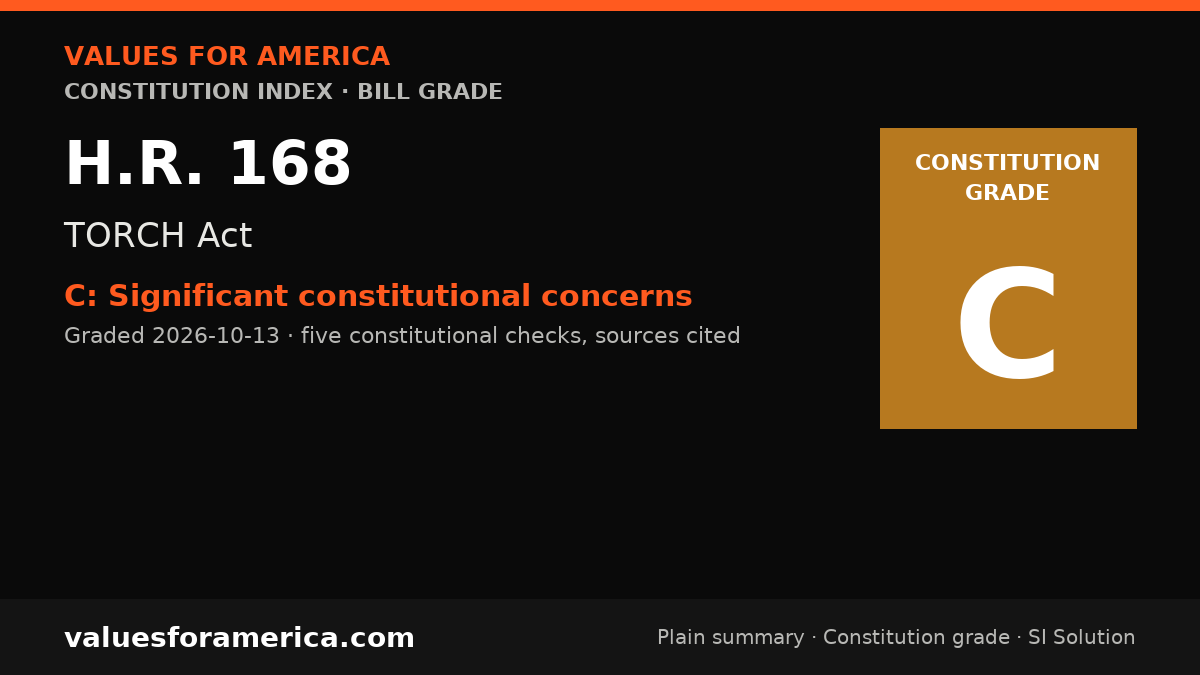
TORCH Act
Cosponsors: none · per Congress.gov, 2026-10-11
Introduced: 2025-01-03
Latest action (2025-04-04): Referred to the Subcommittee on Forestry and Horticulture.
What H.R. 168 does, in plain terms
Targeted Operations to Remove Catastrophic Hazards Act or the TORCH Act This bill establishes requirements concerning forest management on federal land, including provisions to expedite the approval of forest management activities. Specifically, it expands exclusions from environmental review requirements under the National Environmental Policy Act of 1969 for certain forest management activities, including by directing the Forest Service to develop a categorical exclusion for forest management activities that mitigate the risks associated with high-priority hazard trees. A categorical exclusion is a class of actions that a federal agency has determined do not significantly affect the quality of the human environment and, thus, do not require an environmental assessment nor an environmental impact statement. The bill also exempts the Forest Service and the Bureau of Land Management from the requirement to reinitiate consultation with the Fish and Wildlife Service under the Endangered Species Act of 1973 on an approved, amended, or revised land management plan when (1) a new species is listed or critical habitat is designated, or (2) new information reveals that the land management plan may affect a listed species or critical habitat in a manner or to an extent not previously considered. It also creates and modifies requirements related to vegetation management practices and forest management activities, such as activities to reduce wildfire risks. For example, the bill modifies the treatment of certain revenue under good neighbor agreements, which allow federal agencies to partner with state and local governments to carry out certain restoration services.
Official summary by the Congressional Research Service, via Congress.gov.
Constitution Index
“VFA Constitution grade”
Significant constitutional concerns
Graded 2026-10-13
SI-generated grade · five published checks · not individually reviewed by a person · methodology
The TORCH Act raises significant constitutional concerns by expanding federal categorical exclusions from environmental review and exempting federal agencies from Endangered Species Act consultation, which may undermine procedural due process and individual sovereignty over public lands. However, the bill operates within federal authority over public lands under the Property Clause, and its decentralization impact is mixed, as it delegates some authority to state and local partners but also consolidates federal control over environmental review.
-
✓ Passes · Enumerated powers
The federal government has explicit authority over federal lands under Article IV, Section 3, Clause 2 (the Property Clause), which grants Congress the power to dispose of and make all needful rules and regulations respecting the territory or other property belonging to the United States. The TORCH Act concerns forest management on federal land, which falls squarely within this enumerated power. T… -
✗ Concern · Bill of Rights
The bill does not directly infringe on the First, Second, Third, Fourth, Fifth, Sixth, Seventh, Eighth, or Ninth Amendments. However, by exempting federal agencies from reinitiating consultation under the Endangered Species Act, the bill may undermine the procedural protections that are part of the Fifth Amendment's Due Process Clause, as it could deprive individuals and communities of the opportu… -
✗ Concern · Individual sovereignty
The bill restricts individual sovereignty by reducing the ability of citizens to participate in environmental review processes and to challenge federal land management decisions that may affect their property, health, and local environment. The expansion of categorical exclusions and the ESA consultation exemption limit the avenues for individuals and communities to assert their interests in feder… -
✗ Concern · Decentralization
The bill fails the decentralization test on multiple grounds. (1) Individuals and families cannot handle forest management on federal lands on their own, so the first question is answered 'no'. (2) Local communities and counties cannot manage federal lands without state or federal involvement, so the second question is 'no'. (3) States cannot manage federal lands without federal involvement, so th… -
✗ Concern · Due process and takings
The bill raises due process concerns by expanding categorical exclusions from NEPA review and exempting federal agencies from ESA consultation. These provisions reduce the procedural safeguards that ensure fair notice and opportunity to be heard before federal actions that may affect the environment and property interests. While the bill does not directly take property without just compensation, i…
Sources: Congress.gov: HR 168 summary
Report an error in this grade
What should pass
“VFA SI Solution”
No solution yet
A sourced SI draft appears here once it passes automated checks (Constitution citation, source verification, independent SI critic). How publication works.
Related on VFA

For journalists and bloggers
“Embed this grade”
Free to use with the link back. The badge and card update when the grade changes. Embed terms →
