H.R. 1676 explained · 119th Congress · Pending in Congress
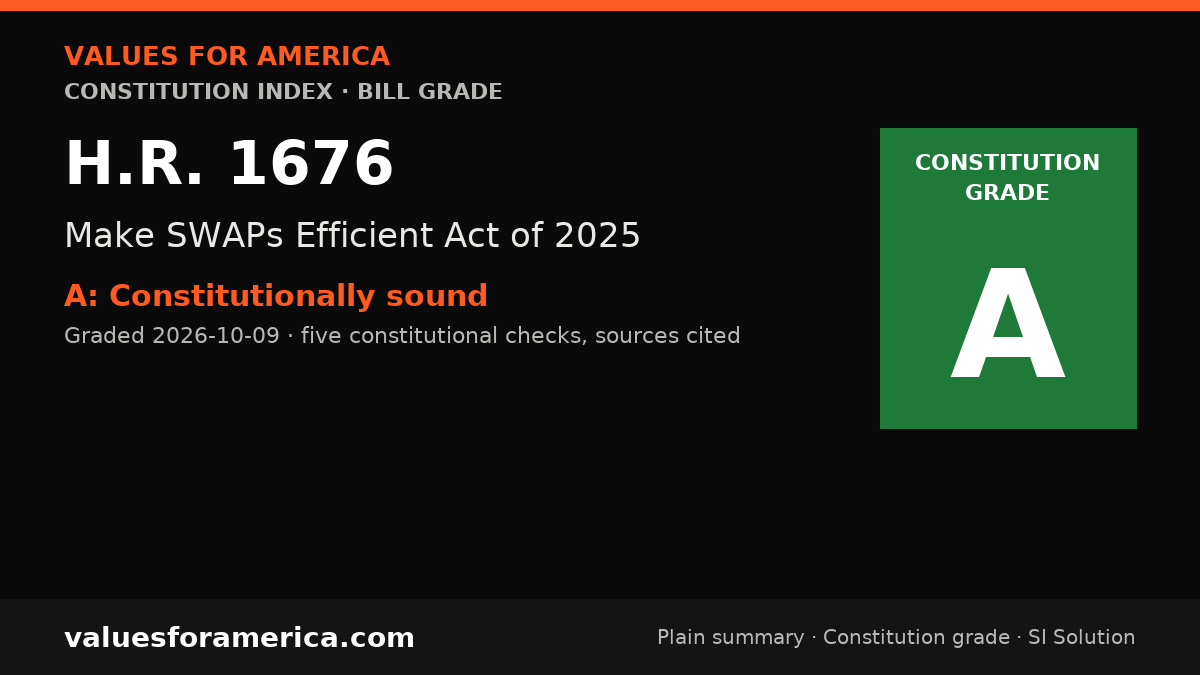
Make SWAPs Efficient Act of 2025
Cosponsors: 9 (1 D, 8 R) · per Congress.gov, 2026-10-10
Introduced: 2025-02-27
Latest action (2025-12-10): Received in the Senate and Read twice and referred to the Committee on Environment and Public Works.
What H.R. 1676 does, in plain terms
Make SWAPs Efficient Act of 2025 or the Make State Wildlife Action Plans Efficient Act of 2025 This bill modifies the State Wildlife Grant Program (SWGP) to establish a deadline for the Department of the Interior to approve state wildlife conservation and restoration programs. Under the SWGP, Interior provides funding to state wildlife agencies to implement their comprehensive plans (commonly known as state wildlife action plans or SWAPs) for state wildlife conservation and restoration programs. The bill directs Interior to approve a state wildlife conservation and restoration program within 180 days after the date on which the state submitted its SWAP if Interior finds that the SWAP complies with the requirements of the SWGP. If Interior misses the deadline, the bill requires (1) the SWAP to be automatically approved, and (2) Interior to set aside amounts under the Wildlife Conservation and Restoration Account for the state.
Official summary by the Congressional Research Service, via Congress.gov.
Constitution Index
“VFA Constitution grade”
Constitutionally sound
Graded 2026-10-09
SI-generated grade · five published checks · not individually reviewed by a person · methodology
The Make SWAPs Efficient Act is a routine administrative reform to an existing cooperative federal-state grant program. Congress is acting within its spending power to fund wildlife conservation and to attach reasonable procedural conditions on that funding. The bill does not infringe any constitutional right, does not restrict individual sovereignty, and actually reduces federal discretion by automatically approving qualified state wildlife action plans when the Department of the Interior misses a deadline. It therefore preserves and reinforces state-level decision-making rather than consolidating power upward.
-
✓ Passes · Enumerated powers
The bill operates under Congress's spending power under Article I, Section 8, Clause 1, which permits appropriations for the general welfare, including wildlife conservation. The State Wildlife Grant Program is an existing exercise of that spending power, and the bill merely sets a deadline for the Department of the Interior to approve submitted state plans and requires funds to be set aside. This… -
✓ Passes · Bill of Rights
The bill imposes no restriction on speech, religion, press, assembly, petition, the right to keep and bear arms, quartering of soldiers, search and seizure, self-incrimination, due process, trial rights, jury rights, cruel and unusual punishment, or unenumerated rights. It addresses only administrative timelines within a federal grant program and therefore does not implicate any provision of the B… -
✓ Passes · Individual sovereignty
The bill does not restrict what any person may do with their own person, property, speech, labor, or belief. It places burdens only on the Department of the Interior by requiring timely action on state submissions. If anything, it protects state sovereignty by preventing indefinite federal delay from blocking state-designed conservation plans. -
✓ Passes · Decentralization
Wildlife conservation and restoration programs are statewide public resource matters that cannot reasonably be handled by an individual or family. Local communities and counties may assist, but comprehensive state wildlife action plans are appropriately designed at the state level. The federal government's role here is limited to providing funds and reviewing whether the plan complies with program… -
✓ Passes · Due process and takings
The bill does not deprive any person of life, liberty, or property, and it does not take private property for public use. It imposes no fine, penalty, or forfeiture. It also does not bypass any hearing or notice requirement. The automatic approval rule is a procedural protection for states, curing agency delay rather than denying any party fair process.
Sources: Congress.gov: HR 1676 summary
Report an error in this grade
What should pass
“VFA SI Solution”
No solution yet
A sourced SI draft appears here once it passes automated checks (Constitution citation, source verification, independent SI critic). How publication works.
Related on VFA

For journalists and bloggers
“Embed this grade”
Free to use with the link back. The badge and card update when the grade changes. Embed terms →
