H.R. 165 explained · 119th Congress · Became law
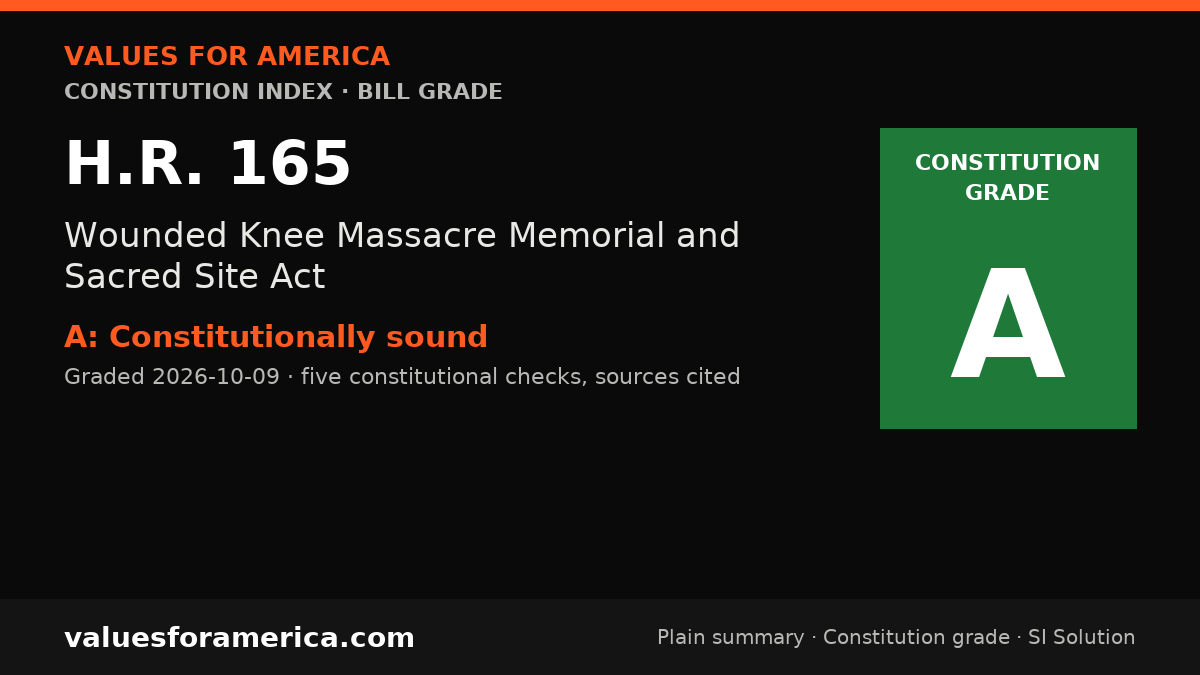
Wounded Knee Massacre Memorial and Sacred Site Act
Cosponsors: none · per Congress.gov, 2026-10-09
Introduced: 2025-01-03
Latest action (2025-12-19): Became Public Law No: 119-61.
What H.R. 165 does, in plain terms
Wounded Knee Massacre Memorial and Sacred Site Act This act directs the Department of the Interior to complete all actions necessary to place approximately 40 acres of land in Oglala Lakota County, South Dakota, into restricted fee status for the Oglala Sioux Tribe and the Cheyenne River Sioux Tribe. Restricted fee status refers to land that is owned by a tribe or tribal member but is subject to restrictions by the United States against alienation (i.e., sale or transfer) or encumbrance (e.g., liens, leases, or rights-of-way) by operation of law. The act requires the land to be held and maintained as a memorial and sacred site, as outlined by the document titled Covenant Between the Oglala Sioux Tribe and the Cheyenne River Sioux Tribe and dated October 21, 2022. Further, it prohibits commercial development and gaming activity on the land.
Official summary by the Congressional Research Service, via Congress.gov.
Constitution Index
“VFA Constitution grade”
Constitutionally sound
Graded 2026-10-09
SI-generated grade · five published checks · not individually reviewed by a person · methodology
This bill is constitutional. It is a narrow exercise of Congress's recognized authority over Indian affairs, it burdens no constitutional rights, and it does not take private property without due process or just compensation. It simply directs the Department of the Interior to complete the process of placing land into restricted fee status for two tribes to hold as a memorial and sacred site.
-
✓ Passes · Enumerated powers
Congress has explicit constitutional authority over Indian affairs under Article I, Section 8, Clause 3, the Indian Commerce Clause. Placing tribal land into restricted fee status and regulating its use is a traditional exercise of Congress's plenary authority over tribes and Indian lands. The federal trust relationship supports this action. -
✓ Passes · Bill of Rights
The bill does not infringe the First, Second, Third, Fourth, Fifth, Sixth, Seventh, Eighth, Ninth, or Tenth Amendments. It neither establishes nor prohibits religion; it preserves a sacred site at the request of tribal governments. No speech, assembly, press, petition, bearing of arms, search-and-seizure, trial, or punishment right is implicated. -
✓ Passes · Individual sovereignty
The bill restricts commercial development and gaming on the 40-acre parcel, but this is a voluntary land-management condition attached to restricted fee status and is consistent with the tribes' own covenant. It does not restrict individuals in their speech, belief, labor, or ordinary use of their property without a legitimate governmental justification; rather, it honors a memorial and sacred sit… -
✓ Passes · Decentralization
Federal involvement is constitutionally required here because tribal land status and restrictions are matters of federal Indian law. The state of South Dakota does not have authority to create restricted fee status for tribal lands, and the local county has no such role either. The action does not consolidate decision-making upward unnecessarily; it performs a uniquely federal function. The tribes… -
✓ Passes · Due process and takings
The bill does not seize or condemn land and does not deprive anyone of property without due process. It directs the Department of the Interior to complete the transfer of land into restricted fee status for the tribes. Any restrictions on alienation or encumbrance are part of that protective status, not an uncompensated taking, and no private owner is deprived without consent.
Sources: Congress.gov: HR 165 summary
Report an error in this grade
What should pass
“VFA SI Solution”
No solution yet
A sourced SI draft appears here once it passes automated checks (Constitution citation, source verification, independent SI critic). How publication works.
Related on VFA

For journalists and bloggers
“Embed this grade”
Free to use with the link back. The badge and card update when the grade changes. Embed terms →
