H.R. 164 explained · 119th Congress · Pending in Congress
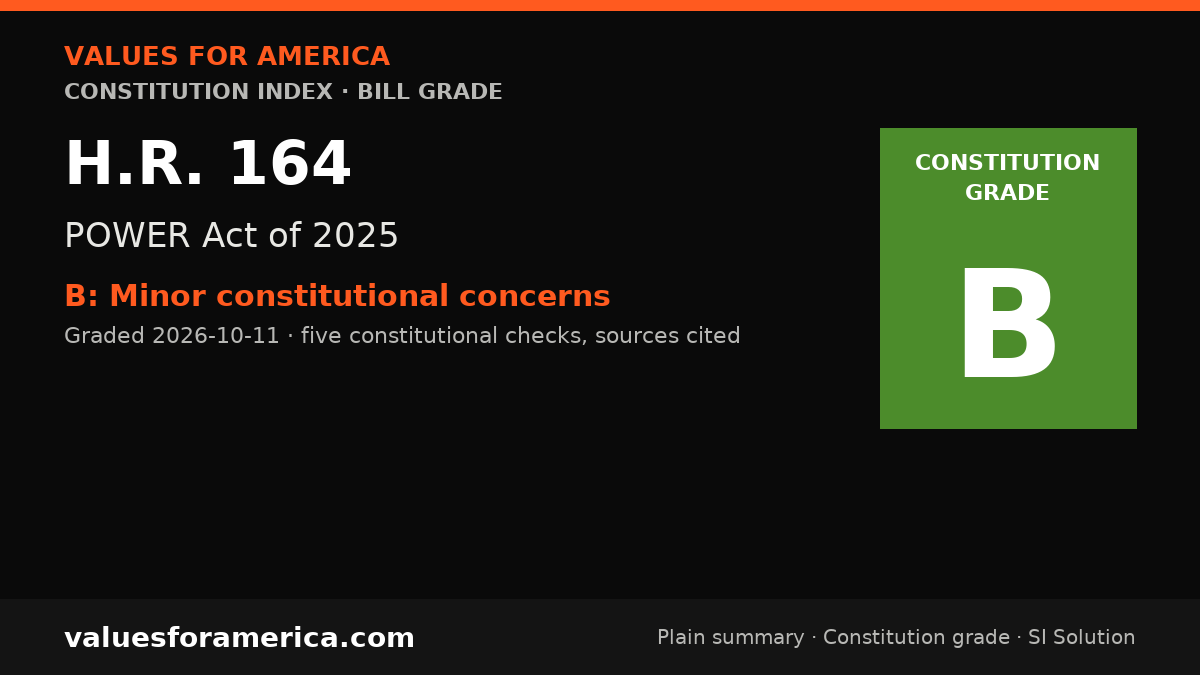
POWER Act of 2025
Cosponsors: 1 (0 D, 1 R) · per Congress.gov, 2026-10-12
Introduced: 2025-01-03
Latest action (2025-01-16): Received in the Senate and Read twice and referred to the Committee on Homeland Security and Governmental Affairs.
What H.R. 164 does, in plain terms
Promoting Opportunities to Widen Electrical Resilience Act of 2025 or the POWER Act of 2025 This bill authorizes electric utilities receiving certain emergency assistance for the restoration of power to also carry out cost-effective hazard mitigation activities in combination with the power restoration activities. Additionally, the bill specifies that electric utilities receiving such assistance for a facility may, if otherwise eligible, also receive hazard mitigation assistance for the same facility under the Federal Emergency Management Agency's Public Assistance program.
Official summary by the Congressional Research Service, via Congress.gov.
Constitution Index
“VFA Constitution grade”
Minor constitutional concerns
Graded 2026-10-11
SI-generated grade · five published checks · not individually reviewed by a person · methodology
The POWER Act of 2025 is a federal statute that authorizes electric utilities receiving emergency assistance to also perform cost-effective hazard mitigation activities, and allows them to receive hazard mitigation assistance for the same facility under FEMA's Public Assistance program. The bill operates within the federal government's enumerated powers under the Spending Clause and the Commerce Clause, as it conditions federal funds on compliance and addresses interstate electricity infrastructure. It does not infringe on individual rights, and it does not take property without due process. However, the bill centralizes decision-making at the federal level, as it expands the scope of a federal assistance program, which could be handled more locally. The bill does not violate the Tenth Amendment because it does not commandeer state or local governments; it merely offers voluntary federal assistance. The grade is B due to minor federalism concerns.
-
✓ Passes · Enumerated powers
The federal government has authority to spend for the general welfare under Article I, Section 8, Clause 1 (Spending Clause). The bill authorizes federal spending for hazard mitigation in connection with emergency power restoration, which is a legitimate federal interest. Additionally, the regulation of interstate electricity infrastructure falls under the Commerce Clause (Article I, Section 8, Cl… -
✓ Passes · Bill of Rights
The bill does not implicate any of the first ten amendments. It does not restrict speech, religion, assembly, press, petition, arms, quartering, search and seizure, self-incrimination, due process, takings, trial rights, or cruel and unusual punishment. The Tenth Amendment is not violated because the bill does not commandeer state or local governments; it merely offers voluntary federal assistance… -
✓ Passes · Individual sovereignty
The bill does not restrict individual liberty. It authorizes additional federal assistance to electric utilities, which is a benefit, not a restriction. Individuals are not compelled to do anything; the bill does not burden personal autonomy, property, speech, labor, or belief. -
✗ Concern · Decentralization
The bill fails the decentralization test because it consolidates decision-making at the federal level. While an individual or family cannot handle large-scale power restoration, local communities and states can and do manage hazard mitigation and power restoration. The federal government's role should be limited to providing resources, not expanding its programmatic reach. The bill expands the fed… -
✓ Passes · Due process and takings
The bill does not bypass due process or take property without just compensation. It provides additional federal assistance, which is a benefit, not a deprivation. There is no arbitrary government action; the bill sets criteria for eligibility and cost-effectiveness. No property is taken; rather, funds are provided.
Sources: Congress.gov: HR 164 summary
Report an error in this grade
What should pass
“VFA SI Solution”
No solution yet
A sourced SI draft appears here once it passes automated checks (Constitution citation, source verification, independent SI critic). How publication works.
Related on VFA

For journalists and bloggers
“Embed this grade”
Free to use with the link back. The badge and card update when the grade changes. Embed terms →
