H.R. 1608 explained · 119th Congress · Pending in Congress
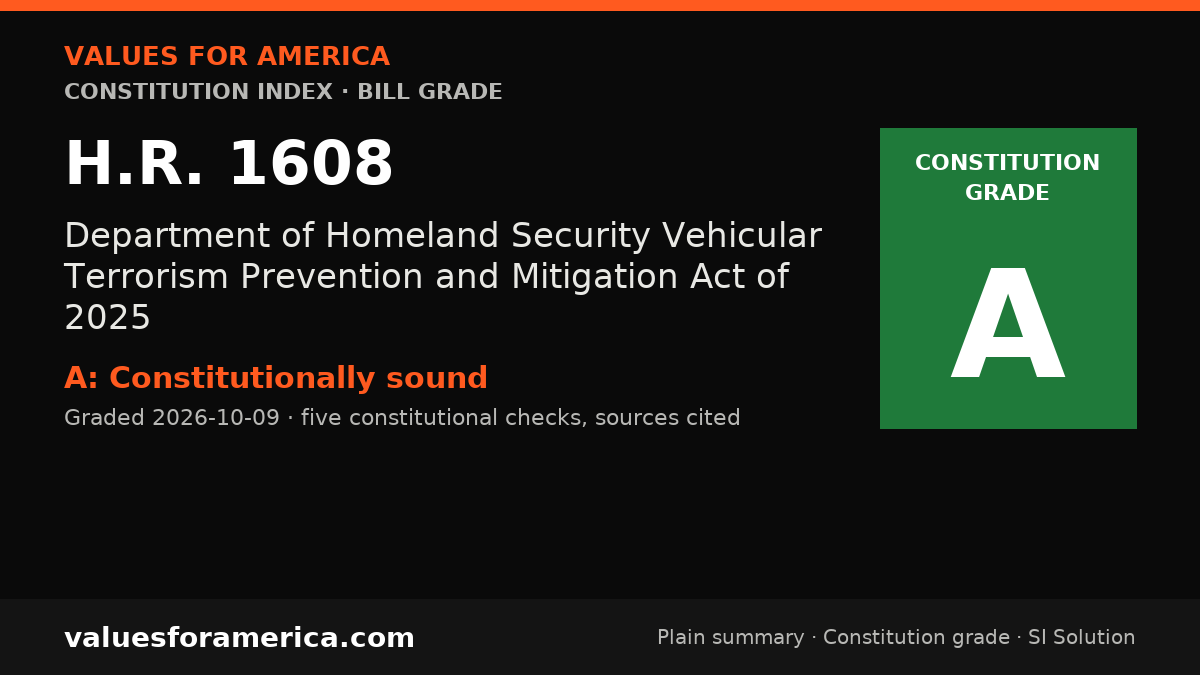
Department of Homeland Security Vehicular Terrorism Prevention and Mitigation Act of 2025
Cosponsors: 2 (1 D, 1 R) · per Congress.gov, 2026-10-10
Introduced: 2025-02-26
Latest action (2025-11-18): Received in the Senate and Read twice and referred to the Committee on Homeland Security and Governmental Affairs.
What H.R. 1608 does, in plain terms
Department of Homeland Security Vehicular Terrorism Prevention and Mitigation Act of 2025 This bill directs the Department of Homeland Security (DHS) to submit a report to Congress on the department's efforts to prevent, deter, and respond to vehicular terrorism (i.e., an action that utilizes automotive transportation to commit terrorism). DHS must submit the report in coordination with the Transportation Security Administration and the Cybersecurity and Infrastructure Security Agency. Among other things, the report on vehicular terrorism must include an assessment of the current and emerging threats; a review of higher-risk locations and events that may be vulnerable, including critical infrastructure sites (e.g., airports and government facilities); a description of DHS’s coordination efforts with federal, state, local, tribal, and territorial law enforcement agencies related to prevention; and recommendations for the research, development, and deployment of technologies to detect, deter, and mitigate vehicular terrorism. DHS must submit a classified report to Congress, but may include an unclassified executive summary. DHS must publish the executive summary on the department's website. In addition, DHS must brief Congress on the report's findings, conclusions, and recommendations.
Official summary by the Congressional Research Service, via Congress.gov.
Constitution Index
“VFA Constitution grade”
Constitutionally sound
Graded 2026-10-09
SI-generated grade · five published checks · not individually reviewed by a person · methodology
This bill is fully constitutional. It merely directs the Department of Homeland Security to study and report on vehicular terrorism threats and coordination efforts. It does not authorize any enforcement action, restrict individual rights, or commandeer state resources. The reporting requirement falls squarely within Congress's enumerated powers to provide for the common defense and to legislate necessary and proper measures for national security.
-
✓ Passes · Enumerated powers
Congress has authority under Article I, Section 8, Clause 1 (to provide for the common defense and general welfare) and Clause 18 (to make all laws necessary and proper for executing its powers) to investigate threats to national security and to require executive branch reports on such matters. The bill does not exceed these powers; it is a legislative oversight tool, not a regulatory or enforceme… -
✓ Passes · Bill of Rights
The bill imposes no restriction on speech, press, assembly, religion, arms, or any other right protected by the first ten amendments. It requires only a report and a briefing. While future technology recommendations could theoretically implicate the Fourth Amendment, the bill itself does not authorize any search, seizure, or surveillance. No rights are infringed. -
✓ Passes · Individual sovereignty
The bill places no obligations or restrictions on private individuals. It directs the Department of Homeland Security to compile and submit information to Congress. Individual liberty to act, speak, own property, or travel is untouched. The government bears no burden to justify a restriction because none exists. -
✓ Passes · Decentralization
The bill passes all four questions of the decentralization test. (1) An individual or family cannot handle nationwide threat assessment and coordination; (2) local communities can address local vulnerabilities but lack the scope to assess national threats; (3) states could conduct similar assessments, but federal coordination with multiple states and federal agencies is more efficient for a cross‑… -
✓ Passes · Due process and takings
The bill contains no provisions that deprive any person of life, liberty, or property without due process, nor does it take private property for public use without just compensation. It is a pure reporting requirement with no adjudicative or enforcement mechanism. Procedural and substantive due process are fully respected.
Sources: Congress.gov: HR 1608 summary
Report an error in this grade
What should pass
“VFA SI Solution”
No solution yet
A sourced SI draft appears here once it passes automated checks (Constitution citation, source verification, independent SI critic). How publication works.
Related on VFA

For journalists and bloggers
“Embed this grade”
Free to use with the link back. The badge and card update when the grade changes. Embed terms →
