H.R. 1558 explained · 119th Congress · Pending in Congress
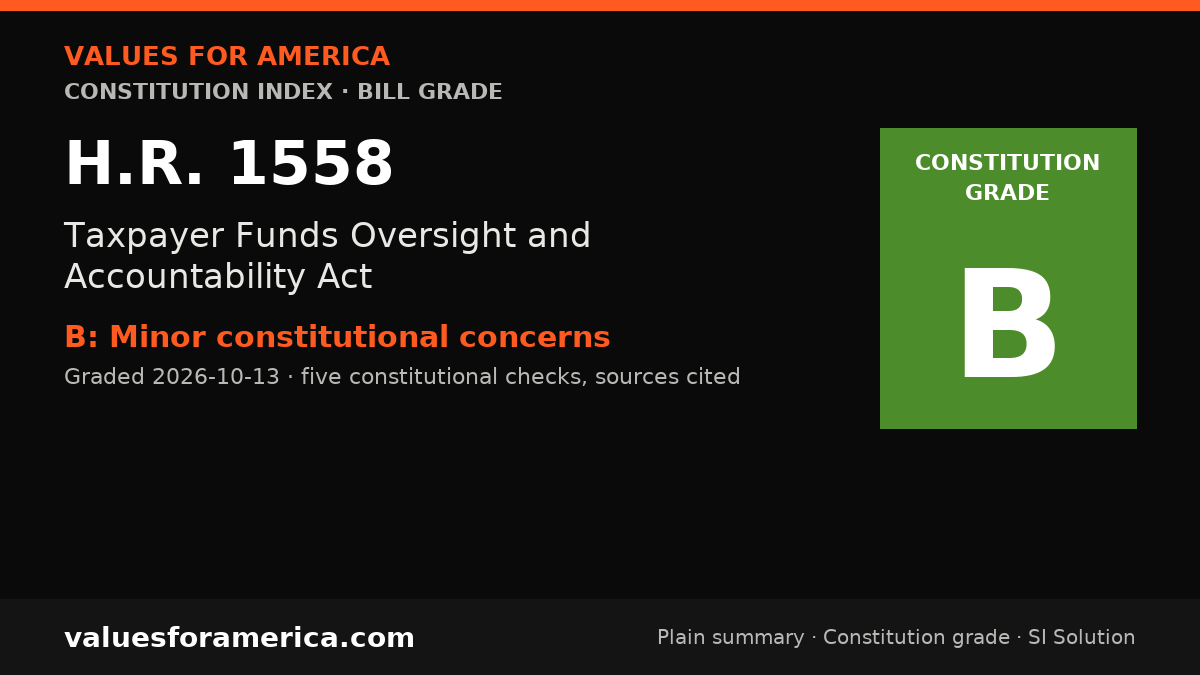
Taxpayer Funds Oversight and Accountability Act
Cosponsors: 18 (18 D, 0 R) · per Congress.gov, 2026-10-10
Introduced: 2025-02-25
Latest action (2025-09-15): ASSUMING FIRST SPONSORSHIP - Mr. Min asked unanimous consent that he may hereafter be considered as the first sponsor of H.R. 1558, a bill originally introduced by Representative Connolly, for the purpose of adding cosponsors and requesting reprintings pursuant to clause 7 of rule XII. Agreed to without objection.
What H.R. 1558 does, in plain terms
Taxpayer Funds Oversight and Accountability Act This bill requires the Office of Management and Budget (OMB) to take certain actions to improve financial management systems across the federal government and expands the responsibilities of federal agency Chief Financial Officers (CFOs). The bill requires OMB to submit a four-year governmentwide financial management plan to Congress within six months of enactment and thereafter with the budget submitted in the first full fiscal year following the start of a presidential term. Such plans must address certain topics, including strategies for (1) improving financial management systems; (2) strengthening the financial management workforce; and (3) reporting performance and cost information. OMB must annually submit related status reports to Congress and the Government Accountability Office. Each agency CFO is assigned new responsibilities, including preparing the agency plan to implement OMB's governmentwide financial management plan; overseeing and providing leadership in the areas of budget formulation and execution, planning and performance, risk management, internal controls, financial systems, accounting, and other areas designated by OMB; coordinating with designated agency personnel on the strategic planning, performance measurement and reporting, and risk management functions of the agency; managing the formulation and financial execution of the agency budget; linking performance and cost information; and preparing annual reports on progress in implementing the governmentwide financial management plan and transmitting such reports to the agency head, OMB, and Congress. The bill establishes new requirements for audits of agency accounts, such as having auditors evaluate the design of the agency's internal controls over financial reporting.
Official summary by the Congressional Research Service, via Congress.gov.
Constitution Index
“VFA Constitution grade”
Minor constitutional concerns
Graded 2026-10-13
SI-generated grade · five published checks · not individually reviewed by a person · methodology
This bill is mostly sound but has minor tensions with decentralization principles. It operates within Congress's enumerated spending and oversight powers, does not infringe on individual rights, and respects due process. However, it consolidates financial management decision-making at the federal level, where states or agencies could handle some functions independently.
-
✓ Passes · Enumerated powers
Congress has authority under Article I, Section 8, Clause 1 (the Spending Clause) to direct how federal funds are managed and accounted for, and under the Necessary and Proper Clause (Article I, Section 8, Clause 18) to require executive branch agencies to report on financial management. The bill imposes requirements on federal agencies and OMB, which are within federal jurisdiction. -
✓ Passes · Bill of Rights
The bill imposes no restrictions on speech, religion, assembly, press, petition, arms, quartering, search and seizure, self-incrimination, due process, fair trial, jury, cruel and unusual punishment, or unenumerated rights. It is purely administrative and financial in nature. -
✓ Passes · Individual sovereignty
The bill does not restrict what individuals may do with their person, property, speech, labor, or belief. It only imposes reporting and management requirements on federal agencies and their CFOs. No individual liberty is burdened. -
✗ Concern · Decentralization
The bill fails the decentralization test on two of four questions. An individual or family cannot handle governmentwide financial management (question 1 passes). A local community or county cannot handle federal financial systems (question 2 passes). However, states could potentially handle their own financial reporting without federal micromanagement (question 3 fails), and the bill consolidates … -
✓ Passes · Due process and takings
The bill does not bypass due process, presume guilt, or take property without just compensation. It imposes no penalties, seizures, or adjudicative procedures. It merely requires reporting and planning, which are standard administrative functions.
Sources: Congress.gov: HR 1558 summary
Report an error in this grade
What should pass
“VFA SI Solution”
No solution yet
A sourced SI draft appears here once it passes automated checks (Constitution citation, source verification, independent SI critic). How publication works.
Related on VFA

For journalists and bloggers
“Embed this grade”
Free to use with the link back. The badge and card update when the grade changes. Embed terms →
