H.R. 1534 explained · 119th Congress · Pending in Congress
IMPACT Act
Cosponsors: 1 (1 D, 0 R) · per Congress.gov, 2026-10-12
Introduced: 2025-02-24
Latest action (2025-03-26): Received in the Senate and Read twice and referred to the Committee on Energy and Natural Resources.
What H.R. 1534 does, in plain terms
Innovative Mitigation Partnerships for Asphalt and Concrete Technologies Act or the IMPACT Act This bill requires the Department of Energy (DOE) to establish a temporary program that supports advanced production of low-emissions cement, concrete, and asphalt. Specifically, the program must support research, development, and commercial application of production processes for low-emissions cement, concrete, and asphalt that are more cost-effective, durable, or resource-efficient (i.e., advanced production). The program must particularly focus on carbon capture technologies, energy-efficient processes, research involving novel materials, and other specified technologies and innovative processes. DOE must select entities to implement relevant demonstration projects; eligible entities include government, nonprofit, educational, and private sector entities. DOE may terminate these projects if it determines that sufficient amounts of low-emissions cement, concrete, and asphalt that are produced through advanced production are commercially available at reasonable prices. The program terminates seven years after the bill is enacted.
Official summary by the Congressional Research Service, via Congress.gov.
Constitution Index
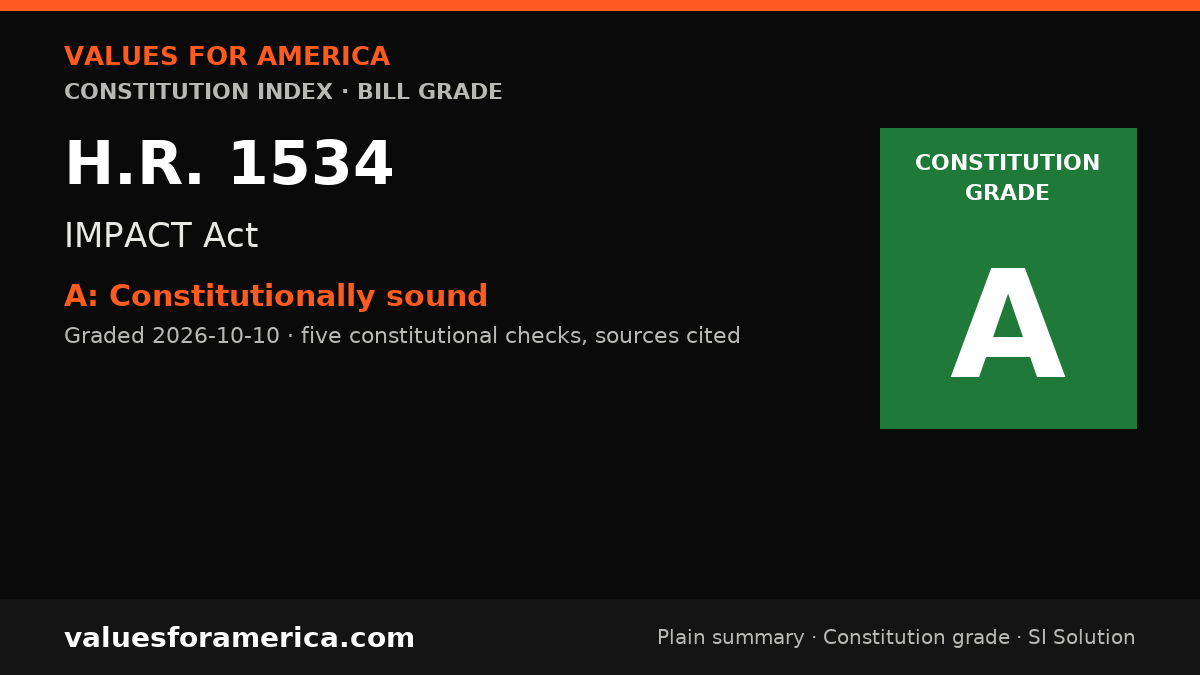
“VFA Constitution grade”
Constitutionally sound
Graded 2026-10-10
SI-generated grade · five published checks · not individually reviewed by a person · methodology
The IMPACT Act is fully constitutional. It authorizes a temporary, voluntary federal research and development program within the Department of Energy's enumerated power under the Commerce Clause to support innovation in industrial materials. The bill does not mandate private conduct, restrict any rights, or centralize authority beyond what is necessary for a federal research initiative. It passes all five constitutional checks with no violations.
-
✓ Passes · Enumerated powers
The bill authorizes the Department of Energy to establish a temporary program supporting research, development, and commercial application of low-emissions cement, concrete, and asphalt. This falls within Congress's enumerated power under Article I, Section 8, Clause 3 (Commerce Clause) to regulate interstate commerce in industrial materials, and under the Spending Clause (Article I, Section 8, Cl… -
✓ Passes · Bill of Rights
The bill imposes no restrictions on speech, religion, assembly, press, petition, arms, quartering, search and seizure, self-incrimination, due process, takings, fair trial, jury, cruel and unusual punishment, or unenumerated rights. It is a purely voluntary grant program that does not infringe any provision of the Bill of Rights. -
✓ Passes · Individual sovereignty
The bill does not restrict any individual's person, property, speech, labor, or belief. It creates a voluntary program where entities may choose to participate in demonstration projects. No individual is compelled to act or refrain from acting. The government bears no burden to justify a restriction because no restriction exists. -
✓ Passes · Decentralization
The bill passes all four questions of the decentralization test. (1) An individual or family could not handle advanced industrial research into cement and asphalt production without government involvement, as this requires large-scale infrastructure and coordination. (2) A local community or county could not handle this without state involvement, as the research involves national-scale supply chai… -
✓ Passes · Due process and takings
The bill does not bypass due process, presume guilt, or take property without just compensation. It creates a voluntary grant program with no penalties, mandates, or property seizures. Participants retain full procedural and substantive due process rights. No Takings Clause issue arises.
Sources: Congress.gov: HR 1534 summary
Report an error in this grade
What should pass
“VFA SI Solution”
No solution yet
A sourced SI draft appears here once it passes automated checks (Constitution citation, source verification, independent SI critic). How publication works.
Related on VFA

For journalists and bloggers
“Embed this grade”
Free to use with the link back. The badge and card update when the grade changes. Embed terms →
