H.R. 1526 explained · 119th Congress · Pending in Congress
NORRA of 2025
Cosponsors: 14 (0 D, 14 R) · per Congress.gov, 2026-10-11
Introduced: 2025-02-24
Latest action (2025-04-10): Received in the Senate and Read twice and referred to the Committee on the Judiciary.
What H.R. 1526 does, in plain terms
No Rogue Rulings Act or NORRA This bill limits the authority of federal district courts to issue injunctions. Specifically, it prohibits a district court from issuing an injunction unless the injunction applies only to the parties of the particular case before the court.
Official summary by the Congressional Research Service, via Congress.gov.
Constitution Index
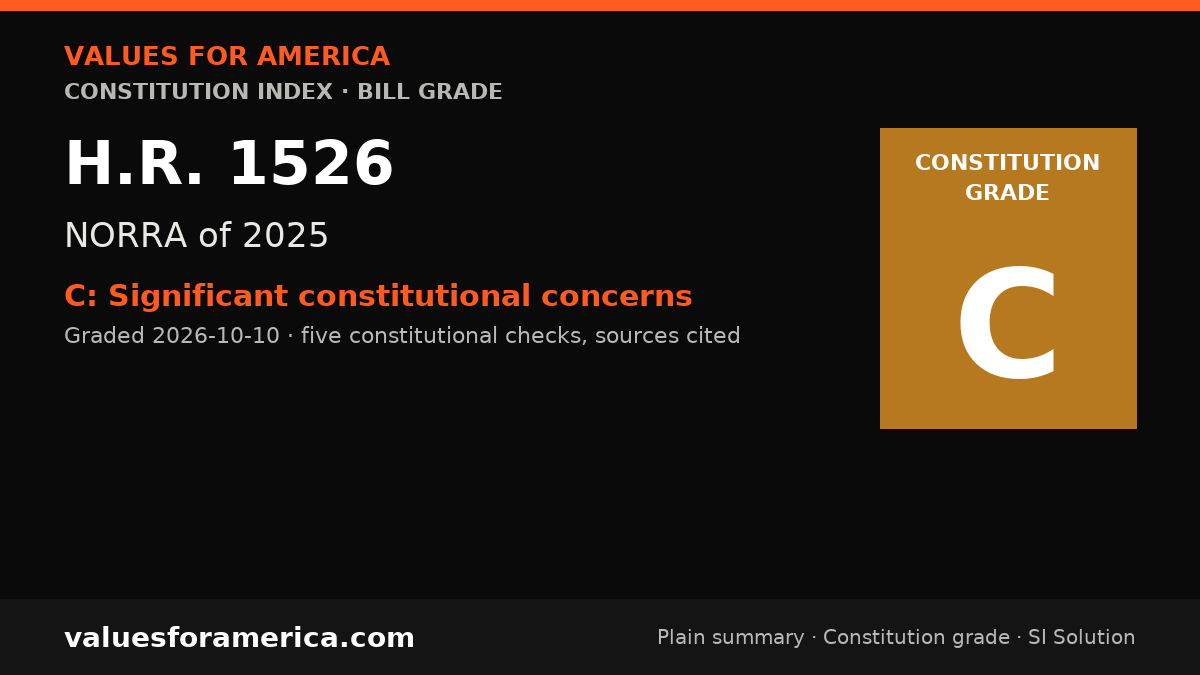
“VFA Constitution grade”
Significant constitutional concerns
Graded 2026-10-10
SI-generated grade · five published checks · not individually reviewed by a person · methodology
The No Rogue Rulings Act (NORRA) raises significant constitutional concerns by restricting the equitable powers of federal district courts, which are rooted in Article III and historical practice. While it does not directly violate a specific constitutional provision, it undermines the judiciary's independence and the effectiveness of injunctive relief, particularly in cases involving ongoing constitutional violations. The bill also centralizes power in Congress over the judiciary, raising separation of powers issues. The decentralization test fails because the bill consolidates decision-making at the federal level, but it does not infringe on individual rights or due process directly.
-
✓ Passes · Enumerated powers
Congress has authority under Article I, Section 8, Clause 18 (the Necessary and Proper Clause) to regulate the jurisdiction and procedures of federal courts, as established by Article III, Section 1. However, this power is not unlimited and must not undermine the essential functions of the judiciary. The bill's restriction on injunctions is a procedural rule, which Congress may enact, but it must … -
✓ Passes · Bill of Rights
The bill does not directly infringe on any specific right enumerated in the Bill of Rights. However, by limiting the ability of courts to issue broad injunctions, it could indirectly impair the enforcement of constitutional rights, such as those protected by the First, Fourth, and Fourteenth Amendments, when systemic violations require class-wide relief. This is a potential indirect effect, not a … -
✓ Passes · Individual sovereignty
The bill does not restrict individual actions or property rights. It only limits the scope of judicial remedies. Individuals retain their rights to seek relief in court, but the available remedies may be narrower. This does not rise to a violation of individual sovereignty, as the burden remains on the government to justify restrictions on rights, and here the restriction is on the judiciary, not … -
✗ Concern · Decentralization
The bill consolidates decision-making at the federal level by restricting the equitable powers of district courts, which are the most local level of the federal judiciary. This fails the decentralization test because it removes discretion from local courts and centralizes control in Congress. However, it does not involve state or local governments, so the questions about individual and local handl… -
✓ Passes · Due process and takings
The bill does not bypass due process or take property without just compensation. It does not affect the procedural rights of parties in court; it only limits the scope of injunctive relief. Parties still receive notice and a hearing, and the bill does not deprive anyone of property. Therefore, there is no violation of the Fifth Amendment's Due Process or Takings Clauses.
Sources: Congress.gov: HR 1526 summary
Report an error in this grade
What should pass
“VFA SI Solution”
No solution yet
A sourced SI draft appears here once it passes automated checks (Constitution citation, source verification, independent SI critic). How publication works.
Related on VFA

For journalists and bloggers
“Embed this grade”
Free to use with the link back. The badge and card update when the grade changes. Embed terms →
