H.R. 152 explained · 119th Congress · Pending in Congress
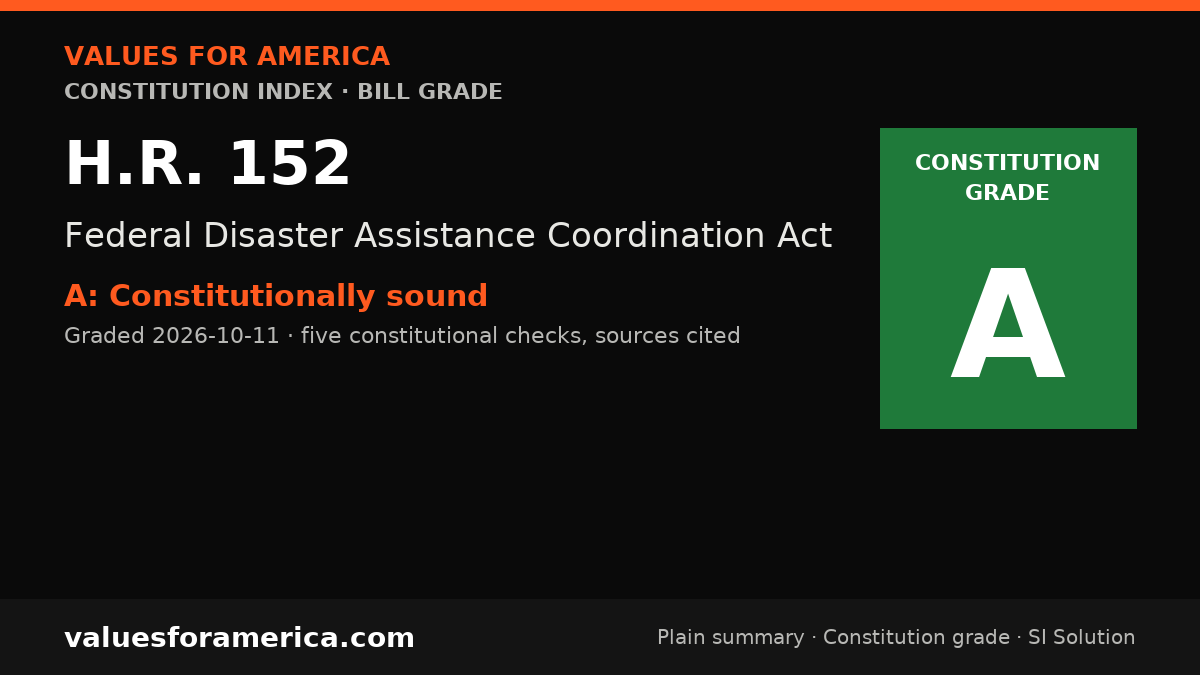
Federal Disaster Assistance Coordination Act
Cosponsors: 2 (2 D, 0 R) · per Congress.gov, 2026-10-12
Introduced: 2025-01-03
Latest action (2025-01-14): Received in the Senate and Read twice and referred to the Committee on Homeland Security and Governmental Affairs.
What H.R. 152 does, in plain terms
Federal Disaster Assistance Coordination Act This bill requires the Federal Emergency Management Agency (FEMA) to streamline disaster information collection, convene a working group on preliminary damage assessments, and provide a report to Congress. FEMA must (1) conduct a study and develop a plan under which the collection of information from disaster assistance applicants and grantees will be made less burdensome, duplicative, and time consuming for applicants and grantees; and (2) develop a plan for the regular collection and reporting of information on federal disaster assistance awarded. Additionally, not later than two years after enactment of the bill, FEMA must convene a working group on a regular basis to (1) identify potential areas of duplication or fragmentation in preliminary damage assessments after disaster declarations; (2) determine the applicability of having one federal agency make the assessments for all agencies; and (3) identify potential emerging technologies, such as unmanned aircraft systems (i.e., drones), to expedite the administration of preliminary damage assessments. FEMA must submit a comprehensive report on the plans for streamlining and consolidating information collection and the findings and recommendations of the working group to Congress with a briefing. The report must be made available to the public and posted on FEMA's website.
Official summary by the Congressional Research Service, via Congress.gov.
Constitution Index
“VFA Constitution grade”
Constitutionally sound
Graded 2026-10-11
SI-generated grade · five published checks · not individually reviewed by a person · methodology
The Federal Disaster Assistance Coordination Act is a routine administrative measure that directs FEMA to study and streamline disaster assistance information collection, convene a working group on preliminary damage assessments, and report to Congress. It does not expand federal regulatory authority, restrict individual rights, or centralize decision-making beyond the existing federal disaster management framework. The bill is fully consistent with the Constitution's enumerated powers and the Tenth Amendment.
-
✓ Passes · Enumerated powers
Congress has authority under Article I, Section 8, Clause 1 (the Spending Clause) to provide for the general welfare, which includes disaster relief and assistance. The bill directs FEMA, an executive agency, to improve the administration of existing federal disaster assistance programs. This is a legitimate exercise of Congress's power to appropriate funds and to make laws necessary and proper fo… -
✓ Passes · Bill of Rights
The bill does not implicate any provision of the Bill of Rights. It does not restrict speech, religion, assembly, press, petition, or the right to keep and bear arms. It does not authorize searches or seizures, nor does it affect criminal procedure, self-incrimination, due process, takings, or cruel and unusual punishment. The provisions regarding information collection are directed at FEMA's admi… -
✓ Passes · Individual sovereignty
The bill does not restrict what individuals can do with their person, property, speech, labor, or belief. It imposes no new obligations on private citizens. The only 'burden' addressed is the administrative burden on disaster assistance applicants, which the bill seeks to reduce. The working group's consideration of emerging technologies like drones is for expediting damage assessments, not for su… -
✓ Passes · Decentralization
The bill does not consolidate decision-making at a higher level than necessary. Disaster assistance is inherently a federal function under the Stafford Act, and the bill only improves coordination within FEMA. It does not preempt state or local authority; states and localities remain responsible for their own disaster response and can request federal assistance. The bill does not transfer any new … -
✓ Passes · Due process and takings
The bill does not affect due process or takings. It does not deprive any person of life, liberty, or property without due process of law (Fifth Amendment). It does not take private property for public use without just compensation. The bill's reporting and study requirements are procedural and do not alter any applicant's rights to fair treatment in disaster assistance claims. The public availabil…
Sources: Congress.gov: HR 152 summary
Report an error in this grade
What should pass
“VFA SI Solution”
No solution yet
A sourced SI draft appears here once it passes automated checks (Constitution citation, source verification, independent SI critic). How publication works.
Related on VFA

For journalists and bloggers
“Embed this grade”
Free to use with the link back. The badge and card update when the grade changes. Embed terms →
