H.R. 1503 explained · 119th Congress · Pending in Congress
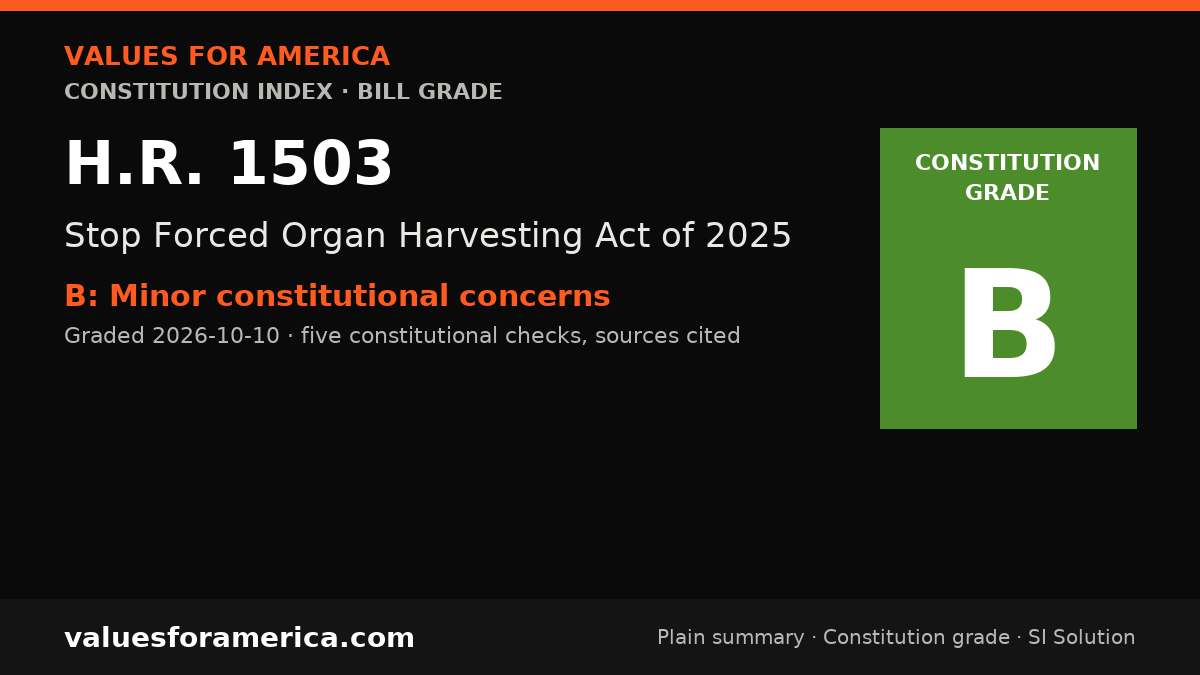
Stop Forced Organ Harvesting Act of 2025
Cosponsors: 1 (1 D, 0 R) · per Congress.gov, 2026-10-11
Introduced: 2025-02-21
Latest action (2025-05-08): Received in the Senate and Read twice and referred to the Committee on Foreign Relations.
What H.R. 1503 does, in plain terms
Stop Forced Organ Harvesting Act of 2025 This bill requires the President to impose sanctions on persons (individuals and entities) involved in forced organ trafficking and authorizes the Department of State to deny or revoke the passports of individuals convicted of certain crimes related to organ trafficking. Specifically, the President must report to Congress a list of persons that facilitate (1) forced organ harvesting, or (2) trafficking in persons for organ harvesting. For each person on the list, the President must impose property- and visa-blocking sanctions. Furthermore, the State Department may deny or revoke the passport of an individual who has been convicted of a federal crime of knowingly transferring any human organ for valuable consideration for use in human transplantation, if the individual (1) is subject to imprisonment or supervised release resulting from that conviction, and (2) used a passport or crossed an international border when committing that crime.
Official summary by the Congressional Research Service, via Congress.gov.
Constitution Index
“VFA Constitution grade”
Minor constitutional concerns
Graded 2026-10-10
SI-generated grade · five published checks · not individually reviewed by a person · methodology
The bill is largely constitutional, as it falls within Congress's enumerated foreign affairs powers and addresses a serious human rights abuse. However, the passport revocation provision raises minor due process concerns regarding the lack of explicit procedural safeguards, and the sanctions regime, while broad, is a legitimate exercise of federal authority in international affairs.
-
✓ Passes · Enumerated powers
Congress has broad authority over foreign affairs and commerce with foreign nations. Article I, Section 8, Clause 3 grants Congress the power to regulate commerce with foreign nations, and the President's foreign affairs powers are well-established. Sanctions on foreign persons involved in organ trafficking directly relate to foreign commerce and international relations. Additionally, the passport… -
✓ Passes · Bill of Rights
The bill does not infringe on the Bill of Rights. Sanctions target foreign persons and entities, not U.S. citizens' speech or assembly. The passport revocation applies only to individuals convicted of a federal crime, which does not implicate the First Amendment. The Fifth Amendment's due process clause is not violated because the sanctions are based on findings of involvement in organ trafficking… -
✓ Passes · Individual sovereignty
The bill restricts the property and travel rights of individuals involved in forced organ harvesting, a practice that is universally condemned and illegal. The government has a compelling interest in preventing such human rights abuses. The restrictions are narrowly tailored to those who have been convicted or are identified as facilitators of these crimes. The burden on individual sovereignty is … -
✓ Passes · Decentralization
This is a matter of international affairs and foreign policy, which inherently requires federal action. Individuals, local communities, and states cannot impose sanctions on foreign persons or revoke passports. The federal government is the only level of government with the authority to conduct foreign relations. The action does not consolidate decision-making at a higher level than necessary; it … -
✓ Passes · Due process and takings
The sanctions are imposed based on a presidential determination, which is subject to judicial review. The passport revocation applies only after a criminal conviction, ensuring procedural due process. However, the bill does not specify the process for challenging the sanctions listing, which could raise due process concerns for U.S. persons. The takings clause is not implicated because the sanctio…
Sources: Congress.gov: HR 1503 summary
Report an error in this grade
What should pass
“VFA SI Solution”
No solution yet
A sourced SI draft appears here once it passes automated checks (Constitution citation, source verification, independent SI critic). How publication works.
Related on VFA

For journalists and bloggers
“Embed this grade”
Free to use with the link back. The badge and card update when the grade changes. Embed terms →
