H.R. 1442 explained · 119th Congress · Pending in Congress
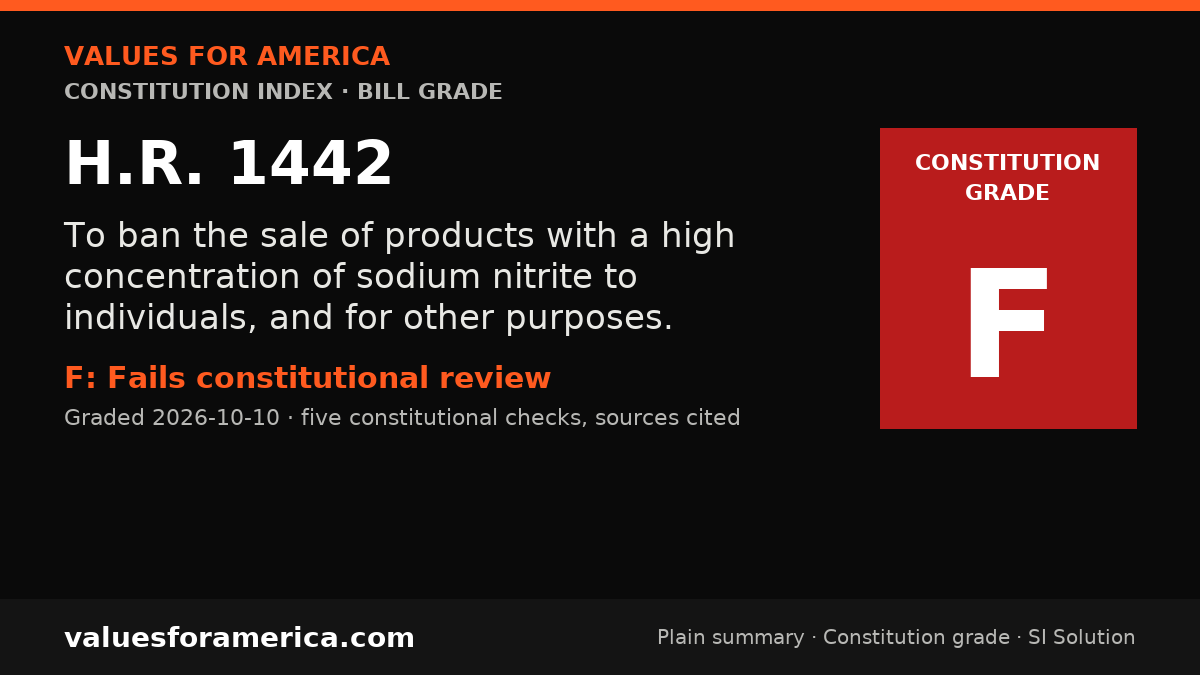
To ban the sale of products with a high concentration of sodium nitrite to individuals, and for other purposes.
Cosponsors: 2 (1 D, 1 R) · per Congress.gov, 2026-10-11
Introduced: 2025-02-18
Latest action (2025-07-16): Read twice. Placed on Senate Legislative Calendar under General Orders. Calendar No. 116.
What H.R. 1442 does, in plain terms
Youth Poisoning Protection Act This bill makes a consumer product with a concentration of sodium nitrite of 10% or greater a banned hazardous product. The restriction does not apply to specified drugs, medical devices, cosmetics, or food products.
Official summary by the Congressional Research Service, via Congress.gov.
Constitution Index
“VFA Constitution grade”
Fails constitutional review
Graded 2026-10-10
SI-generated grade · five published checks · not individually reviewed by a person · methodology
This bill is a direct violation of the Commerce Clause as interpreted by the Tenth Amendment and the principle of individual sovereignty. It bans a legal substance based on potential misuse, not on any inherent defect or interstate commerce issue, and it criminalizes possession by individuals without any nexus to commerce. The federal government lacks enumerated power to ban a consumer product that is not inherently dangerous in its intended use, and the bill infringes on the right of adults to possess and use lawful substances.
-
✗ Concern · Enumerated powers
The bill purports to regulate commerce under Article I, Section 8, Clause 3, but the ban on sodium nitrite products is not a regulation of interstate commerce—it is a prohibition on possession and sale of a substance that is not inherently dangerous in its intended use. The Supreme Court has held that the Commerce Clause does not grant Congress the power to regulate non-economic activity or to ban… -
✗ Concern · Bill of Rights
The bill violates the Ninth and Tenth Amendments by restricting the right of individuals to possess and use a lawful substance without a compelling government interest. While the Bill of Rights does not explicitly mention a right to purchase sodium nitrite, the Ninth Amendment reserves unenumerated rights to the people, and the Tenth Amendment reserves powers not delegated to the federal governmen… -
✗ Concern · Individual sovereignty
The bill restricts what individuals can do with their own property (sodium nitrite) without a compelling constitutional justification. The government has not shown that the substance is inherently dangerous in its intended use (e.g., as a food preservative or curing agent). The burden is on the government to justify the restriction, and here the justification is based on potential misuse (poisonin… -
✗ Concern · Decentralization
The bill fails all four questions of the decentralization test. (1) An individual or family could handle the regulation of sodium nitrite without federal involvement—it is a common household chemical. (2) Local communities or counties could regulate its sale if needed. (3) States could regulate it without federal involvement. (4) The bill consolidates decision-making at the federal level when the … -
✗ Concern · Due process and takings
The bill effectively takes property (sodium nitrite products) from individuals and businesses without just compensation, violating the Fifth Amendment's Takings Clause. It bans the sale and possession of a product that is currently legal, without providing any compensation to owners. Additionally, it bypasses due process by imposing a blanket ban without a hearing or individualized determination o…
Sources: Congress.gov: HR 1442 summary
Report an error in this grade
What should pass
“VFA SI Solution”
No solution yet
A sourced SI draft appears here once it passes automated checks (Constitution citation, source verification, independent SI critic). How publication works.
Related on VFA

For journalists and bloggers
“Embed this grade”
Free to use with the link back. The badge and card update when the grade changes. Embed terms →
