H.R. 1402 explained · 119th Congress · Pending in Congress
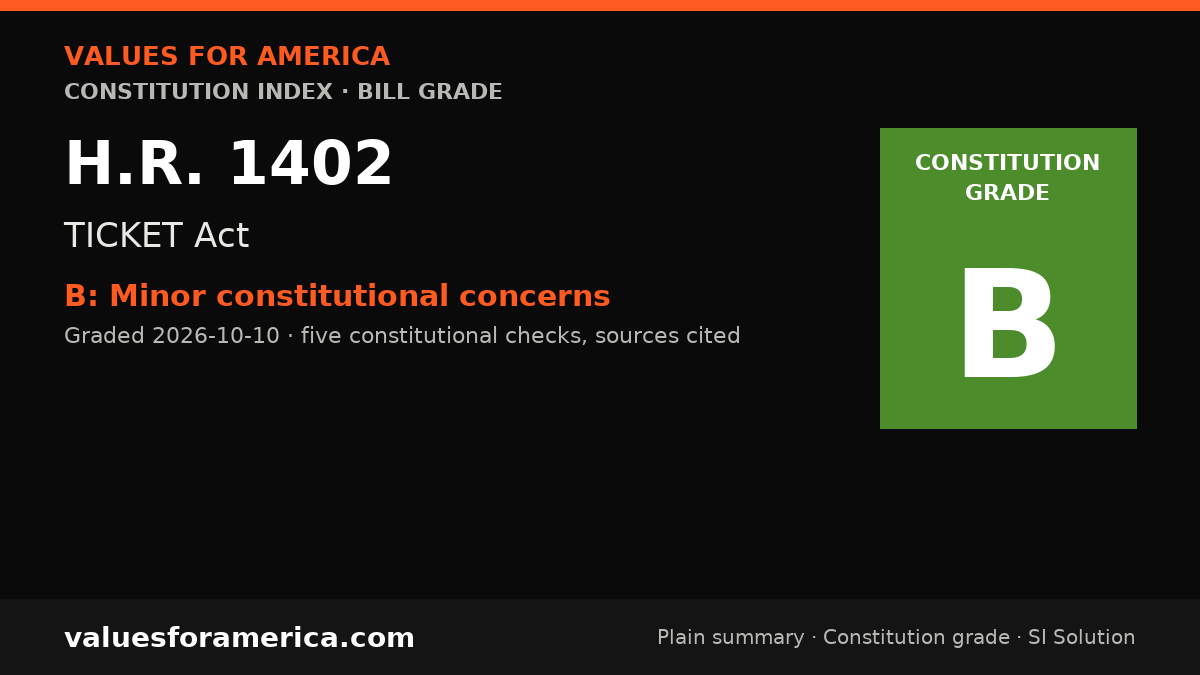
TICKET Act
Cosponsors: 2 (1 D, 1 R) · per Congress.gov, 2026-10-10
Introduced: 2025-02-18
Latest action (2025-09-16): Read twice. Placed on Senate Legislative Calendar under General Orders. Calendar No. 163.
What H.R. 1402 does, in plain terms
Transparency In Charges for Key Events Ticketing Act or the TICKET Act This bill requires ticket sellers (including sellers on the secondary market) for concerts, performances, sporting events, and similar activities to clearly and prominently disclose the total ticket price for the event at the time the ticket is first displayed to an individual (and anytime thereafter during the purchasing process). Prior to completing a purchase, ticket sellers also must provide an itemized list of the base ticket price and each fee (e.g., service fee, processing fee, or other charge). The total ticket price must also be disclosed in any advertisement, marketing, or price list. Additionally, a ticket seller, secondary market seller, or ticket exchange that does not have actual or constructive possession of an event ticket is prohibited from selling or advertising a ticket for the event. However, a secondary market seller or exchange may sell or advertise a service to obtain an event ticket for an individual if the seller or exchange (1) does not market the service as an event ticket, (2) maintains a clear separation between the provided service and the event tickets throughout the entire purchasing process, and (3) clearly discloses that the service is not an event ticket. The bill establishes additional disclosure requirements for ticket sellers, secondary market sellers, and ticket exchanges, and requires such entities to issue a refund for the total ticket price if an event is canceled or postponed. The Federal Trade Commission must enforce these requirements.
Official summary by the Congressional Research Service, via Congress.gov.
Constitution Index
“VFA Constitution grade”
Minor constitutional concerns
Graded 2026-10-10
SI-generated grade · five published checks · not individually reviewed by a person · methodology
The TICKET Act is a federal consumer protection measure that falls within Congress's enumerated power to regulate interstate commerce. It imposes disclosure and refund requirements on ticket sellers, which are commercial actors engaged in interstate transactions. While the bill does not directly infringe on fundamental rights, it does impose new federal mandates on private businesses, raising minor concerns about federal overreach and the proper level of government for such regulation. The bill's requirements are clear and provide for FTC enforcement, which includes procedural safeguards. Overall, the bill is likely constitutional but with minor tensions regarding federalism and the scope of the commerce power.
-
✓ Passes · Enumerated powers
Congress has the power to regulate interstate commerce under Article I, Section 8, Clause 3. Ticket sales for concerts, sporting events, and similar activities are commercial transactions that substantially affect interstate commerce. The bill's requirements on ticket sellers, including secondary market sellers, directly regulate commercial activity that crosses state lines. Therefore, the bill fa… -
✓ Passes · Bill of Rights
The bill does not infringe on any of the rights protected by the first ten amendments. It does not restrict speech, religion, assembly, press, or petition. It does not affect the right to bear arms, quartering of soldiers, search and seizure, self-incrimination, due process, fair trial, jury trial, cruel and unusual punishment, or unenumerated rights. The disclosure requirements are commercial spe… -
✓ Passes · Individual sovereignty
The bill imposes regulations on businesses, not on individuals' personal conduct. It does not restrict what individuals can do with their own person, property, speech, labor, or belief. The requirements are aimed at commercial entities and are designed to protect consumers by ensuring transparency. While businesses have some constitutional protections, the burden on them is minimal and justified b… -
✗ Concern · Decentralization
The bill fails the decentralization test because it consolidates regulatory authority at the federal level when states could handle this issue. Ticket sales are often local or regional, and states have their own consumer protection laws. The federal government's involvement is not strictly necessary, as states could enact similar disclosure requirements. However, the interstate nature of many tick… -
✓ Passes · Due process and takings
The bill does not bypass due process or take property without just compensation. It imposes clear, prospective rules on ticket sellers, and the FTC enforcement process includes procedural safeguards such as notice and opportunity to be heard. The refund requirement for canceled or postponed events is a contractual remedy, not a taking. The bill does not violate the Fifth Amendment's Due Process or…
Sources: Congress.gov: HR 1402 summary
Report an error in this grade
What should pass
“VFA SI Solution”
No solution yet
A sourced SI draft appears here once it passes automated checks (Constitution citation, source verification, independent SI critic). How publication works.
Related on VFA

For journalists and bloggers
“Embed this grade”
Free to use with the link back. The badge and card update when the grade changes. Embed terms →
