H.R. 14 explained · 119th Congress · Pending in Congress
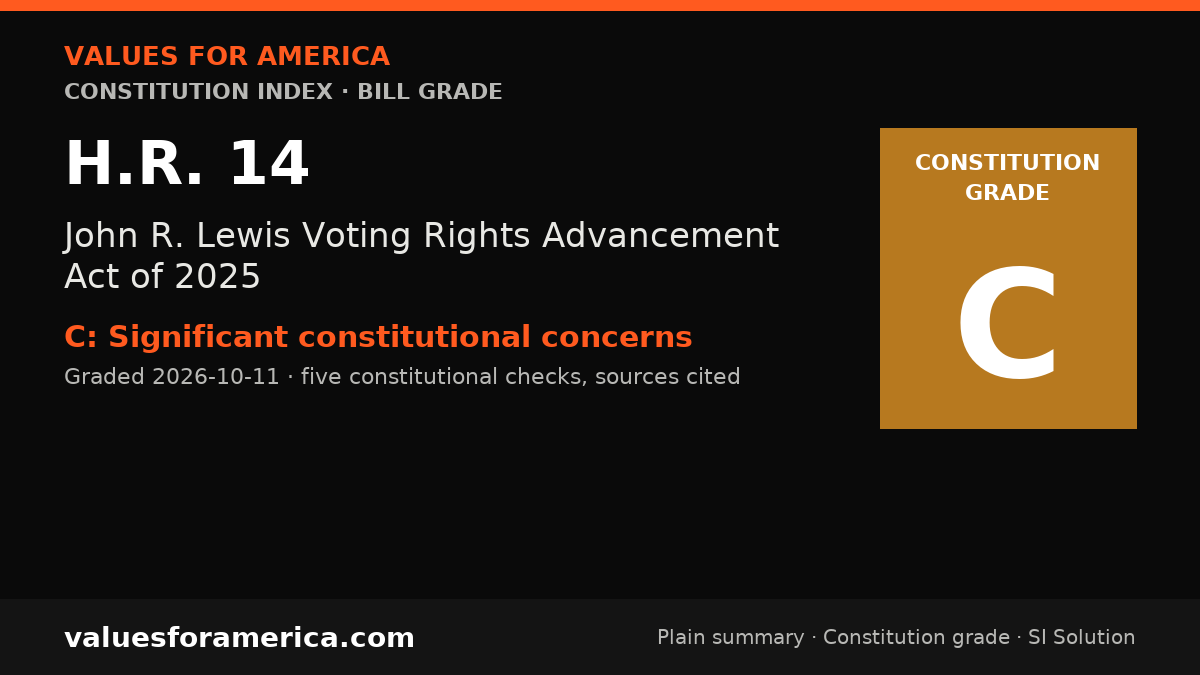
John R. Lewis Voting Rights Advancement Act of 2025
Cosponsors: 221 (221 D, 0 R) · per Congress.gov, 2026-10-12
Introduced: 2025-03-05
Latest action (2025-03-05): Referred to the House Committee on the Judiciary.
What H.R. 14 does, in plain terms
John R. Lewis Voting Rights Advancement Act of 2025 This bill establishes new criteria for determining which states and political subdivisions must obtain preclearance before changes to voting practices may take effect. Preclearance is the process of receiving preapproval from the Department of Justice (DOJ) or the U.S. District Court for the District of Columbia before making legal changes that would affect voting rights. A state and all of its political subdivisions shall be subject to preclearance of voting practice changes for a 10-year period if, during the previous 25 years: 15 or more voting rights violations occurred in the state; 10 or more violations occurred, at least 1 of which was committed by the state itself; or 3 or more violations occurred and the state administers the elections. A political subdivision as a separate unit shall also be subject to preclearance for a 10-year period if three or more voting rights violations occurred there during the previous 25 years. States and political subdivisions that meet certain thresholds regarding minority groups must preclear covered practices before implementation, such as redistricting. States and political subdivisions must notify the public of changes to voting practices. The bill authorizes DOJ to require states or political subdivisions to provide certain documents or answers to questions for enforcing voting rights. The bill outlines factors courts must consider when hearing challenges to voting practices, such as the extent of any history of official voting discrimination in the state or political subdivision.
Official summary by the Congressional Research Service, via Congress.gov.
Constitution Index
“VFA Constitution grade”
Significant constitutional concerns
Graded 2026-10-11
SI-generated grade · five published checks · not individually reviewed by a person · methodology
The bill raises significant constitutional concerns under the Fourteenth and Fifteenth Amendments, particularly regarding the preclearance formula and the shift of enforcement authority to the Department of Justice. While Congress has broad power to enforce voting rights, the new coverage formula may not be sufficiently tailored to current conditions, and the delegation of authority to DOJ to demand documents and answers could infringe on state sovereignty and due process. The bill also centralizes voting administration oversight at the federal level, failing the decentralization test. However, it does not directly violate the Bill of Rights, and its intent to protect voting rights is constitutionally legitimate.
-
✓ Passes · Enumerated powers
Congress has explicit authority under the Fifteenth Amendment, Section 2, to enforce the right to vote regardless of race, and under the Fourteenth Amendment, Section 5, to enforce equal protection. The bill is a valid exercise of these enforcement powers, as it aims to prevent racial discrimination in voting. The Supreme Court in Shelby County v. Holder (2013) affirmed that Congress retains the p… -
✓ Passes · Bill of Rights
The bill does not directly infringe on the First, Second, Third, Fourth, Fifth, Sixth, Seventh, Eighth, Ninth, or Tenth Amendments. It does not restrict speech, religion, assembly, or petition; it does not involve searches or seizures; it does not impose cruel punishment. The Tenth Amendment is implicated in the sense that it reserves powers to the states, but the bill is an exercise of Congress's… -
✓ Passes · Individual sovereignty
The bill does not restrict individual liberties; rather, it protects the individual right to vote, which is fundamental to sovereignty. It imposes obligations on states and political subdivisions, not on individuals. The requirement to notify the public of voting changes enhances individual awareness and participation. There is no restriction on personal property, speech, labor, or belief. The bil… -
✗ Concern · Decentralization
The bill fails the decentralization test because it consolidates decision-making at the federal level. While states and localities can handle voting administration, the bill imposes federal preclearance and DOJ oversight, which is a higher level of government than necessary. The coverage formula and preclearance requirements are a federal mandate that overrides state and local control. This is a s… -
✗ Concern · Due process and takings
The bill raises due process concerns because it authorizes DOJ to require states and political subdivisions to provide documents or answer questions without specifying clear standards or procedural safeguards. This could lead to arbitrary enforcement and burden states without a fair hearing. The preclearance process itself may not provide adequate notice and opportunity to be heard before a voting…
Sources: Congress.gov: HR 14 summary
Report an error in this grade
What should pass
“VFA SI Solution”
No solution yet
A sourced SI draft appears here once it passes automated checks (Constitution citation, source verification, independent SI critic). How publication works.
Related on VFA

For journalists and bloggers
“Embed this grade”
Free to use with the link back. The badge and card update when the grade changes. Embed terms →
