H.R. 139 explained · 119th Congress · Pending in Congress
Sunshine Protection Act of 2025
Cosponsors: 34 (3 D, 31 R) · per Congress.gov, 2026-10-08
Introduced: 2025-01-03
Latest action (2026-07-15): Received in the Senate and Read twice and referred to the Committee on Commerce, Science, and Transportation.
What H.R. 139 does, in plain terms
Sunshine Protection Act of 2025 This bill makes daylight saving time the new, permanent standard time. States with areas exempt from daylight saving time may choose the standard time for those areas.
Official summary by the Congressional Research Service, via Congress.gov.
Constitution Index
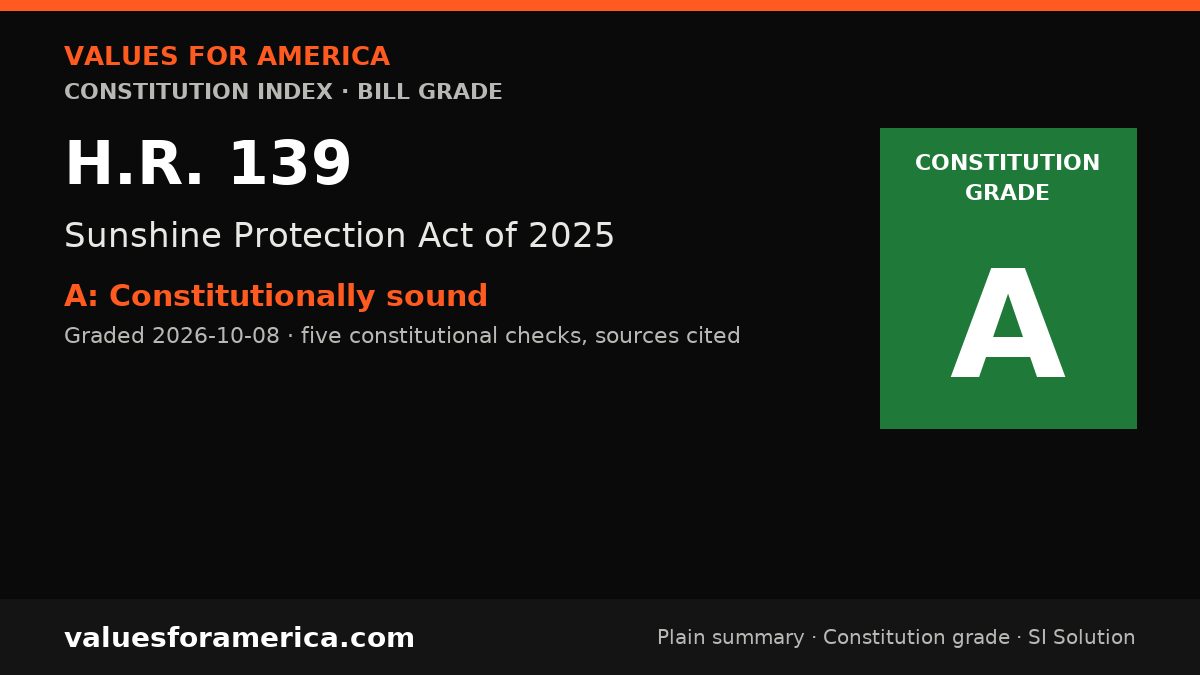
“VFA Constitution grade”
Constitutionally sound
Graded 2026-10-08
SI-generated grade · five published checks · not individually reviewed by a person · methodology
Permanent daylight saving time is a uniform commercial standard within Congress commerce power. It restricts no protected right, takes no property, denies no hearing, preserves exempt-area choice, and leaves personal liberty intact.
-
✓ Passes · Enumerated powers
Congress has authority to set uniform time standards as an exercise of Article I, Section 8, Clause 3, the Commerce Clause, because uniform time directly regulates channels and instrumentalities of interstate commerce including transportation, broadcasting, communications, and financial markets. The existing Uniform Time Act framework confirms this is regulation of interstate activity, not a gener… -
✓ Passes · Bill of Rights
The bill does not restrict speech, religion, press, assembly, or petition under the First Amendment, does not touch arms under the Second Amendment, and does not authorize searches, seizures, or surveillance implicating the Fourth Amendment. It creates no criminal liability, compelled testimony, or punishment implicating the Fifth, Sixth, Seventh, or Eighth Amendments. Setting a uniform national t… -
✓ Passes · Individual sovereignty
The bill does not restrict what a person may do with their person, property, speech, labor, or belief. No individual is compelled to speak, worship, associate, disarm, submit to search, or surrender property. Changing the legal definition of standard time does not burden a fundamental liberty interest, and any incidental inconvenience in scheduling is not a sovereignty restriction requiring height… -
✓ Passes · Decentralization
(1) Individuals and families cannot set a workable interstate time standard alone; uncoordinated timekeeping would disrupt commerce, travel, and communication. (2) Local communities and counties cannot maintain a uniform standard across county and state lines. (3) States could and historically have set observance rules, so state handling is possible for local preference. (4) The bill does not cons… -
✓ Passes · Due process and takings
The bill provides fair notice through prospective legislation setting permanent daylight saving time as standard time, with no retroactive penalty. It requires no hearing-triggering deprivation of life, liberty, or property under the Fifth Amendment Due Process Clause, creates no presumption of guilt or summary seizure, and effects no physical or regulatory taking of private property requiring jus…
Sources: Congress.gov: HR 139 summary
Report an error in this grade
What should pass
“VFA SI Solution”
No solution yet
A sourced SI draft appears here once it passes automated checks (Constitution citation, source verification, independent SI critic). How publication works.
Related on VFA

For journalists and bloggers
“Embed this grade”
Free to use with the link back. The badge and card update when the grade changes. Embed terms →
