H.R. 1383 explained · 119th Congress · Pending in Congress
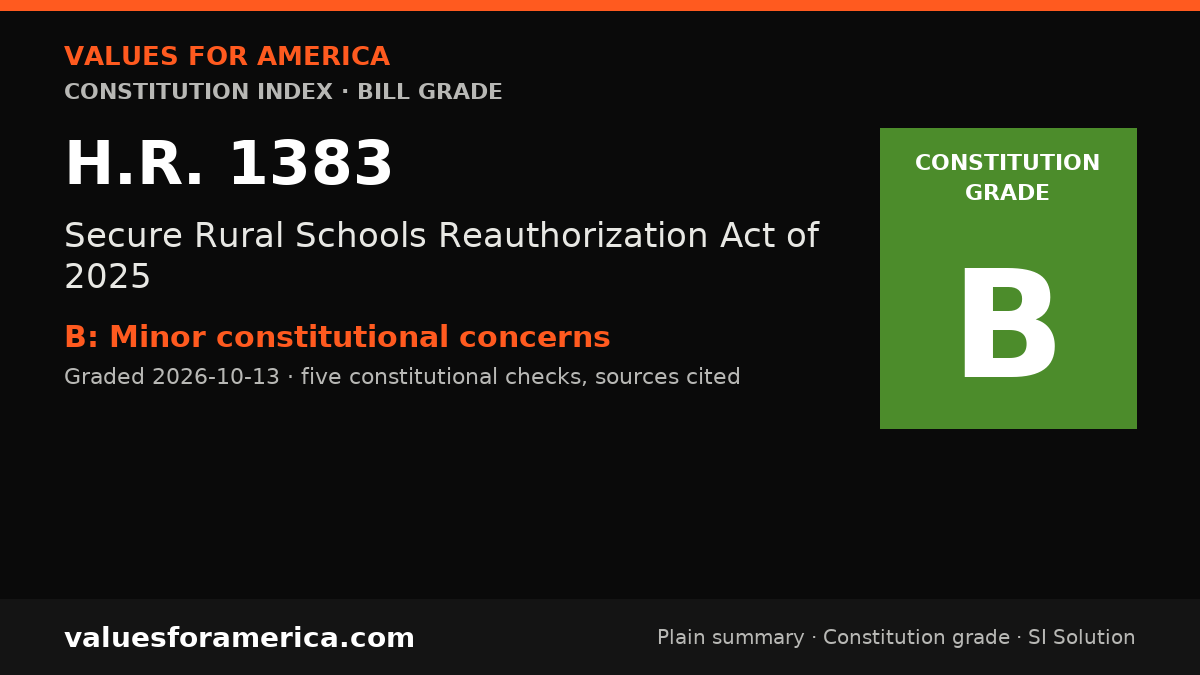
Secure Rural Schools Reauthorization Act of 2025
Cosponsors: 93 (58 D, 35 R) · per Congress.gov, 2026-10-12
Introduced: 2025-02-14
Latest action (2025-02-28): Referred to the Subcommittee on Forestry and Horticulture.
What H.R. 1383 does, in plain terms
Secure Rural Schools Reauthorization Act of 2025 This bill extends and modifies the Secure Rural Schools and Community Self-Determination Act of 2000, including by extending payments made to states and counties containing federal land through FY2026, providing for payments for FY2024 and FY2025, extending the authority of counties to initiate projects using such funds through FY2028, and extending the authority to initiate projects proposed by resource advisory committees through FY2028.
Official summary by the Congressional Research Service, via Congress.gov.
Constitution Index
“VFA Constitution grade”
Minor constitutional concerns
Graded 2026-10-13
SI-generated grade · five published checks · not individually reviewed by a person · methodology
The bill is a routine reauthorization of federal payments to states and counties for federal lands within their borders, grounded in the Property Clause and the Spending Clause. It does not infringe on individual rights, respects state and local roles, and follows established statutory procedures. Minor concerns arise from the extension of federal funding mechanisms that could influence local land-use decisions, but these are consistent with long-standing federal land management practice.
-
✓ Passes · Enumerated powers
The federal government has explicit authority over federal lands under Article I, Section 8, Clause 17 (the Enclave Clause) and Article IV, Section 3, Clause 2 (the Property Clause). Payments to states and counties in lieu of taxes on federal lands are a valid exercise of the Spending Clause (Article I, Section 8, Clause 1) to promote the general welfare and to compensate local governments for the… -
✓ Passes · Bill of Rights
The bill does not implicate any of the first ten amendments. It does not restrict speech, religion, assembly, press, petition, arms, quartering, search and seizure, self-incrimination, due process, takings, trial rights, or cruel and unusual punishment. It is a funding mechanism for local governments and does not affect individual liberties. -
✓ Passes · Individual sovereignty
The bill does not restrict what individuals can do with their person, property, speech, labor, or belief. It provides funds to states and counties for projects on federal lands, which may include resource management activities, but these are government actions on government-owned land, not restrictions on individual freedom. No compelling constitutional justification is needed because no individua… -
✓ Passes · Decentralization
The bill actually supports decentralization by channeling federal funds to states and counties, allowing local decision-making on how to use the funds for projects. It does not consolidate decision-making upward; rather, it provides resources for local communities to address local needs. The federal government retains ownership of the lands, but the bill empowers local entities to initiate project… -
✓ Passes · Due process and takings
The bill does not bypass due process or take property without just compensation. It is a voluntary funding program for states and counties; no one is deprived of life, liberty, or property without a hearing. The payments are not a taking of private property; they are a transfer of federal funds to local governments. The bill follows statutory procedures for project initiation and approval, providi…
Sources: Congress.gov: HR 1383 summary
Report an error in this grade
What should pass
“VFA SI Solution”
No solution yet
A sourced SI draft appears here once it passes automated checks (Constitution citation, source verification, independent SI critic). How publication works.
Related on VFA

For journalists and bloggers
“Embed this grade”
Free to use with the link back. The badge and card update when the grade changes. Embed terms →
