H.R. 1366 explained · 119th Congress · Pending in Congress
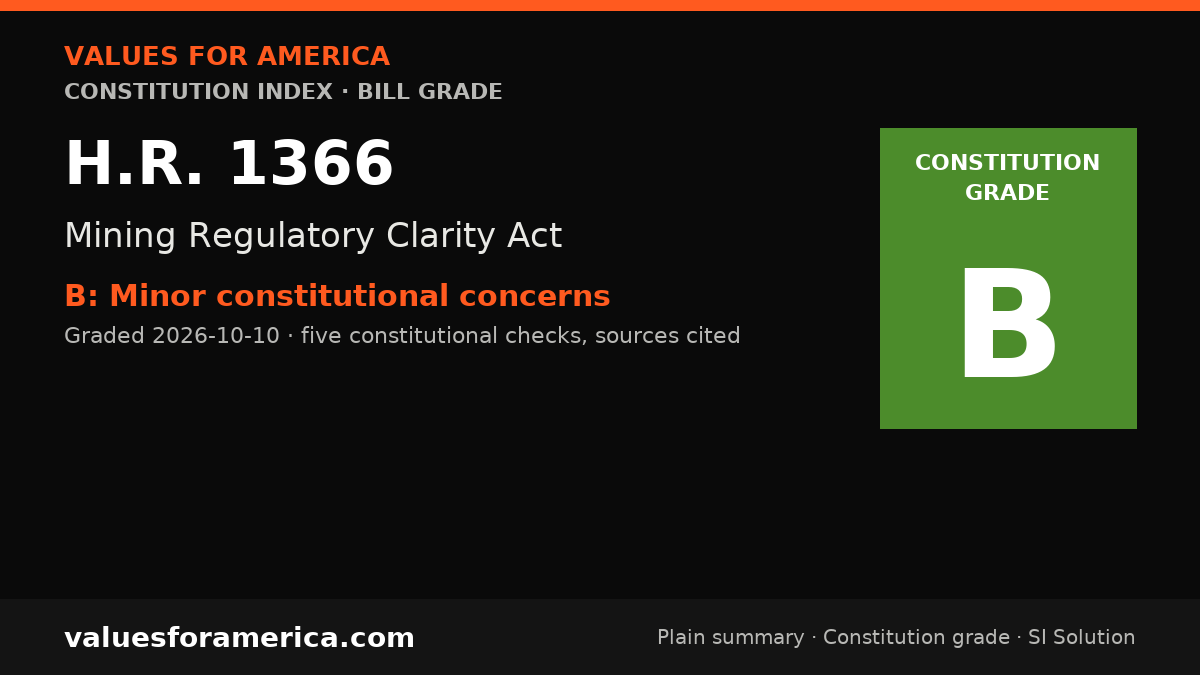
Mining Regulatory Clarity Act
Cosponsors: 2 (1 D, 1 R) · per Congress.gov, 2026-10-09
Introduced: 2025-02-14
Latest action (2026-03-17): Read twice. Placed on Senate Legislative Calendar under General Orders. Calendar No. 357.
What H.R. 1366 does, in plain terms
Mining Regulatory Clarity Act This bill allows mining operators to use federal lands for activities ancillary to mining, such as waste disposal, regardless of whether those lands contain mineral deposits valuable enough to be mined (mineral validity). It also establishes the Abandoned Hardrock Mine Fund. The bill addresses a 2022 decision in the U.S. Court of Appeals for the Ninth Circuit related to the Rosemont Copper Mine in Arizona (commonly known as the Rosemont decision, described further in CRS Report R48166). The court held that mining claims are only allowed where mineral validity has been established and that mill site claims are more appropriate means for establishing a mining waste disposal site under the Mining Act. The bill allows a mining operator to (1) locate and include within its plan of operations as many mill site claims (e.g., areas for waste rock disposal) as are reasonably necessary for its operations, and (2) use or occupy public land in accordance with an approved plan of operations. Additionally, the bill requires any revenue generated from fees for such mill site claims to be deposited into the Abandoned Hardrock Mine Fund. The Department of the Interior must use the fund for certain abandoned hardrock mine reclamation activities.
Official summary by the Congressional Research Service, via Congress.gov.
Constitution Index
“VFA Constitution grade”
Minor constitutional concerns
Graded 2026-10-10
SI-generated grade · five published checks · not individually reviewed by a person · methodology
The Mining Regulatory Clarity Act is mostly sound but has minor tensions with the Property Clause and the Ninth Amendment. It operates within Congress's enumerated power over federal lands, does not directly infringe the Bill of Rights, and preserves individual sovereignty. However, it consolidates decision-making at the federal level for land-use decisions that could be handled locally, and the creation of a federal fund raises minor due process concerns regarding the use of fees.
-
✓ Passes · Enumerated powers
Congress has explicit constitutional authority over federal lands under Article IV, Section 3, Clause 2 (the Property Clause), which grants Congress the power to 'dispose of and make all needful Rules and Regulations respecting the Territory or other Property belonging to the United States.' This bill regulates the use of public lands for mining-related activities, which falls squarely within that… -
✓ Passes · Bill of Rights
The bill does not infringe any of the first ten amendments. It does not restrict speech, religion, assembly, press, petition (First Amendment), the right to keep and bear arms (Second Amendment), quartering of soldiers (Third Amendment), or search and seizure (Fourth Amendment). It does not involve self-incrimination, double jeopardy, or due process in a criminal context (Fifth Amendment), nor doe… -
✓ Passes · Individual sovereignty
The bill does not restrict what individuals can do with their own person, property, speech, labor, or belief. It regulates the use of federal lands by mining operators, who are voluntarily engaging in commercial activity on government property. The bill does not impose restrictions on private property owners or individuals acting outside the context of mining on federal lands. The burden of justif… -
✗ Concern · Decentralization
The bill fails the decentralization test on two of four questions. (1) An individual or family could not handle this without government involvement because mining on federal lands requires federal permission and oversight. (2) A local community or county could handle waste disposal and mining regulation without state involvement, but the bill centralizes this at the federal level. (3) A state coul… -
✓ Passes · Due process and takings
The bill does not bypass due process or take property without just compensation. It does not impose criminal penalties or deprive anyone of life, liberty, or property without a hearing. The bill's requirement that fees be deposited into the Abandoned Hardrock Mine Fund does not constitute a taking because the fees are voluntarily paid by mining operators as part of their plan of operations, and th…
Sources: Congress.gov: HR 1366 summary
Report an error in this grade
What should pass
“VFA SI Solution”
No solution yet
A sourced SI draft appears here once it passes automated checks (Constitution citation, source verification, independent SI critic). How publication works.
Related on VFA

For journalists and bloggers
“Embed this grade”
Free to use with the link back. The badge and card update when the grade changes. Embed terms →
