H.R. 1346 explained · 119th Congress · Pending in Congress
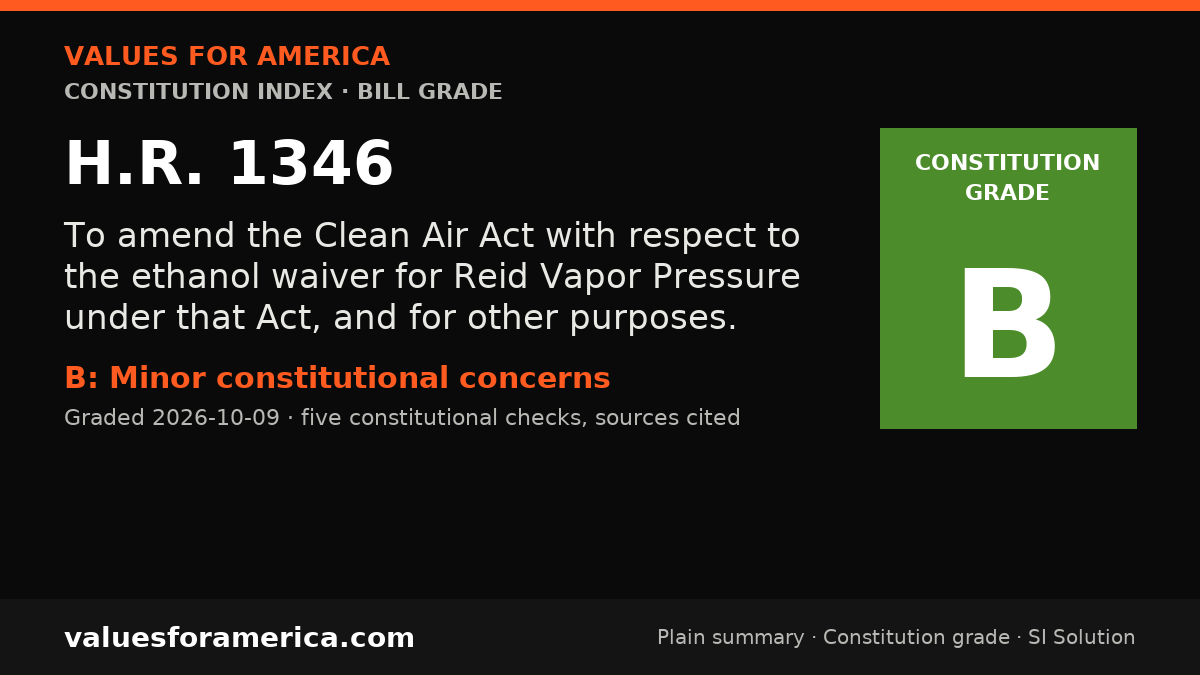
To amend the Clean Air Act with respect to the ethanol waiver for Reid Vapor Pressure under that Act, and for other purposes.
Cosponsors: 55 (18 D, 37 R) · per Congress.gov, 2026-10-08
Introduced: 2025-02-13
Latest action (2026-05-14): Received in the Senate and Read twice and referred to the Committee on Environment and Public Works.
What H.R. 1346 does, in plain terms
Nationwide Consumer and Fuel Retailer Choice Act of 2025 This bill amends the Clean Air Act to address the limitations on Reid Vapor Pressure (a measure of gasoline's volatility) that are placed on gasoline during the summer ozone season. Specifically, the bill applies the waiver for Reid Vapor Pressure requirements that is applicable to gasoline blended with 10% ethanol (E10) to gasoline blended with up to 15% ethanol (E15). This change allows gasoline that is blended with 10% to 15% ethanol to be sold year-round. Currently, states may be excluded from the waiver for Reid Vapor Pressure requirements by submitting documentation supporting that the waiver would increase air pollution. The bill nullifies existing state exclusions, but states may submit documentation after enactment of the bill to be excluded going forward. The bill also modifies the Renewable Fuel Standard Program, which requires transportation fuel sold or introduced into commerce in the United States to contain minimum volumes of renewable fuel. Under the existing program, obligated parties, such as small refineries, must satisfy the volume obligations by either blending renewable fuels into their gasoline or diesel fuel products or by acquiring credits that represent the required renewable fuel volume. The bill directs the Environmental Protection Agency to return compliance credits to small refineries under certain circumstances.
Official summary by the Congressional Research Service, via Congress.gov.
Constitution Index
“VFA Constitution grade”
Minor constitutional concerns
Graded 2026-10-09
SI-generated grade · five published checks · not individually reviewed by a person · methodology
HR 1346 is mostly constitutional but has minor federalism concerns. The bill falls within Congress's Commerce Clause authority to regulate interstate fuel markets and air pollution. It does not infringe individual rights or due process. However, nullifying existing state exclusions under the Clean Air Act, even with a reapplication process, creates a temporary federal override of state determinations, raising a mild Tenth Amendment tension. The decentralization test shows unnecessary consolidation at the federal level, though states retain an opt-out mechanism. Overall, the bill is sound with fixable issues.
-
✓ Passes · Enumerated powers
Congress has authority under the Commerce Clause (Article I, Section 8, Clause 3) to regulate gasoline volatility and renewable fuel standards because these activities substantially affect interstate commerce. The Clean Air Act is a longstanding exercise of this power. The bill's modifications to the Reid Vapor Pressure waiver and Renewable Fuel Standard are within this scope. -
✓ Passes · Bill of Rights
The bill does not implicate any of the first ten amendments. It regulates commercial fuel standards and does not restrict speech, religion, assembly, press, petition, arms, quartering, search and seizure, self-incrimination, due process (beyond procedural), fair trial, jury, cruel and unusual punishment, or unenumerated rights. No infringement on the Bill of Rights. -
✓ Passes · Individual sovereignty
The bill imposes obligations on commercial entities (fuel retailers, small refineries) rather than directly restricting individual liberty. The Ninth and Tenth Amendments protect unenumerated rights, but economic regulation of this nature does not violate individual sovereignty when applied to businesses engaged in interstate commerce. The burden is on the government to justify restrictions, and h… -
✗ Concern · Decentralization
The bill fails the decentralization test because it consolidates decision-making at the federal level beyond the minimum necessary. An individual or family cannot handle fuel volatility standards (question 1: false). A local community cannot effectively regulate interstate fuel markets (question 2: false). A state could handle this through its own environmental and fuel standards (question 3: true… -
✓ Passes · Due process and takings
The bill does not deprive any person of life, liberty, or property without due process. It returns compliance credits to small refineries, which is a benefit, not a taking. The nullification of state exclusions does not involve private property; states are not protected by the Takings Clause. Procedural due process is satisfied because states can reapply for exclusions after enactment. No Fifth Am…
Sources: Congress.gov: HR 1346 summary
Report an error in this grade
What should pass
“VFA SI Solution”
No solution yet
A sourced SI draft appears here once it passes automated checks (Constitution citation, source verification, independent SI critic). How publication works.
Related on VFA

For journalists and bloggers
“Embed this grade”
Free to use with the link back. The badge and card update when the grade changes. Embed terms →
