H.R. 1326 explained · 119th Congress · Pending in Congress
DOE and USDA Interagency Research Act
Cosponsors: 2 (1 D, 1 R) · per Congress.gov, 2026-10-12
Introduced: 2025-02-13
Latest action (2025-03-25): Received in the Senate and Read twice and referred to the Committee on Energy and Natural Resources.
What H.R. 1326 does, in plain terms
DOE and USDA Interagency Research Act This bill requires the Department of Energy and Department of Agriculture to carry out cross-cutting and collaborative research and development activities through the establishment of an interagency agreement. The agencies are authorized to (1) carry out reimbursable agreements in order to maximize research and development effectiveness, and (2) collaborate with other federal agencies. Further, the interagency agreement must require the use of a competitive, merit-reviewed process, which considers applications from federal agencies, national laboratories, institutions of higher education, and nonprofit institutions. Research and development activities may include collaborative research in a variety of focus areas such as machine learning and artificial intelligence, biofuels and biobased products, grid modernization and security, rural technology development, and wildfire risks and prevention; developing methods to accommodate large voluntary standardized and integrated data sets on agricultural, environmental, supply chain, and economic information; supporting research infrastructure and workforce development; and collaborative research and development on ways to improve agriculture operations and processing efficiencies, and reduce greenhouse gas emissions.
Official summary by the Congressional Research Service, via Congress.gov.
Constitution Index
“VFA Constitution grade”
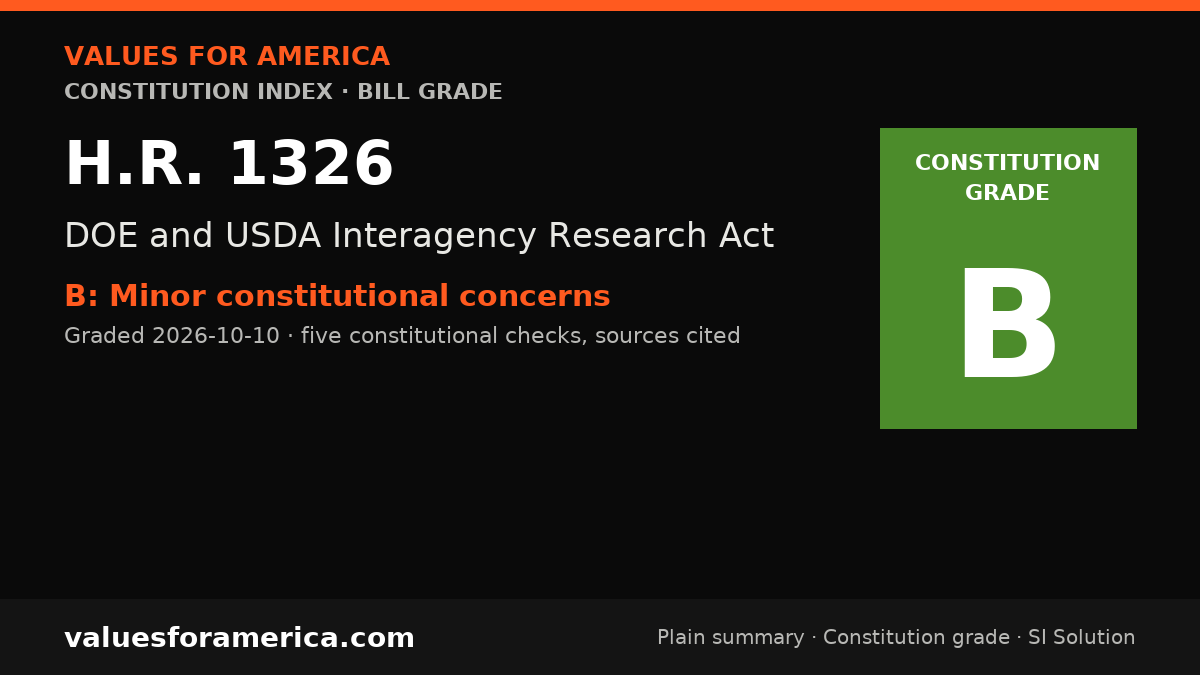
Minor constitutional concerns
Graded 2026-10-10
SI-generated grade · five published checks · not individually reviewed by a person · methodology
The bill authorizes collaborative research and development between the Department of Energy and the Department of Agriculture, which falls within the enumerated powers of Congress to promote science and the general welfare. It does not infringe on individual rights, and it does not centralize authority beyond what is necessary for federal research coordination. However, the bill's broad authorization for data collection and sharing raises minor concerns about potential privacy and due process implications, which are not fully addressed.
-
✓ Passes · Enumerated powers
Congress has the power to authorize federal agencies to conduct research and development under Article I, Section 8, Clause 8 (the Patent and Copyright Clause) and the Necessary and Proper Clause (Article I, Section 8, Clause 18). Additionally, the promotion of science and the general welfare is a recognized federal interest. The bill's focus on energy, agriculture, and rural development falls wit… -
✓ Passes · Bill of Rights
The bill does not directly infringe on any of the first ten amendments. It does not restrict speech, religion, assembly, press, petition, arms, quartering, search and seizure, self-incrimination, due process, takings, fair trial, jury, cruel and unusual punishment, or unenumerated rights. The data collection provisions are voluntary and standardized, not mandatory, so they do not implicate the Fou… -
✓ Passes · Individual sovereignty
The bill does not restrict individual action. It authorizes federal agencies to conduct research and development, which does not impose obligations on individuals. The data collection is described as 'voluntary,' so it does not compel individuals to provide information. The burden of justification for any restriction is not triggered because no restriction is imposed. -
✓ Passes · Decentralization
The bill involves federal research coordination, which is a legitimate federal function. The research areas—such as grid modernization, wildfire risks, and agricultural data—are national in scope and require federal coordination. The bill does not consolidate decision-making at a higher level than necessary; it authorizes interagency collaboration, which is appropriate for federal research. The fo… -
✓ Passes · Due process and takings
The bill does not bypass due process or take property without just compensation. It establishes a competitive, merit-reviewed process for research applications, which provides fair procedures. The data collection is voluntary, so it does not implicate the Takings Clause or due process rights.
Sources: Congress.gov: HR 1326 summary
Report an error in this grade
What should pass
“VFA SI Solution”
No solution yet
A sourced SI draft appears here once it passes automated checks (Constitution citation, source verification, independent SI critic). How publication works.
Related on VFA

For journalists and bloggers
“Embed this grade”
Free to use with the link back. The badge and card update when the grade changes. Embed terms →
