H.R. 131 explained · 119th Congress · Pending in Congress
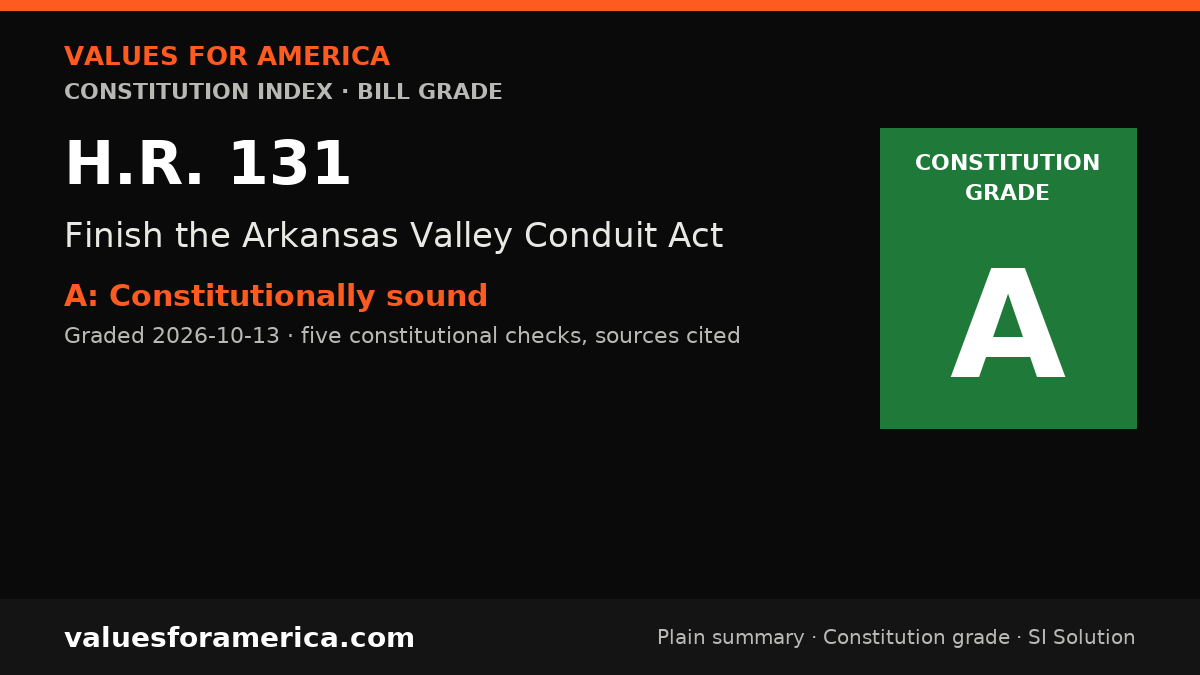
Finish the Arkansas Valley Conduit Act
Cosponsors: 1 (0 D, 1 R) · per Congress.gov, 2026-10-09
Introduced: 2025-01-03
Latest action (2026-01-08): The Chair directed the Clerk to notify the Senate of the action of the House.
What H.R. 131 does, in plain terms
Finish the Arkansas Valley Conduit Act This bill reduces payments that communities within the Arkansas River Valley must pay to the Bureau of Reclamation for the construction of the Arkansas Valley Conduit, a pipeline in Colorado for delivering water from the Pueblo Reservoir to such communities. Specifically, it removes interest payments and extends the repayment period to 100 years.
Official summary by the Congressional Research Service, via Congress.gov.
Constitution Index
“VFA Constitution grade”
Constitutionally sound
Graded 2026-10-13
SI-generated grade · five published checks · not individually reviewed by a person · methodology
The bill is a routine adjustment to federal water project repayment terms, well within Congress's enumerated powers over federal property and spending. It does not infringe on any constitutional rights, respects state and local roles, and does not implicate due process or takings concerns.
-
✓ Passes · Enumerated powers
Congress has authority under Article I, Section 8, Clause 3 (Commerce Clause) and the Property Clause (Article IV, Section 3, Clause 2) to manage federal water projects and set repayment terms. The Arkansas Valley Conduit is a federal project, and adjusting repayment schedules is a valid exercise of federal spending and property management powers. -
✓ Passes · Bill of Rights
The bill does not implicate any of the first ten amendments. It does not affect speech, religion, assembly, press, petition, arms, quartering, search and seizure, self-incrimination, due process, takings, trial rights, jury rights, cruel and unusual punishment, unenumerated rights, or reserved powers. -
✓ Passes · Individual sovereignty
The bill reduces financial obligations on communities, thereby expanding their economic freedom. It does not restrict personal liberty, property, speech, labor, or belief. The burden of proof for any restriction is not triggered because there is no restriction. -
✓ Passes · Decentralization
The bill does not consolidate decision-making upward. It adjusts repayment terms for a federal project that already exists, and the change is administrative in nature. It does not prevent individuals, communities, or states from handling water delivery; it merely alters the financial terms of a federal contract. The project itself is federal, so federal involvement is already established and appro… -
✓ Passes · Due process and takings
The bill does not deprive anyone of property or liberty without due process. It does not take property for public use without just compensation. It only reduces payments owed to the federal government, which is a benefit to the affected communities, not a deprivation.
Sources: Congress.gov: HR 131 summary
Report an error in this grade
What should pass
“VFA SI Solution”
No solution yet
A sourced SI draft appears here once it passes automated checks (Constitution citation, source verification, independent SI critic). How publication works.
Related on VFA

For journalists and bloggers
“Embed this grade”
Free to use with the link back. The badge and card update when the grade changes. Embed terms →
