H.R. 1309 explained · 119th Congress · Pending in Congress
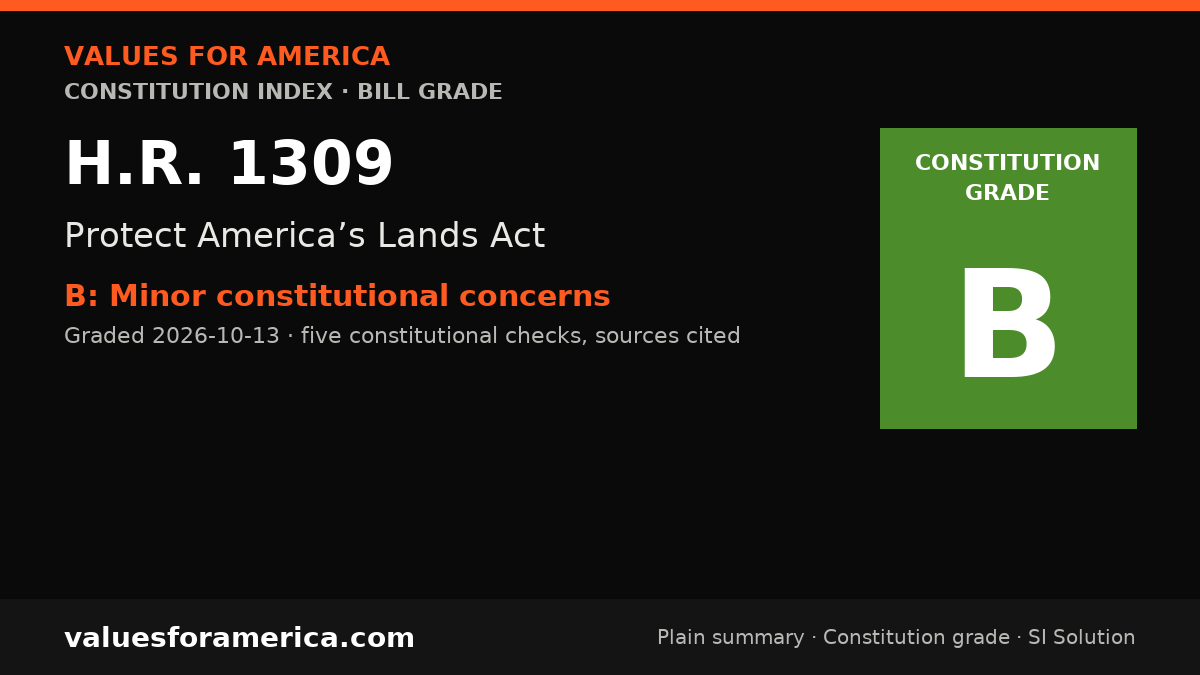
Protect America’s Lands Act
Cosponsors: 22 (0 D, 22 R) · per Congress.gov, 2026-10-12
Introduced: 2025-02-13
Latest action (2025-02-13): Referred to the House Committee on Financial Services.
What H.R. 1309 does, in plain terms
Protect America’s Lands Act This bill prohibits national securities exchanges from allowing the trade of securities issued by natural asset companies. Natural asset companies are companies that oversee land for conservation, restoration, or for the sustainable management of the natural resources and ecosystem services on that land.
Official summary by the Congressional Research Service, via Congress.gov.
Constitution Index
“VFA Constitution grade”
Minor constitutional concerns
Graded 2026-10-13
SI-generated grade · five published checks · not individually reviewed by a person · methodology
The bill is a federal prohibition on trading certain securities, which falls within Congress's enumerated power over interstate commerce and securities regulation. It does not directly infringe on individual rights, but it does restrict the ability of natural asset companies to access capital markets, raising minor concerns about economic liberty and decentralization. The bill is mostly sound but has minor tensions that could be addressed by narrowing its scope or providing alternative mechanisms.
-
✓ Passes · Enumerated powers
Congress has authority to regulate securities exchanges under the Commerce Clause (Article I, Section 8, Clause 3) and its power to regulate interstate commerce. The bill directly regulates national securities exchanges, which are instruments of interstate commerce. This is a valid exercise of federal power. -
✓ Passes · Bill of Rights
The bill does not implicate the First, Second, Third, Fourth, Fifth, Sixth, Seventh, Eighth, Ninth, or Tenth Amendments. It does not restrict speech, religion, assembly, press, petition, arms, quartering, search and seizure, self-incrimination, due process, takings, fair trial, jury, or cruel and unusual punishment. The Tenth Amendment is not violated because the bill regulates interstate commerce… -
✗ Concern · Individual sovereignty
The bill restricts the ability of natural asset companies to raise capital by prohibiting their securities from being traded on national exchanges. This limits the economic freedom of individuals who wish to invest in such companies and the companies' ability to engage in voluntary transactions. While the government has a compelling interest in regulating securities markets, the restriction is bro… -
✗ Concern · Decentralization
The bill fails the decentralization test because it consolidates decision-making at the federal level. While an individual or family could not handle securities regulation alone, and local communities or states could not effectively regulate national exchanges, the federal government is the appropriate level for securities regulation. However, the bill imposes a blanket prohibition that could be a… -
✓ Passes · Due process and takings
The bill does not bypass due process or take property without just compensation. It does not deprive any person of life, liberty, or property without a hearing. It does not take private property for public use without compensation. The prohibition on trading securities does not constitute a taking of property, as it regulates the manner of exchange rather than confiscating assets.
Sources: Congress.gov: HR 1309 summary
Report an error in this grade
What should pass
“VFA SI Solution”
No solution yet
A sourced SI draft appears here once it passes automated checks (Constitution citation, source verification, independent SI critic). How publication works.
Related on VFA

For journalists and bloggers
“Embed this grade”
Free to use with the link back. The badge and card update when the grade changes. Embed terms →
