H.R. 1271 explained · 119th Congress · Pending in Congress
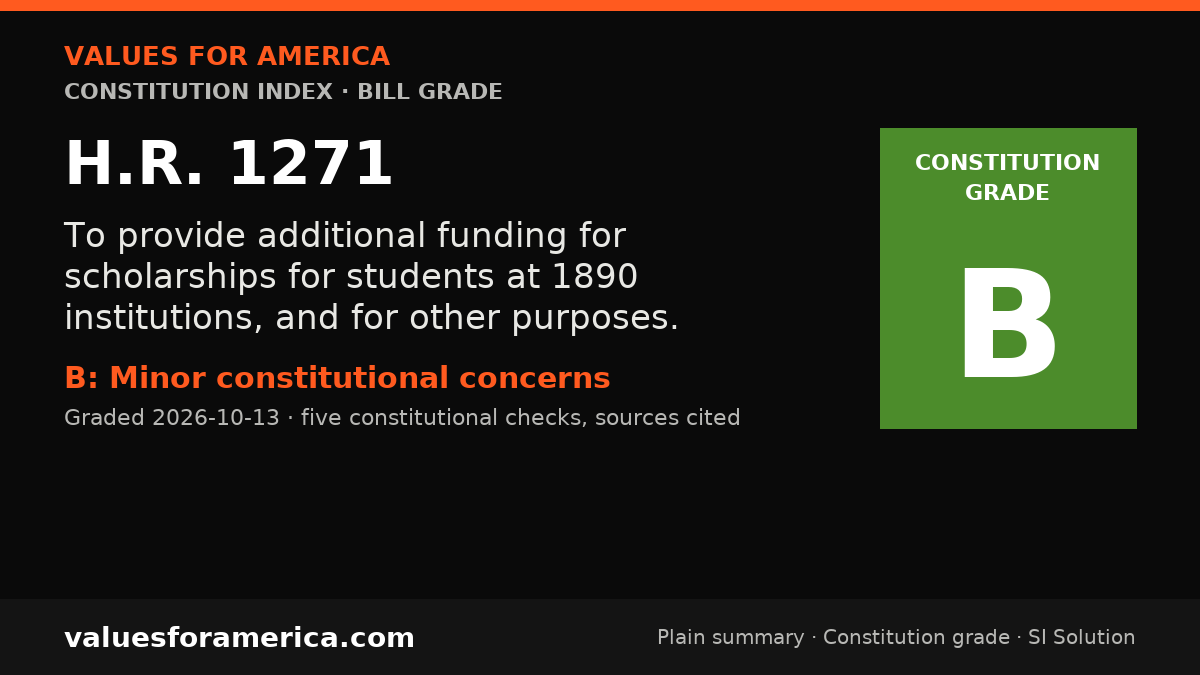
To provide additional funding for scholarships for students at 1890 institutions, and for other purposes.
Cosponsors: 19 (19 D, 0 R) · per Congress.gov, 2026-10-12
Introduced: 2025-02-12
Latest action (2025-03-28): Referred to the Subcommittee on Conservation, Research, and Biotechnology.
What H.R. 1271 does, in plain terms
This bill provides specified funds to the 1890 Scholarships Program for FY2025 and each succeeding year for student scholarships. This National Institute of Food and Agriculture program provides grants to 1890 Institutions (i.e., historically Black colleges and universities that belong to the U.S. land-grant university system) for students who intend to pursue a career in the food and agricultural sciences. The bill also permanently reauthorizes the 1890 Scholarships Program. Further, the bill specifies that student scholarships include scholarships for programs leading to a bachelor or graduate degree.
Official summary by the Congressional Research Service, via Congress.gov.
Constitution Index
“VFA Constitution grade”
Minor constitutional concerns
Graded 2026-10-13
SI-generated grade · five published checks · not individually reviewed by a person · methodology
The bill is a federal spending measure that falls within Congress's enumerated power to provide for the general welfare and to support agricultural education. It does not infringe on individual rights, and while it centralizes funding at the federal level, the program itself is administered through state-based institutions. The main constitutional tension is the permanent reauthorization, which could be seen as an ongoing federal role in education, but this is a minor issue given the long-standing federal involvement in land-grant institutions.
-
✓ Passes · Enumerated powers
Congress has the power to spend for the general welfare under Article I, Section 8, Clause 1. Funding scholarships for agricultural education at 1890 institutions is a legitimate exercise of this power, as it supports the agricultural sector and education, both of which have been recognized as within the federal spending power. The bill also falls under Congress's authority to regulate interstate … -
✓ Passes · Bill of Rights
The bill does not implicate any of the first ten amendments. It does not restrict speech, religion, assembly, press, petition, arms, quartering, search and seizure, self-incrimination, due process, takings, trial rights, or cruel and unusual punishment. It is a purely voluntary spending program that provides scholarships to students. -
✓ Passes · Individual sovereignty
The bill does not restrict individual liberty. It provides voluntary funding for education, which enhances individual opportunity rather than restricting it. There is no coercion or mandate imposed on individuals; students are free to apply for scholarships or not. -
✗ Concern · Decentralization
While the program is administered by the federal government, it delegates implementation to state-based institutions (1890 land-grant universities). However, the funding and program design are centralized at the federal level, which fails the test of whether a state could handle this without federal involvement. States already operate land-grant universities and could fund scholarships themselves,… -
✓ Passes · Due process and takings
The bill does not deprive anyone of life, liberty, or property without due process. It does not take property; it only provides funding. There are no procedural or substantive due process concerns, as the program is voluntary and does not impose penalties or obligations.
Sources: Congress.gov: HR 1271 summary
Report an error in this grade
What should pass
“VFA SI Solution”
No solution yet
A sourced SI draft appears here once it passes automated checks (Constitution citation, source verification, independent SI critic). How publication works.
Related on VFA

For journalists and bloggers
“Embed this grade”
Free to use with the link back. The badge and card update when the grade changes. Embed terms →
