H.R. 1223 explained · 119th Congress · Pending in Congress
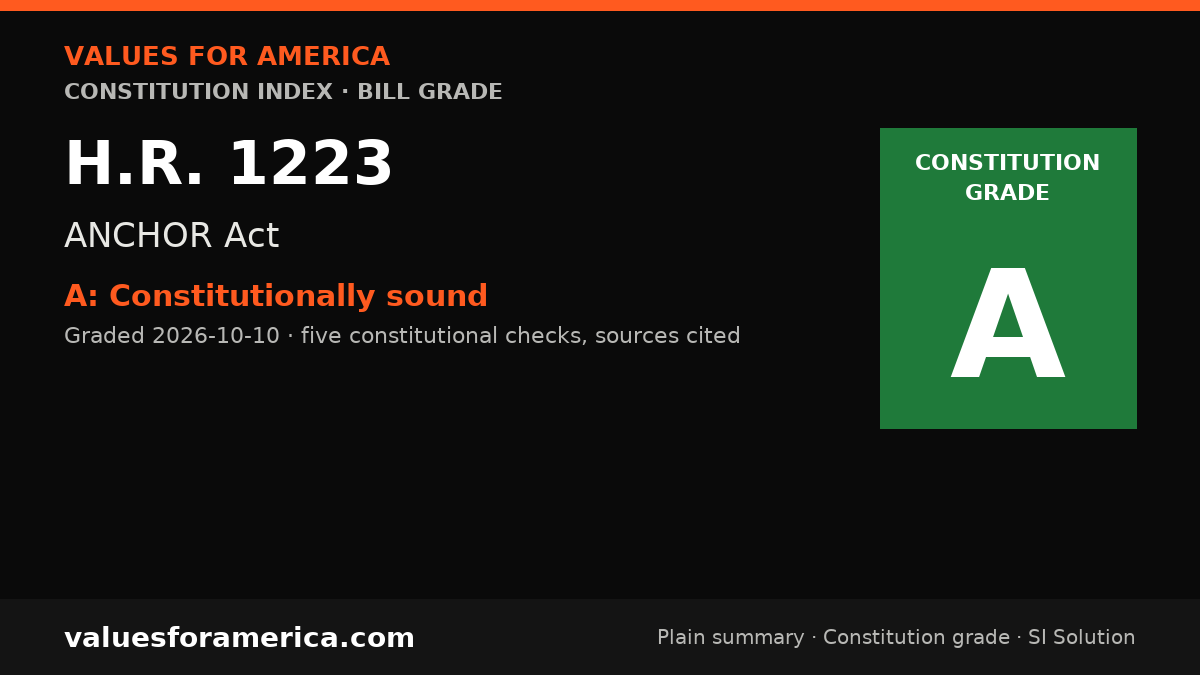
ANCHOR Act
Cosponsors: 5 (3 D, 2 R) · per Congress.gov, 2026-10-11
Introduced: 2025-02-12
Latest action (2025-05-21): Received in the Senate and Read twice and referred to the Committee on Commerce, Science, and Transportation.
What H.R. 1223 does, in plain terms
Accelerating Networking, Cyberinfrastructure, and Hardware for Oceanic Research Act or the ANCHOR Act This bill requires the National Science Foundation (NSF) to develop a plan to improve the cybersecurity and telecommunications capabilities of the U.S. Academic Research Fleet (ARF). ARF is comprised of U.S.-flagged vessels that provide at-sea laboratories where oceanographic scientists, educators, and students research and learn about marine science. The bill requires the plan to include assessments of telecommunications and networking needs of ARF, consistent with typical scientific missions; cybersecurity needs appropriate for the operation of ARF vessels and their specific research functions; the costs necessary to meet these needs; the time required to implement necessary upgrades; and opportunities for the adoption of common solutions or consortial licensing agreements, or for the centralization of cybersecurity, telecommunications, or data management at a single facility. The plan must also include a spending plan for the NSF, the Office of Naval Research, nonfederal owners of ARF vessels, and users of the vessels to cover identified costs. Among other factors specified in the bill, the NSF must consider, as appropriate, the network capabilities necessary to meet mission needs (e.g., to upload data to cloud-based or shoreside servers), international standards and guidance for information security, and requirements for controlled unclassified or classified information. The plan must be provided to Congress within 18 months of the bill's enactment, and the NSF must later report to Congress on the plan's implementation.
Official summary by the Congressional Research Service, via Congress.gov.
Constitution Index
“VFA Constitution grade”
Constitutionally sound
Graded 2026-10-10
SI-generated grade · five published checks · not individually reviewed by a person · methodology
The ANCHOR Act directs the National Science Foundation to study and plan for cybersecurity and telecommunications upgrades to the U.S. Academic Research Fleet. This falls squarely within Congress's enumerated power to promote the progress of science under Article I, Section 8, Clause 8, and does not infringe any constitutional right, restrict individual liberty, centralize power beyond necessity, or violate due process. The bill is fully constitutional.
-
✓ Passes · Enumerated powers
Congress has explicit authority under Article I, Section 8, Clause 8 to 'promote the Progress of Science and useful Arts.' The ANCHOR Act funds and directs planning for scientific research infrastructure — specifically the Academic Research Fleet used for oceanographic science. This is a textbook exercise of the enumerated power to support scientific advancement. No overreach occurs. -
✓ Passes · Bill of Rights
The bill imposes no restrictions on speech, religion, press, assembly, petition, arms, quartering, search and seizure, self-incrimination, due process, takings, trial rights, or cruel punishment. It does not regulate any private conduct or expression. It merely requires a federal agency to produce a plan and report. No provision of the Bill of Rights is implicated. -
✓ Passes · Individual sovereignty
The ANCHOR Act does not restrict what any individual may do with their person, property, speech, labor, or belief. It imposes no mandates, prohibitions, or penalties on private citizens. The burden of justification does not arise because no individual freedom is constrained. The act operates entirely within the federal government's internal management of its own research fleet. -
✓ Passes · Decentralization
The bill passes all four questions of the decentralization test. (1) An individual or family could not handle cybersecurity and telecommunications for a nationwide fleet of oceanographic research vessels — this is inherently a large-scale infrastructure coordination problem. (2) A local community or county could not handle it, as the fleet operates across U.S. waters and internationally. (3) A sta… -
✓ Passes · Due process and takings
The bill does not deprive any person of life, liberty, or property. It imposes no fines, penalties, or forfeitures. It does not take private property for public use. It requires no adjudication or hearing. The planning and reporting requirements apply only to federal agencies and their contractors. No due process or takings issue arises.
Sources: Congress.gov: HR 1223 summary
Report an error in this grade
What should pass
“VFA SI Solution”
No solution yet
A sourced SI draft appears here once it passes automated checks (Constitution citation, source verification, independent SI critic). How publication works.
Related on VFA

For journalists and bloggers
“Embed this grade”
Free to use with the link back. The badge and card update when the grade changes. Embed terms →
