H.R. 1181 explained · 119th Congress · Pending in Congress
Protecting Privacy in Purchases Act
Cosponsors: 132 (0 D, 132 R) · per Congress.gov, 2026-10-08
Introduced: 2025-02-11
Latest action (2026-07-15): Received in the Senate and Read twice and referred to the Committee on Banking, Housing, and Urban Affairs.
What H.R. 1181 does, in plain terms
Protecting Privacy in Purchases Act This bill prohibits payment card networks from using merchant codes that distinguish firearms retailers from general-merchandise retailers or sporting-goods retailers. The Department of Justice must enforce this bill and report annually on the resulting investigations and cases.
Official summary by the Congressional Research Service, via Congress.gov.
Constitution Index
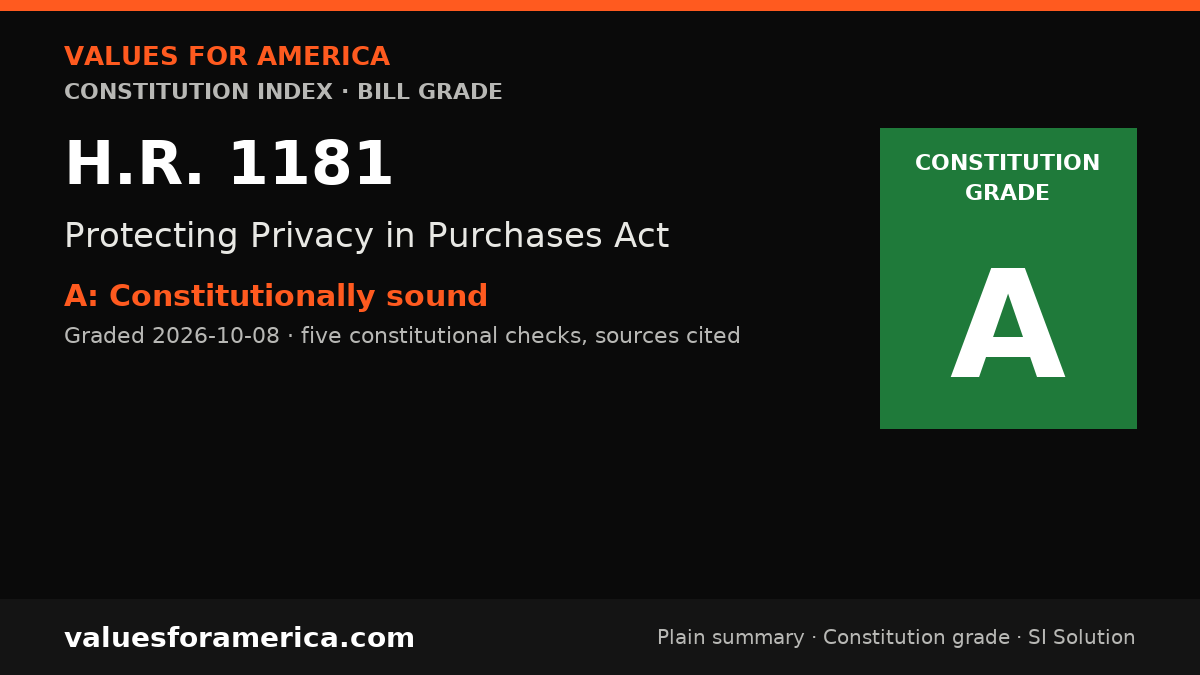
“VFA Constitution grade”
Constitutionally sound
Graded 2026-10-08
SI-generated grade · five published checks · not individually reviewed by a person · methodology
HR 1181 is a narrow exercise of the Commerce Clause to bar national card networks from singling out firearms retailers with distinct merchant codes, with DOJ enforcement. It claims no new federal police power, infringes no right, expands individual privacy for lawful purchasers, and addresses an inherently interstate network that states cannot uniformly govern.
-
✓ Passes · Enumerated powers
Congress has explicit authority to regulate interstate payment card networks under Article I, Section 8, Clause 3 (Commerce Clause), as these networks facilitate commercial transactions across state lines. The Necessary and Proper Clause in Article I, Section 8, Clause 18 supports prohibiting discriminatory merchant coding as a means of executing that commerce regulation. -
✓ Passes · Bill of Rights
The bill restricts no protected right; it protects them. It does not compel or abridge speech under the First Amendment, as merchant category codes assigned by private networks are commercial classification, not protected expression of the networks, and Congress may regulate deceptive or discriminatory commercial coding under its commerce power. It supports rather than infringes the Second Amendme… -
✓ Passes · Individual sovereignty
The bill expands rather than restricts individual sovereignty. It prevents the creation of a distinct financial trail for lawful firearms purchases, protecting the individual's ability to exercise Second Amendment rights, associational privacy under the First Amendment, and personal property choices without government or corporate surveillance chill. It imposes no burden on what a person may buy, … -
✓ Passes · Decentralization
Payment card networks operate in interstate commerce across all 50 states. (1) Individuals cannot set network-wide merchant codes. (2) Local communities cannot regulate national payment networks. (3) States cannot effectively handle this without federal involvement because a patchwork of 50 conflicting coding rules would burden interstate commerce. (4) The bill does not consolidate upward beyond t… -
✓ Passes · Due process and takings
The bill takes no property and imposes no criminal penalty without process. Enforcement by the Department of Justice with annual reporting to Congress presumes use of existing civil enforcement procedures subject to procedural due process under the Fifth Amendment (notice and opportunity to be heard) and judicial review under Article III. No presumption of innocence is reversed, and no physical or…
Sources: Congress.gov: HR 1181 summary
Report an error in this grade
What should pass
“VFA SI Solution”
No solution yet
A sourced SI draft appears here once it passes automated checks (Constitution citation, source verification, independent SI critic). How publication works.
Related on VFA

For journalists and bloggers
“Embed this grade”
Free to use with the link back. The badge and card update when the grade changes. Embed terms →
