H.R. 1156 explained · 119th Congress · Pending in Congress
Pandemic Unemployment Fraud Enforcement Act
Cosponsors: 25 (0 D, 25 R) · per Congress.gov, 2026-10-12
Introduced: 2025-02-10
Latest action (2025-03-13): Read the second time. Placed on Senate Legislative Calendar under General Orders. Calendar No. 29.
What H.R. 1156 does, in plain terms
Pandemic Unemployment Fraud Enforcement Act This bill extends from 5 to 10 years the statute of limitations for federal criminal charges or civil enforcement actions for fraud related to several unemployment insurance programs that were established during the COVID-19 pandemic. The extension applies to Pandemic Unemployment Assistance, Federal Pandemic Unemployment Compensation, Mixed Earners Unemployment Compensation, and Pandemic Emergency Unemployment Compensation. The bill extends the statute of limitations for (1) criminal charges related to fraud, including aggravated identity theft, wire fraud, and conspiracy to commit fraud; and (2) civil actions involving false claims. However, the bill does not apply to a criminal prosecution or civil enforcement action if the applicable statute of limitations expired before the date of the bill's enactment. Additionally, the bill rescinds specified unobligated funds that were provided in the American Rescue Plan Act of 2021 to the Department of Labor for anti-fraud and program integrity activities.
Official summary by the Congressional Research Service, via Congress.gov.
Constitution Index
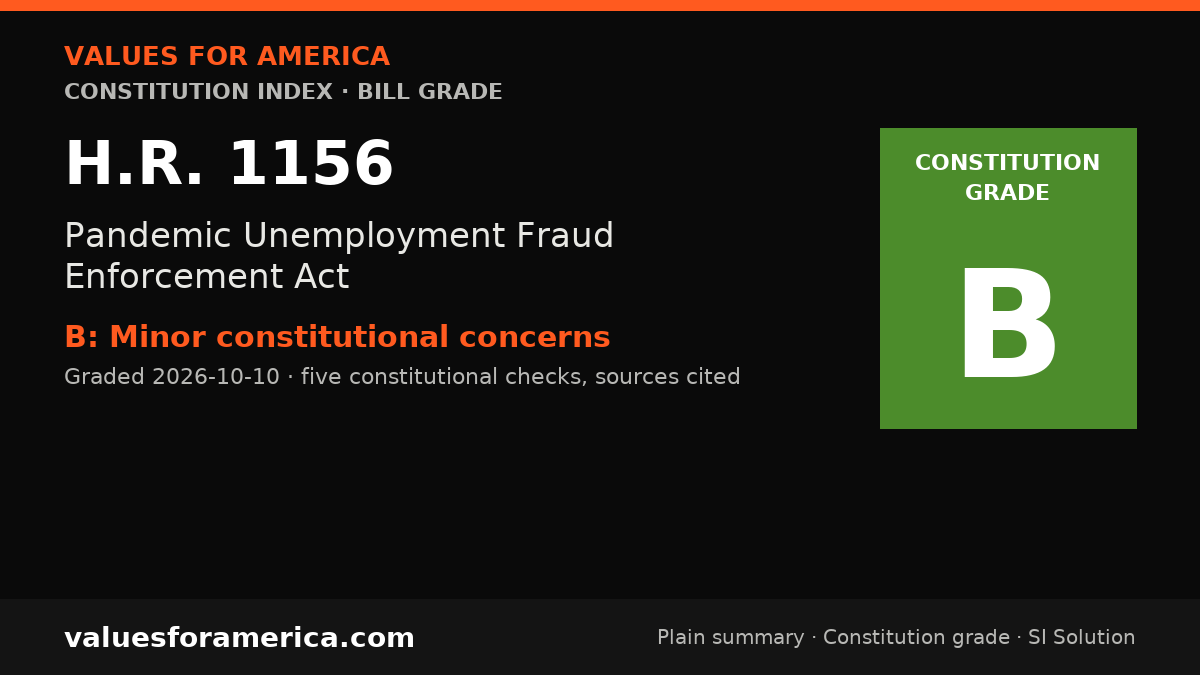
“VFA Constitution grade”
Minor constitutional concerns
Graded 2026-10-10
SI-generated grade · five published checks · not individually reviewed by a person · methodology
The bill is a federal response to fraud in federally-created unemployment programs, which falls within Congress's spending and necessary-and-proper powers. It extends statutes of limitations for fraud crimes and civil actions, which is a procedural change that does not infringe on substantive rights. The rescission of unobligated funds is a routine exercise of Congress's appropriations power. The main constitutional tension is the retroactive extension of limitations periods, which, while generally permissible for procedural changes, raises due process concerns if applied to cases where the original period has already expired. The bill explicitly avoids that by not applying to expired limitations periods, mitigating the concern. The bill does not centralize power beyond the federal level because the programs are federally funded and administered, and the fraud involves federal funds. Overall, the bill is mostly sound, with minor due process considerations that are adequately addressed.
-
✓ Passes · Enumerated powers
Congress has the power to enact laws necessary and proper for executing its enumerated powers, including the power to spend for the general welfare (Article I, Section 8, Clause 1) and to regulate interstate commerce (Article I, Section 8, Clause 3). The unemployment programs in question were created by Congress under these powers, and extending statutes of limitations for fraud related to those p… -
✓ Passes · Bill of Rights
The bill does not infringe on any of the first ten amendments. It does not restrict speech, religion, assembly, press, or petition. It does not affect the right to bear arms, quartering, search and seizure, self-incrimination, due process, fair trial, jury trial, cruel and unusual punishment, or unenumerated rights. The extension of statutes of limitations is a procedural change that does not impl… -
✓ Passes · Individual sovereignty
The bill does not restrict what individuals can do with their person, property, speech, labor, or belief. It only extends the time during which the government can bring charges for fraud. Fraud is not a protected activity, and the government has a compelling interest in prosecuting fraud. The bill does not impose new restrictions on individual freedom; it merely extends the enforcement window for … -
✓ Passes · Decentralization
The bill concerns fraud in federal unemployment programs that were created and funded by the federal government. The federal government has a direct interest in ensuring the integrity of its own programs. States administer these programs, but the federal government provides the funds and sets the rules. Extending the statute of limitations for fraud is a federal function because the fraud involves… -
✓ Passes · Due process and takings
The bill extends the statute of limitations for fraud crimes and civil actions. The Supreme Court has held that extending a statute of limitations before the original period expires is generally permissible because it does not deprive a defendant of a vested right. The bill explicitly does not apply to cases where the statute of limitations has already expired, which avoids ex post facto concerns.…
Sources: Congress.gov: HR 1156 summary
Report an error in this grade
What should pass
“VFA SI Solution”
No solution yet
A sourced SI draft appears here once it passes automated checks (Constitution citation, source verification, independent SI critic). How publication works.
Related on VFA

For journalists and bloggers
“Embed this grade”
Free to use with the link back. The badge and card update when the grade changes. Embed terms →
