H.R. 1122 explained · 119th Congress · Pending in Congress
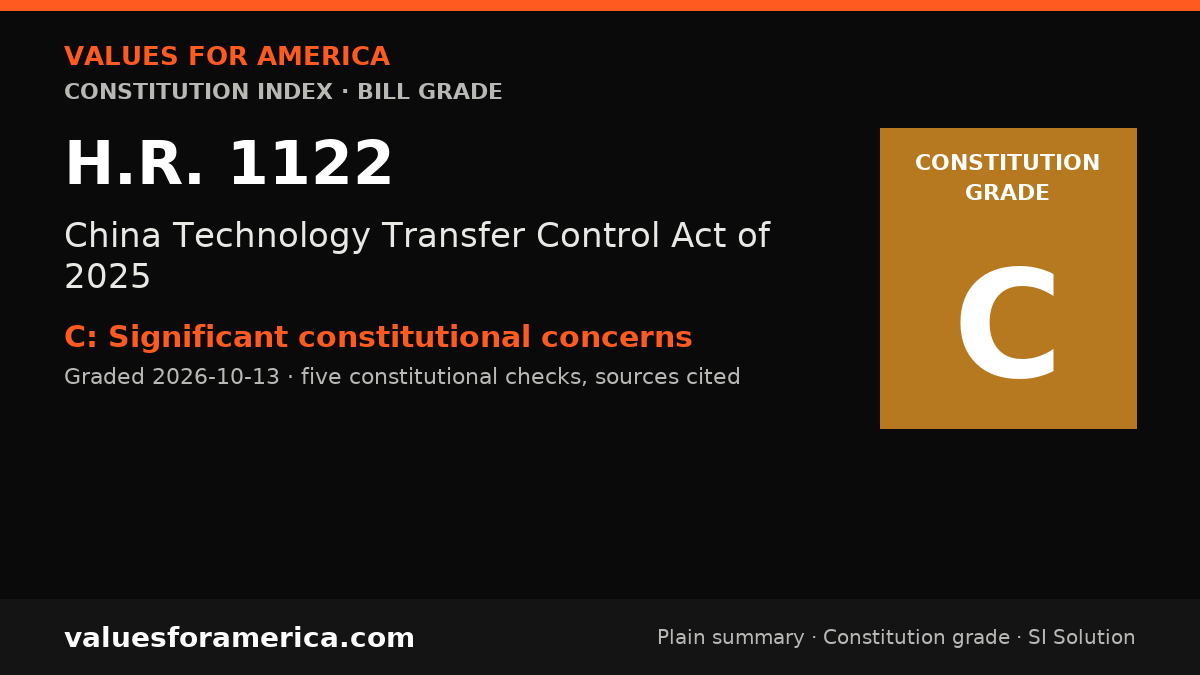
China Technology Transfer Control Act of 2025
Cosponsors: none · per Congress.gov, 2026-10-12
Introduced: 2025-02-07
Latest action (2025-02-07): Referred to the Committee on Foreign Affairs, and in addition to the Committee on Ways and Means, for a period to be subsequently determined by the Speaker, in each case for consideration of such provisions as fall within the jurisdiction of the committee concerned.
What H.R. 1122 does, in plain terms
China Technology Transfer Control Act of 2025 This bill controls exports of certain national interest technology and intellectual property to China. Specifically, covered technology or intellectual property includes items that (1) would contribute significantly to the Chinese military to the detriment of U.S. national security, (2) are included in a designated list of product components compiled by the Office of the U.S. Trade Representative (USTR), or (3) are used by China to violate human rights or religious liberties. The President must control exports to China of any covered technology or intellectual property. Further, the President must sanction (1) a foreign person who sells to China or purchases from China any covered item, and (2) a Chinese person who knowingly uses a covered item provided to them in violation of U.S. export control law. The USTR must compile a list of certain products from China that that are subject to the bill because they either receive designated support from the Chinese government or are used by China to violate human rights or religious liberties. The bill requires the USTR to include products from certain industries (e.g., civil aircraft, artificial intelligence, semiconductors, and biotechnology) on the list.
Official summary by the Congressional Research Service, via Congress.gov.
Constitution Index
“VFA Constitution grade”
Significant constitutional concerns
Graded 2026-10-13
SI-generated grade · five published checks · not individually reviewed by a person · methodology
The bill raises significant constitutional concerns regarding the delegation of legislative power to the executive, potential overbreadth in restricting trade and speech, and the extraterritorial application of U.S. law. While the federal government has clear authority over foreign commerce and national security, the bill's vague standards and mandatory sanctions may infringe on due process and individual liberties. The bill also centralizes decision-making in the federal executive, though some coordination with states is possible. Overall, the bill requires structural revisions to align with constitutional limits.
-
✓ Passes · Enumerated powers
The federal government has explicit authority to regulate foreign commerce under Article I, Section 8, Clause 3 (the Commerce Clause), and to enact laws necessary and proper for carrying out foreign affairs and national security. Export controls and sanctions on foreign entities fall squarely within this power. The bill's focus on technology transfer to China is a legitimate exercise of the foreig… -
✗ Concern · Bill of Rights
The bill's provisions may infringe on the First Amendment by restricting the exchange of information and technology that could be considered protected speech or expressive conduct. The vague definition of 'covered technology' and the mandatory sanctions for 'knowingly using' such items could chill legitimate academic, scientific, and commercial speech. Additionally, the bill's designation of produ… -
✗ Concern · Individual sovereignty
The bill restricts the ability of individuals and businesses to engage in voluntary transactions involving technology and intellectual property. While the government has a compelling interest in national security, the bill's broad and vague definitions could restrict legitimate activities without a clear, compelling justification. The burden is on the government to narrowly tailor restrictions, an… -
✗ Concern · Decentralization
The bill consolidates decision-making at the federal executive level, with the President and USTR having broad discretion to designate covered technology and products. While foreign trade and national security are inherently federal matters, the bill does not allow for input from states or local communities, and it centralizes power in the executive branch. The four-question test: (1) Individuals … -
✗ Concern · Due process and takings
The bill may violate the Fifth Amendment's Due Process Clause by imposing sanctions and export controls without adequate notice and hearing. The designation of 'covered technology' and the compilation of product lists by the USTR lack clear standards and procedural safeguards. The bill also requires the President to sanction foreign persons and Chinese individuals, potentially depriving them of pr…
Sources: Congress.gov: HR 1122 summary
Report an error in this grade
What should pass
“VFA SI Solution”
No solution yet
A sourced SI draft appears here once it passes automated checks (Constitution citation, source verification, independent SI critic). How publication works.
Related on VFA

For journalists and bloggers
“Embed this grade”
Free to use with the link back. The badge and card update when the grade changes. Embed terms →
