H.R. 1118 explained · 119th Congress · Pending in Congress
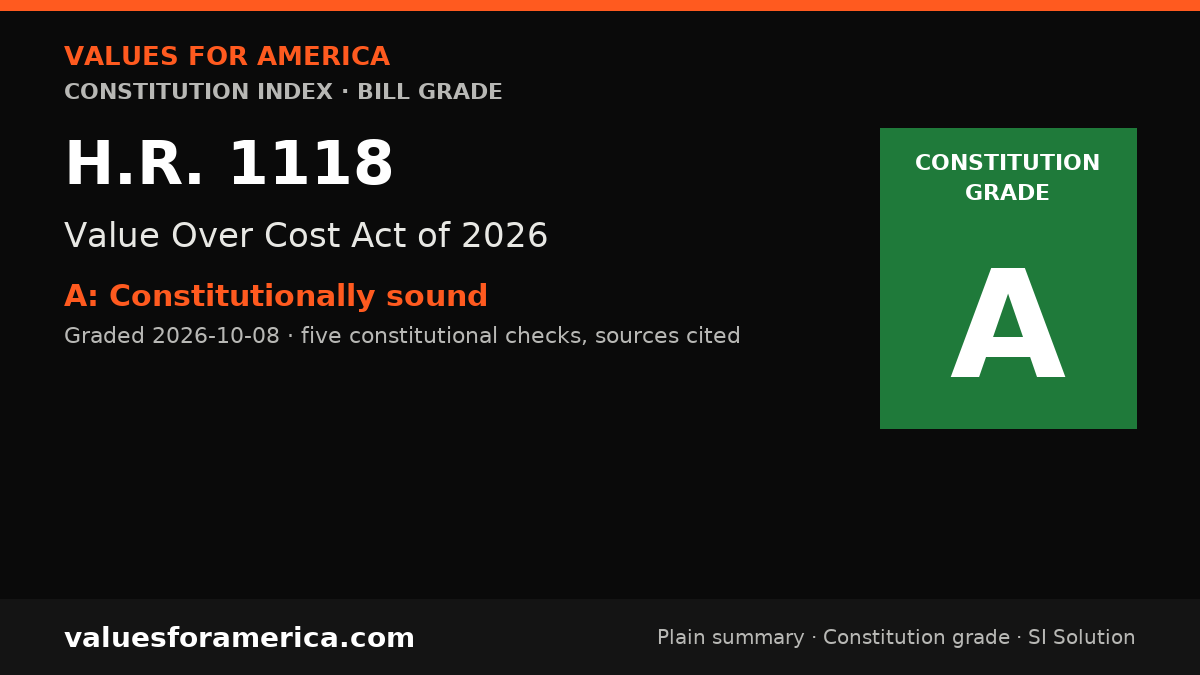
Value Over Cost Act of 2026
Cosponsors: 1 (1 D, 0 R) · per Congress.gov, 2026-10-15
Introduced: 2025-02-07
Latest action (2026-07-22): Received in the Senate and Read twice and referred to the Committee on Homeland Security and Governmental Affairs.
What H.R. 1118 does, in plain terms
Value Over Cost Act of 2025 This bill specifies that contracts and orders under the multiple award schedule program of the General Services Administration (GSA) may be evaluated on best value, rather than lowest overall cost, if the GSA determines that to be in the best interests of the federal government. (Best value allows consideration of non-cost factors when evaluating contract proposals to determine the offer that provides the greatest overall benefit. The GSA's multiple award schedules provide federal agencies with a simplified process for obtaining commercial supplies and commercial services at prices associated with volume buying.)
Official summary by the Congressional Research Service, via Congress.gov.
Constitution Index
“VFA Constitution grade”
Constitutionally sound
Graded 2026-10-08
SI-generated grade · five published checks · not individually reviewed by a person · methodology
Routine internal federal procurement reform within Congress's spending and Necessary and Proper powers. It infringes no rights, restricts no individual liberty, takes no property, and centralizes nothing beyond the Federal Government buying for itself.
-
✓ Passes · Enumerated powers
Congress has explicit authority to manage federal property and spending and to make laws necessary to execute federal powers. Authority rests on Article I, Section 8, Clause 1 for providing for the common Defence and general Welfare through procurement spending, and Article I, Section 8, Clause 18, the Necessary and Proper Clause, to prescribe how executive agencies buy commercial supplies and ser… -
✓ Passes · Bill of Rights
The bill does not restrict speech, religion, press, assembly, arms, searches, trial rights, or other protections in the first ten Amendments. It changes only the evaluation standard for General Services Administration multiple-award contracts from lowest cost to best value when in the best interests of the federal government. No First Amendment, Second Amendment, Fourth Amendment, or other Bill of… -
✓ Passes · Individual sovereignty
The bill restricts no personal conduct involving person, property, speech, labor, or belief. It directs how the government evaluates its own contract offers. Private vendors remain free to bid or not bid, and no citizen must speak, refrain from speaking, or surrender property or labor. No individual-sovereignty justification is required because no individual liberty is burdened. -
✓ Passes · Decentralization
This concerns the Federal Government's own purchasing process. Individuals, counties, and states cannot conduct federal agency procurement for commercial supplies and services. The minimum necessary level is federal because the buyer is the Federal Government itself. The bill does not transfer state, local, or private decisions upward and does not violate the Tenth Amendment; it only gives GSA dis… -
✓ Passes · Due process and takings
No deprivation of life, liberty, or property without due process under the Fifth Amendment and Fourteenth Amendment, no presumption-of-innocence violation, and no taking under the Fifth Amendment Takings Clause. Contractors remain subject to competitive procedures with notice and award standards; unsuccessful offerors lose no vested property right, and no property is seized without just compensati…
Sources: Congress.gov: HR 1118 summary
Report an error in this grade
What should pass
“VFA SI Solution”
No solution yet
A sourced SI draft appears here once it passes automated checks (Constitution citation, source verification, independent SI critic). How publication works.
Related on VFA

For journalists and bloggers
“Embed this grade”
Free to use with the link back. The badge and card update when the grade changes. Embed terms →
