H.R. 1049 explained · 119th Congress · Pending in Congress
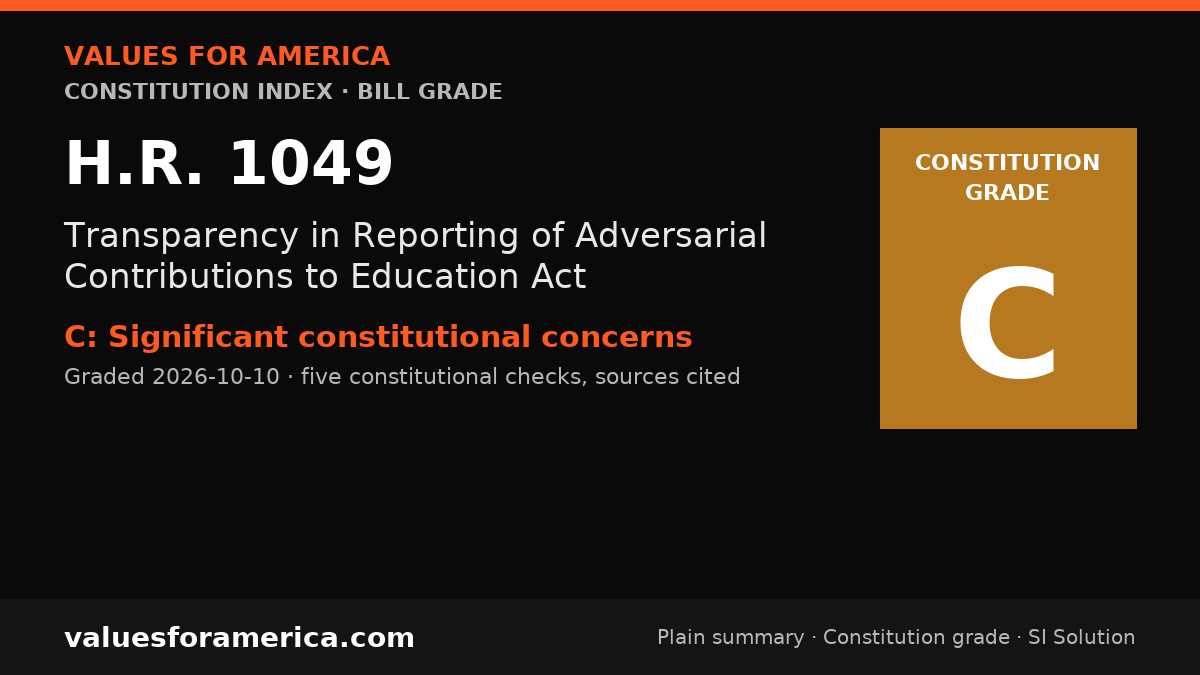
Transparency in Reporting of Adversarial Contributions to Education Act
Cosponsors: 3 (0 D, 3 R) · per Congress.gov, 2026-10-10
Introduced: 2025-02-06
Latest action (2025-12-04): Received in the Senate and Read twice and referred to the Committee on Health, Education, Labor, and Pensions.
What H.R. 1049 does, in plain terms
Transparency in Reporting of Adversarial Contributions to Education Act This bill requires each local educational agency (LEA), as a condition of receiving federal elementary and secondary education funds, to ensure that each elementary and secondary school served by the LEA notifies parents of their rights to request and receive information regarding foreign influence (e.g., influence by China) in schools. These rights include the right to review (and make copies of at no cost) any curricular or professional development material used at the school that was obtained using funds received from a foreign government or a foreign entity of concern; know, by written response, how many school personnel are compensated using funds received from a foreign government or a foreign entity of concern; and know, by written response, information about funding from or agreements (e.g., contracts) with a foreign country or a foreign entity of concern. Parents must submit a written request for this information. Each school must post on a publicly accessible website (or otherwise widely disseminate to the public) a summary notice of parental rights under the bill. The bill requires the Department of Education to notify state educational agencies (SEAs) about the bill's requirements. Each SEA must, as a condition of receiving federal elementary and secondary education funds, notify LEAs about the bill's requirements.
Official summary by the Congressional Research Service, via Congress.gov.
Constitution Index
“VFA Constitution grade”
Significant constitutional concerns
Graded 2026-10-10
SI-generated grade · five published checks · not individually reviewed by a person · methodology
This bill raises significant constitutional concerns primarily because it conditions federal education funding on state and local compliance with specific parental notification requirements regarding foreign influence in schools. While the federal government has broad spending power under Article I, Section 8, Clause 1, the conditions imposed here may be unduly coercive and infringe on state sovereignty under the Tenth Amendment. Additionally, the bill's targeting of specific foreign entities (e.g., China) raises First Amendment concerns by potentially chilling speech and academic freedom. The bill fails the decentralization test by consolidating decision-making at the federal level for matters that could be handled locally. Overall, the bill has significant issues requiring structural rewrite to align with constitutional principles.
-
✗ Concern · Enumerated powers
The federal government's power over education is not enumerated in Article I, Section 8. The bill relies on the Spending Clause (Article I, Section 8, Clause 1) to condition federal funds on state compliance. However, the conditions are not clearly related to the purpose of the funding (elementary and secondary education) and may be seen as an attempt to regulate local educational policy indirectl… -
✗ Concern · Bill of Rights
The bill's requirement to notify parents about 'foreign influence' specifically from countries like China may violate the First Amendment by chilling academic freedom and the free exchange of ideas in schools. It could lead to self-censorship by educators and schools to avoid scrutiny, infringing on the rights of students and teachers to receive and impart information. Additionally, the bill's foc… -
✓ Passes · Individual sovereignty
The bill enhances individual sovereignty by empowering parents with the right to request information about foreign influence in their children's schools. This does not restrict personal freedoms but rather provides transparency and choice. The burden is on the government to justify any restrictions, and here the bill expands parental rights without imposing direct restrictions on individuals. -
✗ Concern · Decentralization
The bill fails the decentralization test. While parents and local communities could handle transparency about foreign influence without federal involvement, the bill mandates federal conditions on funding, consolidating decision-making upward. It fails three of the four questions: local communities could handle this without state involvement, states could handle this without federal involvement, a… -
✓ Passes · Due process and takings
The bill does not bypass due process or take property without just compensation. It provides a clear process for parents to request information and requires schools to respond in writing. There is no deprivation of property or liberty without a hearing. The conditions on funding are prospective and do not retroactively affect existing rights.
Sources: Congress.gov: HR 1049 summary
Report an error in this grade
What should pass
“VFA SI Solution”
No solution yet
A sourced SI draft appears here once it passes automated checks (Constitution citation, source verification, independent SI critic). How publication works.
Related on VFA

For journalists and bloggers
“Embed this grade”
Free to use with the link back. The badge and card update when the grade changes. Embed terms →
