H.R. 1048 explained · 119th Congress · Pending in Congress
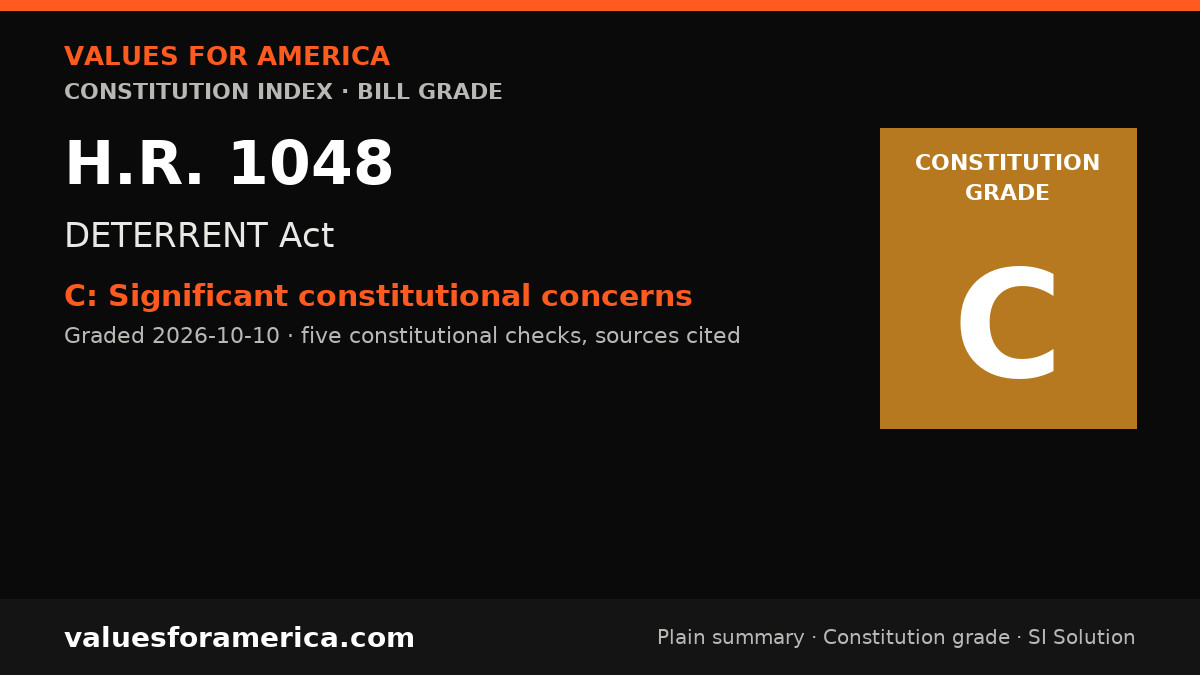
DETERRENT Act
Cosponsors: 21 (2 D, 19 R) · per Congress.gov, 2026-10-12
Introduced: 2025-02-06
Latest action (2025-03-31): Received in the Senate and Read twice and referred to the Committee on Health, Education, Labor, and Pensions.
What H.R. 1048 does, in plain terms
Defending Education Transparency and Ending Rogue Regimes Engaging in Nefarious Transactions Act or the DETERRENT Act This bill expands oversight and disclosure requirements related to foreign sources and institutions of higher education (IHEs). Specifically, the bill requires an IHE to annually disclose to the Department of Education (ED) any year in which the IHE receives a gift from a foreign country of concern (e.g., China or Russia) or foreign entity of concern of any dollar amount; receives a gift or contract from a foreign source (other than a foreign country of concern or foreign entity of concern) that is valued at $50,000 or more, considered alone or in combination with all other gifts or contracts within a calendar year (current disclosure threshold is $250,000 or more), or which has an undetermined monetary value; enters into a contract with a foreign country of concern or foreign entity of concern after receiving a waiver for such contract; or is substantially controlled by a foreign source. Additionally, the bill prohibits IHEs from entering into contracts with a foreign country of concern or with a foreign entity of concern without obtaining a waiver, requires certain IHEs to disclose gifts or contracts between covered individuals (e.g., researchers) and foreign sources, and requires private IHEs with specified assets or investments to file annual investment disclosure reports. The bill requires ED to investigate possible violations of this bill and outlines the various penalties for each violation. Penalties may include losing eligibility for federal student financial aid.
Official summary by the Congressional Research Service, via Congress.gov.
Constitution Index
“VFA Constitution grade”
Significant constitutional concerns
Graded 2026-10-10
SI-generated grade · five published checks · not individually reviewed by a person · methodology
The DETERRENT Act raises significant constitutional concerns. While Congress has broad authority over interstate commerce and the spending power, the bill's expansive disclosure requirements and prohibitions on contracts with foreign entities of concern implicate First Amendment associational and expressive freedoms, and may overreach into areas traditionally reserved to the states and private institutions. The bill's delegation of broad investigative and penal authority to the Department of Education, without clear due process safeguards, further compounds these issues. The bill is not a direct violation, but it requires structural revisions to align with constitutional limits.
-
✓ Passes · Enumerated powers
Congress has authority under Article I, Section 8, Clause 3 (Commerce Clause) to regulate transactions with foreign entities, and under the Spending Clause (Article I, Section 8, Clause 1) to attach conditions to federal funding for higher education. The bill's requirements on institutions receiving federal funds are within these powers. However, the bill's application to private institutions that… -
✗ Concern · Bill of Rights
The bill's disclosure requirements for gifts and contracts from foreign sources, especially those involving 'covered individuals' such as researchers, may compel speech and association in violation of the First Amendment. Mandatory disclosure of donor identities and affiliations can chill protected associational rights, as recognized in NAACP v. Alabama (1958). The prohibition on contracts with fo… -
✗ Concern · Individual sovereignty
The bill restricts the ability of individuals (researchers, faculty) to engage in contracts and collaborations with foreign sources without government oversight. This burdens individual autonomy in professional and academic pursuits. The government must demonstrate a compelling interest and narrowly tailor the restrictions; the bill's broad scope, including any gift of any amount from a country of… -
✗ Concern · Decentralization
The bill consolidates oversight and decision-making at the federal level, requiring institutions to report to the Department of Education and obtain waivers from federal authorities. This fails the decentralization test: (1) individuals cannot handle this without government involvement, as the bill mandates federal oversight; (2) local communities cannot handle this without state involvement; (3) … -
✗ Concern · Due process and takings
The bill grants the Department of Education authority to investigate violations and impose penalties, including loss of federal student aid eligibility. This could deprive institutions of property (federal funds) without adequate procedural safeguards. The bill does not specify clear procedures for hearings, appeals, or judicial review, raising due process concerns under the Fifth Amendment. Addit…
Sources: Congress.gov: HR 1048 summary
Report an error in this grade
What should pass
“VFA SI Solution”
No solution yet
A sourced SI draft appears here once it passes automated checks (Constitution citation, source verification, independent SI critic). How publication works.
Related on VFA

For journalists and bloggers
“Embed this grade”
Free to use with the link back. The badge and card update when the grade changes. Embed terms →
