H.R. 10451 explained · 119th Congress · Pending in Congress
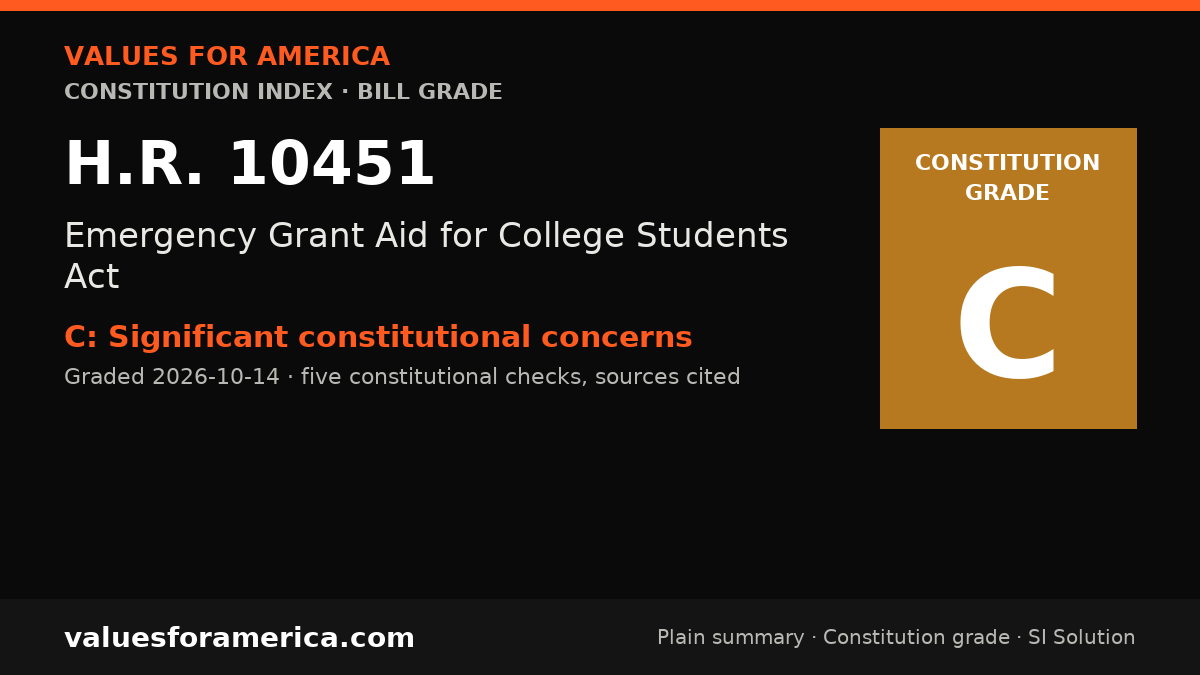
Emergency Grant Aid for College Students Act
Cosponsors: none · per Congress.gov, 2026-10-14
Introduced: 2026-09-16
Latest action (2026-09-16): Referred to the House Committee on Education and Workforce.
What H.R. 10451 does, in plain terms
Emergency Grant Aid for College Students Act This bill establishes a grant program for emergency student financial aid. It also prohibits the Department of Education (ED) from transferring functions related to this program to other federal agencies. Specifically, the bill directs ED to establish a grant program for institutions of higher education to provide emergency financial aid grants to students. The bill also prohibits ED from entering into or carrying out interagency agreements related to this program. This prohibition applies to the transfer of functions such as administering or operating programs, making grants, carrying out technical assistance, enforcing rights and requirements (e.g., data collection requirements), conducting administrative and oversight functions, and monitoring grantees.
Official summary by the Congressional Research Service, via Congress.gov.
Constitution Index
“VFA Constitution grade”
Significant constitutional concerns
Graded 2026-10-14
SI-generated grade · five published checks · not individually reviewed by a person · methodology
The bill proposes a federal grant program for emergency student financial aid, which raises significant constitutional concerns regarding enumerated powers and federal overreach into education, a domain traditionally reserved to the states under the Tenth Amendment. While the Spending Clause may provide a basis for conditional grants, the program's broad scope and lack of clear connection to enumerated powers, combined with the centralization of decision-making at the federal level, warrant a grade of C. The bill does not directly infringe on individual rights, but it does consolidate authority over education, which is a significant structural issue.
-
✗ Concern · Enumerated powers
The federal government's authority to enact this bill is questionable. Education is not among the enumerated powers in Article I, Section 8. While the Spending Clause (Article I, Section 8, Clause 1) allows Congress to tax and spend for the general welfare, the Supreme Court has held that spending must be for the 'general welfare' and not merely for local concerns. Emergency student aid, while arg… -
✓ Passes · Bill of Rights
The bill does not appear to infringe upon any of the rights protected by the Bill of Rights. It does not restrict speech, religion, assembly, press, petition, the right to bear arms, or any other enumerated right. It does not involve searches, seizures, self-incrimination, or cruel and unusual punishment. The program is a voluntary grant program, and no rights are directly abridged. -
✓ Passes · Individual sovereignty
The bill does not restrict individual liberty. It provides a benefit (grants) without imposing any direct restrictions on individuals. Students are free to apply or not apply for the grants, and institutions are free to participate or not. The burden of proof is on the government to justify restrictions, and here there are no restrictions on individual action. -
✗ Concern · Decentralization
The bill fails the decentralization test. (1) Individuals and families cannot handle the provision of emergency aid to all college students without government involvement, but they can handle their own emergencies. (2) Local communities and counties could potentially handle emergency student aid through local charities, community colleges, or local government programs. (3) States are clearly capab… -
✓ Passes · Due process and takings
The bill does not bypass due process or take property without just compensation. It establishes a grant program, which is a voluntary benefit, not a deprivation of life, liberty, or property. There is no issue of procedural or substantive due process, and no takings are involved.
Sources: Congress.gov: HR 10451 summary
Report an error in this grade
What should pass
“VFA SI Solution”
SI-generated · passed automated checks (Constitution citation, source verification, independent SI critic) · not individually reviewed by a person · Report an error: hello@valuesforamerica.com
Temporary Emergency Student Grant Fund With Cap and Sunset
Generated by VFA SI Solutions
Help college students stay enrolled when a sudden expense hits, by having colleges provide small emergency grants.
Bipartisan rationale: VFA assesses this draft gives Republicans enforceable fiscal discipline, state and campus control, and a ban on open-ended federal administration, with capped funds and a sunset. It gives Democrats rapid help for students facing sudden costs that can force them to drop out, with clear grant rules and public reporting on whether funds reached students in need.
Possible legislative path: In the House and Senate, support may come from members focused on college completion and workforce readiness, while opposition may come from members concerned about federal education spending and program duplication.
Source limits: The official summary does not supply the full bill text, eligibility rules, appeal rights, cost effects, or current law. Readers should verify grant terms, student eligibility, administrative limits, and program status at the Congress.gov bill page before treating this draft as a full account.
Article I, Section 8, Clause 1 Article I, Section 8, Clause 18 Amendment X Amendment V
Report an error in this Solution
Citizen Consensus
“Do you support this VFA SI Solution?”
One vote per verified account; you can change it any time. Only verified accounts count, results publish once 30 verified people have voted, and state and district results count only people who attested a home ZIP code. How this works.
Email verification is not switched on yet, so no vote counts toward results yet. Votes cast now are saved and count once the voter verifies their email address.
Sign in or create a free account to vote.
Add a short reason (optional)
/280 · no links or contact details · reasons are reviewed before anyone sees them, and many never are shown.
Your vote is saved but held out of published results by an automated integrity check (for example, several accounts voting from one browser).
Your vote is saved. It will count once you verify your email address. Verify on your account page.
Your vote counts nationally. Add your home ZIP code to count in your state and district too.
Your vote counts nationally and in .
Reason saved privately; it is shown only if it passes review.
Verified participants nationwide · n =
Self-selected participants, not a random sample; ± is the 95% sampling margin.
Not enough verified votes yet. Results publish at verified votes.
A sudden surge of votes on this item was flagged and is under review; votes from new accounts in that surge are held out until it is resolved.
Related on VFA

For journalists and bloggers
“Embed this grade”
Free to use with the link back. The badge and card update when the grade changes. Embed terms →
