H.R. 10410 explained · 119th Congress · Pending in Congress
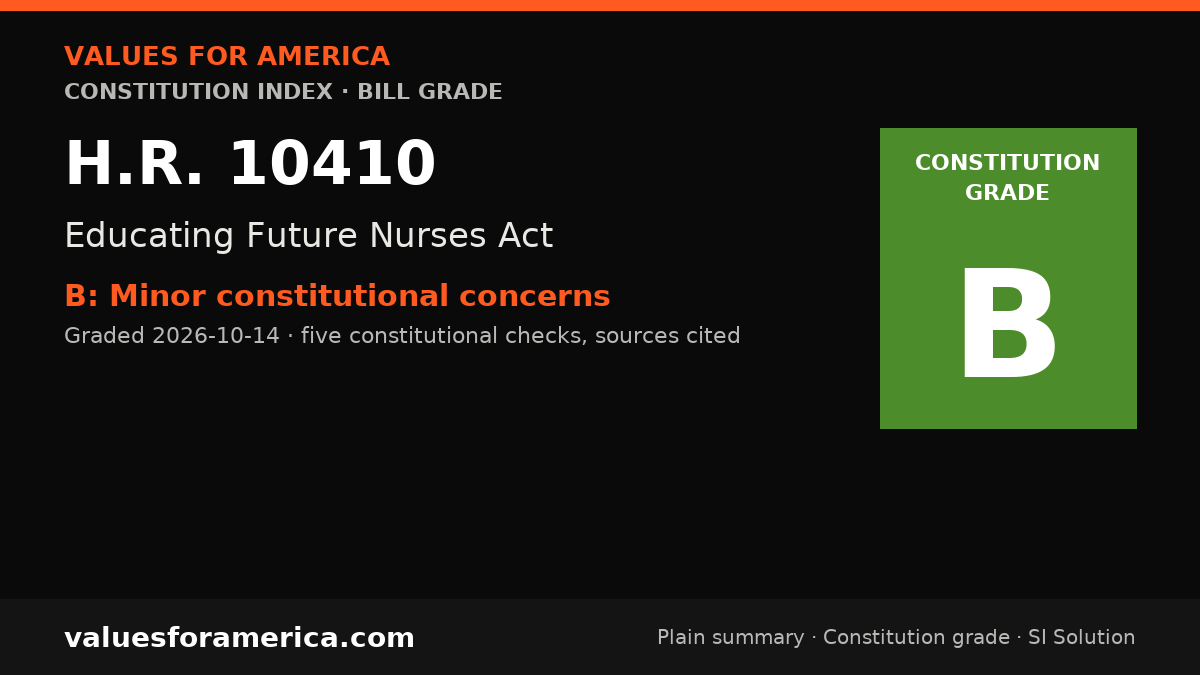
Educating Future Nurses Act
Cosponsors: 2 (1 D, 1 R) · per Congress.gov, 2026-10-14
Introduced: 2026-09-16
Latest action (2026-09-16): Referred to the Committee on Ways and Means, and in addition to the Committee on Energy and Commerce, for a period to be subsequently determined by the Speaker, in each case for consideration of such provisions as fall within the jurisdiction of the committee concerned.
What H.R. 10410 does, in plain terms
Educating Future Nurses Act This bill establishes a permanent National Graduate Nurse Education Program to provide clinical training to advanced practice registered nurses (APRNs), particularly with respect to services for Medicare beneficiaries. (The Centers for Medicare & Medicaid Services conducted a similar demonstration program from 2012-2016.) Under the program, hospitals may receive payments for the costs associated with providing clinical education to APRNs. Hospitals must partner with nursing schools, regional hospitals or health systems, or non-hospital community providers (e.g., nursing homes) to provide qualifying clinical education. Such education must consist of clinical experience in primary, preventive, transitional, acute, and chronic care, as well as other services that are appropriate for Medicare beneficiaries; at least half of this education must be provided in non-hospital, community-based settings. Participating hospitals must report annually on their programs, subject to payment reductions.
Official summary by the Congressional Research Service, via Congress.gov.
Constitution Index
“VFA Constitution grade”
Minor constitutional concerns
Graded 2026-10-14
SI-generated grade · five published checks · not individually reviewed by a person · methodology
The bill is mostly sound but has minor tensions with the enumerated powers doctrine and decentralization principles. It uses the spending power to incentivize nurse training, which is within federal authority, but the permanent nature of the program and its detailed mandates push against the Tenth Amendment's reservation of powers to the states.
-
✓ Passes · Enumerated powers
The bill operates through Medicare payments, which is an exercise of Congress's spending power under Article I, Section 8, Clause 1 (the General Welfare Clause). The Supreme Court has long held that Congress may attach conditions to federal spending to achieve policy goals, provided the conditions are clear and related to the federal interest. Here, the program is tied to Medicare beneficiary serv… -
✓ Passes · Bill of Rights
The bill imposes no restrictions on speech, religion, assembly, press, petition, arms, quartering, search and seizure, self-incrimination, due process, trial rights, jury rights, cruel and unusual punishment, or unenumerated rights. It is a funding and training program that does not infringe any provision of the Bill of Rights. -
✓ Passes · Individual sovereignty
The bill does not restrict what individuals can do with their person, property, speech, labor, or belief. It creates a voluntary program for hospitals and nursing schools to receive payments for training APRNs. No individual is compelled to participate, and no personal freedoms are curtailed. The burden of justification is not triggered because there is no restriction on individual liberty. -
✗ Concern · Decentralization
The bill fails the decentralization test on two of four questions. (1) Individual or family: An individual or family cannot handle the systemic training of advanced practice nurses across a region; this requires institutional coordination. (2) Local community or county: A local community or county could handle nurse training through local hospitals and nursing schools without federal involvement. … -
✓ Passes · Due process and takings
The bill does not bypass due process or take property without just compensation. It establishes a voluntary payment program with clear reporting requirements and payment reductions for non-compliance. Hospitals choose to participate and receive notice of the conditions. There is no deprivation of life, liberty, or property without a hearing, and no physical or regulatory taking of private property…
Sources: Congress.gov: HR 10410 summary
Report an error in this grade
What should pass
“VFA SI Solution”
No solution yet
A sourced SI draft appears here once it passes automated checks (Constitution citation, source verification, independent SI critic). How publication works.
Related on VFA

For journalists and bloggers
“Embed this grade”
Free to use with the link back. The badge and card update when the grade changes. Embed terms →
