H.R. 10346 explained · 119th Congress · Pending in Congress
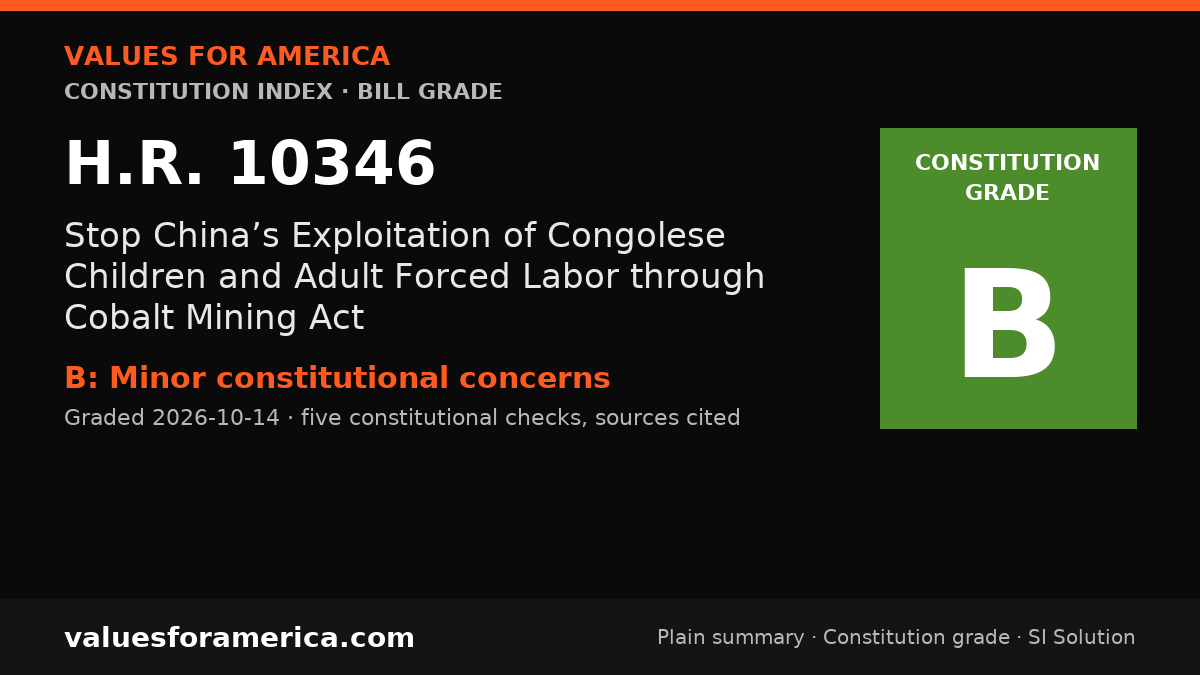
Stop China’s Exploitation of Congolese Children and Adult Forced Labor through Cobalt Mining Act
Cosponsors: none · per Congress.gov, 2026-10-14
Introduced: 2026-09-10
Latest action (2026-09-16): Ordered to be Reported in the Nature of a Substitute by the Yeas and Nays: 32 - 8.
What H.R. 10346 does, in plain terms
Stop China’s Exploitation of Congolese Children and Adult Forced Labor through Cobalt Mining Act This bill requires the Forced Labor Enforcement Task Force to complete and submit to Congress the results of an investigation into the alleged use of forced labor in the cobalt mining industry of the Democratic Republic of the Congo (DRC). Specifically, the task force must (1) submit to Congress strategies for preventing the importation of cobalt mined using forced labor, and (2) provide semiannual briefings to Congress. This requirement ceases to have effect on the earlier of (1) eight years after the date of enactment, or (2) the date on which the President submits to Congress a determination that forced labor in the DRC mining industry has ended.
Official summary by the Congressional Research Service, via Congress.gov.
Constitution Index
“VFA Constitution grade”
Minor constitutional concerns
Graded 2026-10-14
SI-generated grade · five published checks · not individually reviewed by a person · methodology
The bill directs an existing federal task force to investigate and report on forced labor in the DRC cobalt mining industry, which falls within Congress's enumerated powers over foreign commerce and trade. It does not directly restrict individual rights or impose new burdens on citizens, but it does involve federal action in an area that could be addressed through existing trade enforcement mechanisms. The main constitutional tension is the potential for overreach if the investigation leads to import restrictions without due process, but as written, the bill is limited to reporting and strategy development.
-
✓ Passes · Enumerated powers
Congress has explicit authority to regulate foreign commerce under Article I, Section 8, Clause 3. The bill's focus on preventing importation of cobalt mined with forced labor is a legitimate exercise of this power, as it seeks to enforce trade laws and address labor abuses in the supply chain. -
✓ Passes · Bill of Rights
The bill does not infringe on any of the first ten amendments. It imposes no restrictions on speech, religion, assembly, press, petition, arms, quartering, search and seizure, self-incrimination, due process, takings, trial rights, or cruel and unusual punishment. It is a reporting and investigation requirement directed at the executive branch, not at individuals. -
✓ Passes · Individual sovereignty
The bill does not restrict what individuals can do with their person, property, speech, labor, or belief. It does not impose new obligations on private citizens or businesses directly. The investigation and reporting requirements are directed at the Forced Labor Enforcement Task Force, a government body. Any future import restrictions would be subject to separate constitutional review, but as writ… -
✗ Concern · Decentralization
The bill fails the decentralization test because it consolidates decision-making at the federal level for an issue that could be addressed by states or through existing federal trade enforcement mechanisms. However, foreign trade is inherently a federal responsibility under the Constitution, so federal involvement is appropriate. The bill does not pass all four questions because it requires federa… -
✓ Passes · Due process and takings
The bill does not bypass due process or take property without just compensation. It merely requires an investigation and reporting to Congress. It does not impose penalties, seize assets, or restrict imports directly. Any future enforcement actions would need to comply with the Fifth Amendment's Due Process Clause, but this bill itself does not violate it.
Sources: Congress.gov: HR 10346 summary
Report an error in this grade
What should pass
“VFA SI Solution”
SI-generated · passed automated checks (Constitution citation, source verification, independent SI critic) · not individually reviewed by a person · Report an error: hello@valuesforamerica.com
Cobalt Supply Chain Accountability and Sunset Act
Generated by VFA SI Solutions
End the use of child labor and adult forced labor in cobalt mining in the Democratic Republic of the Congo and keep cobalt produced that way out of American supply chains.
Bipartisan rationale: VFA assesses this compromise honors Democratic priorities by confronting child labor and forced labor in cobalt supply chains through a mandated investigation, prevention strategies, and regular briefings to Congress. It honors Republican priorities by limiting federal power to study and border enforcement under existing import law, adding a firm spending cap, a five-year sunset with early termination, and independent oversight to prevent open-ended mandates or new domestic regulation.
Possible legislative path: In the House and Senate, supporters of trade enforcement and human rights may back the measure while fiscal conservatives and business groups may press for cost limits and due process, with opposition likely if the scope widens beyond imports.
Source limits: The full bill text and current law were not available for this draft. Readers should verify at Congress.gov the scope of Task Force powers, existing import bans and appeal rights, eligibility and evidentiary standards, fiscal effects, and whether any new penalty or private right is created. Administrative review and spending caps described here are new proposed safeguards, not confirmed existing rights.
Article I, Section 8, Clause 3 Article I, Section 8, Clause 1 Amendment V Amendment X
Report an error in this Solution
Citizen Consensus
“Do you support this VFA SI Solution?”
One vote per verified account; you can change it any time. Only verified accounts count, results publish once 30 verified people have voted, and state and district results count only people who attested a home ZIP code. How this works.
Email verification is not switched on yet, so no vote counts toward results yet. Votes cast now are saved and count once the voter verifies their email address.
Sign in or create a free account to vote.
Add a short reason (optional)
/280 · no links or contact details · reasons are reviewed before anyone sees them, and many never are shown.
Your vote is saved but held out of published results by an automated integrity check (for example, several accounts voting from one browser).
Your vote is saved. It will count once you verify your email address. Verify on your account page.
Your vote counts nationally. Add your home ZIP code to count in your state and district too.
Your vote counts nationally and in .
Reason saved privately; it is shown only if it passes review.
Verified participants nationwide · n =
Self-selected participants, not a random sample; ± is the 95% sampling margin.
Not enough verified votes yet. Results publish at verified votes.
A sudden surge of votes on this item was flagged and is under review; votes from new accounts in that surge are held out until it is resolved.
Related on VFA

For journalists and bloggers
“Embed this grade”
Free to use with the link back. The badge and card update when the grade changes. Embed terms →
