H.R. 10334 explained · 119th Congress · Pending in Congress
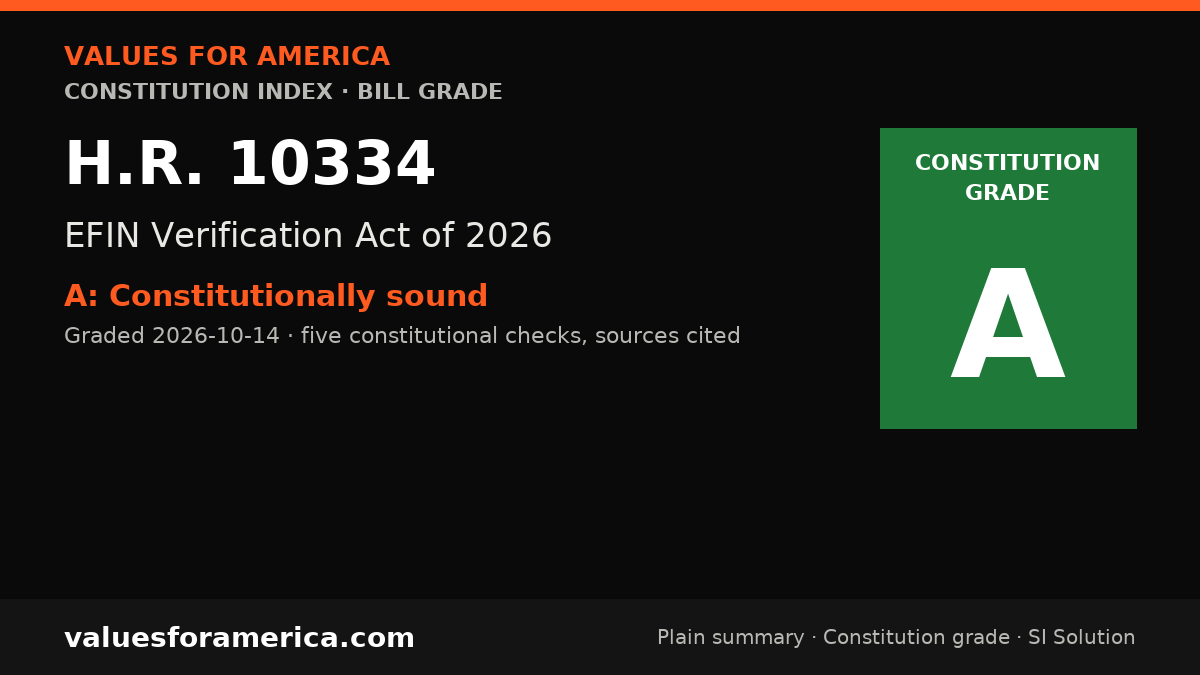
EFIN Verification Act of 2026
Cosponsors: 3 (2 D, 1 R) · per Congress.gov, 2026-10-14
Introduced: 2026-09-10
Latest action (2026-09-16): Ordered to be Reported in the Nature of a Substitute by the Yeas and Nays: 40 - 0.
What H.R. 10334 does, in plain terms
EFIN Verification Act of 2026 This bill requires the Internal Revenue Service (IRS) or a specified validator (e.g., software provider or state agency) to validate that an electronic filing identification number (EFIN) is authorized and active before a federal tax return or other document may be electronically filed with the IRS. (As background, an EFIN is assigned by the IRS to an individual or entity who is authorized to file federal tax returns and other documents on behalf of other taxpayers.) Specifically, the bill requires (1) the IRS to develop a program to validate the status of an EFIN in real time, and (2) EFINs to be validated prior to the initial use and at intervals determined by the IRS.
Official summary by the Congressional Research Service, via Congress.gov.
Constitution Index
“VFA Constitution grade”
Constitutionally sound
Graded 2026-10-14
SI-generated grade · five published checks · not individually reviewed by a person · methodology
The EFIN Verification Act of 2026 is fully constitutional. It operates within Congress's enumerated power to collect taxes under Article I, Section 8, Clause 1, imposes no restriction on speech, privacy, or individual liberty, and does not consolidate power upward beyond what is necessary for the federal government to administer its own tax filing system.
-
✓ Passes · Enumerated powers
Article I, Section 8, Clause 1 grants Congress the power to 'lay and collect Taxes, Duties, Imposts and Excises.' Requiring validation of electronic filing identification numbers (EFINs) before a tax return may be filed is a reasonable procedural measure to ensure the integrity of federal tax collection. This is well within the necessary and proper authority under Article I, Section 8, Clause 18 t… -
✓ Passes · Bill of Rights
The bill does not infringe any provision of the Bill of Rights. It does not restrict speech, religion, assembly, press, or petition (First Amendment). It does not regulate firearms (Second Amendment). It does not authorize any search or seizure (Fourth Amendment). It does not compel self-incrimination or deprive anyone of life, liberty, or property without due process (Fifth Amendment). It does no… -
✓ Passes · Individual sovereignty
The bill imposes a minimal administrative requirement on tax preparers and filers — that an EFIN be validated as active before electronic filing. This does not restrict what a person may do with their own person, property, speech, labor, or belief. It is a routine procedural safeguard for federal tax administration, not a restriction on individual liberty. The government has a compelling interest … -
✓ Passes · Decentralization
The bill passes all four questions of the decentralization test. (1) An individual or family cannot handle EFIN validation on their own because EFINs are issued by the IRS for the purpose of federal tax filing. (2) A local community or county cannot handle this because it involves a federal tax identification system. (3) A state cannot handle this because the IRS administers federal tax returns, n… -
✓ Passes · Due process and takings
The bill does not bypass due process or take property without just compensation. It requires the IRS to develop a program to validate EFIN status in real time, which provides fair notice and an opportunity to comply. There is no presumption of innocence issue, no deprivation of property, and no arbitrary government action. The requirement is procedural and non-punitive.
Sources: Congress.gov: HR 10334 summary
Report an error in this grade
What should pass
“VFA SI Solution”
SI-generated · passed automated checks (Constitution citation, source verification, independent SI critic) · not individually reviewed by a person · Report an error: hello@valuesforamerica.com
Secure EFIN Pilot With Due Process and Sunset
Generated by VFA SI Solutions
Protect taxpayers and the tax system from fraud by making sure only authorized and active tax preparers can file returns electronically for others.
Bipartisan rationale: VFA assesses this draft honors Democratic priorities for taxpayer protection, accurate administration, and service for victims of filing fraud, and honors Republican priorities for fraud prevention, narrow mandates that exclude self-filers, fiscal discipline through a capped pilot, and oversight with a sunset and review.
Possible legislative path: House and Senate support may come from members focused on tax fraud prevention and taxpayer service, while opposition may come from members concerned about IRS capacity, software costs, and filing delays.
Source limits: The full bill text and current law were not stated in the official summary reviewed, so eligibility rules, existing appeal rights, technical standards, privacy controls, cost effects, and conflicts with current statutes remain unverified and should be checked at the Congress.gov bill page before action.
Article I, Section 8, Clause 1 Article I, Section 8, Clause 18 Amendment XVI Amendment V
Report an error in this Solution
Citizen Consensus
“Do you support this VFA SI Solution?”
One vote per verified account; you can change it any time. Only verified accounts count, results publish once 30 verified people have voted, and state and district results count only people who attested a home ZIP code. How this works.
Email verification is not switched on yet, so no vote counts toward results yet. Votes cast now are saved and count once the voter verifies their email address.
Sign in or create a free account to vote.
Add a short reason (optional)
/280 · no links or contact details · reasons are reviewed before anyone sees them, and many never are shown.
Your vote is saved but held out of published results by an automated integrity check (for example, several accounts voting from one browser).
Your vote is saved. It will count once you verify your email address. Verify on your account page.
Your vote counts nationally. Add your home ZIP code to count in your state and district too.
Your vote counts nationally and in .
Reason saved privately; it is shown only if it passes review.
Verified participants nationwide · n =
Self-selected participants, not a random sample; ± is the 95% sampling margin.
Not enough verified votes yet. Results publish at verified votes.
A sudden surge of votes on this item was flagged and is under review; votes from new accounts in that surge are held out until it is resolved.
Related on VFA

For journalists and bloggers
“Embed this grade”
Free to use with the link back. The badge and card update when the grade changes. Embed terms →
