H.R. 10331 explained · 119th Congress · Pending in Congress
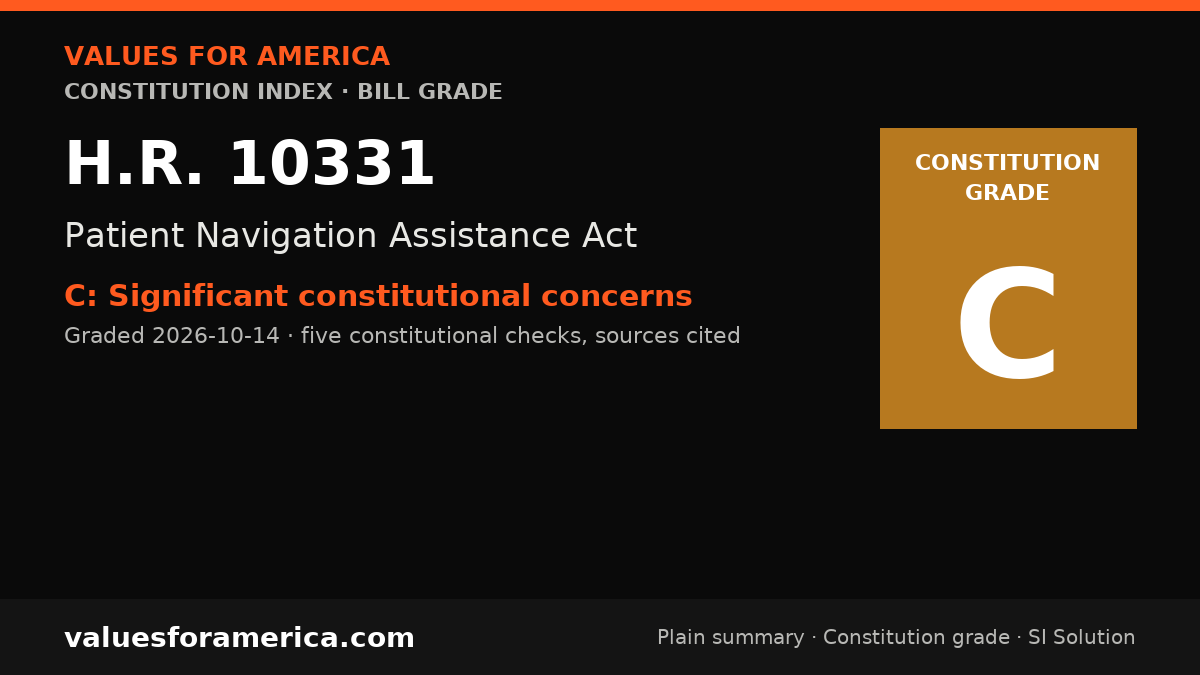
Patient Navigation Assistance Act
Cosponsors: none · per Congress.gov, 2026-10-14
Introduced: 2026-09-10
Latest action (2026-09-10): Referred to the House Committee on Energy and Commerce.
What H.R. 10331 does, in plain terms
Patient Navigation Assistance Act This bill requires state Medicaid programs to cover patient navigator services for enrollees. Patient navigator services are services that help link an individual with medical, social, logistical, financial, or other programs or services to address the individual's needs.
Official summary by the Congressional Research Service, via Congress.gov.
Constitution Index
“VFA Constitution grade”
Significant constitutional concerns
Graded 2026-10-14
SI-generated grade · five published checks · not individually reviewed by a person · methodology
The bill requires state Medicaid programs to cover patient navigator services, which is a conditional exercise of federal spending power under Article I, Section 8, Clause 1. While the federal government can attach conditions to Medicaid funds, this mandate intrudes on state sovereignty and the Tenth Amendment by dictating specific coverage requirements, and it consolidates decision-making at the federal level. The bill does not directly infringe individual rights, but it raises significant federalism concerns.
-
✓ Passes · Enumerated powers
The federal government has authority to spend for the general welfare under Article I, Section 8, Clause 1, and may attach conditions to state receipt of federal funds, as established in South Dakota v. Dole. Requiring state Medicaid programs to cover patient navigator services is a permissible exercise of the spending power, provided the conditions are unambiguous and related to the federal inter… -
✓ Passes · Bill of Rights
The bill does not implicate any of the first ten amendments. It does not restrict speech, religion, assembly, press, petition, arms, quartering, search and seizure, self-incrimination, due process, takings, trial rights, or cruel and unusual punishment. It merely mandates coverage of a service in a government program. -
✓ Passes · Individual sovereignty
The bill does not restrict individual liberty. It expands access to services for Medicaid enrollees. It does not compel individuals to do anything or prohibit any personal conduct. The burden of compliance falls on states and Medicaid programs, not on individuals. -
✗ Concern · Decentralization
The bill fails the decentralization test because it consolidates decision-making at the federal level. While states administer Medicaid, the federal government is dictating a specific coverage requirement, overriding state flexibility. The question of whether an individual or family could handle this without government is not directly applicable, but the federal mandate is an upward consolidation … -
✓ Passes · Due process and takings
The bill does not deprive anyone of life, liberty, or property without due process, nor does it take private property for public use without just compensation. It imposes a condition on state receipt of federal funds, which is a contractual arrangement, not a taking.
Sources: Congress.gov: HR 10331 summary
Report an error in this grade
What should pass
“VFA SI Solution”
No solution yet
A sourced SI draft appears here once it passes automated checks (Constitution citation, source verification, independent SI critic). How publication works.
Related on VFA

For journalists and bloggers
“Embed this grade”
Free to use with the link back. The badge and card update when the grade changes. Embed terms →
