H.R. 10327 explained · 119th Congress · Pending in Congress
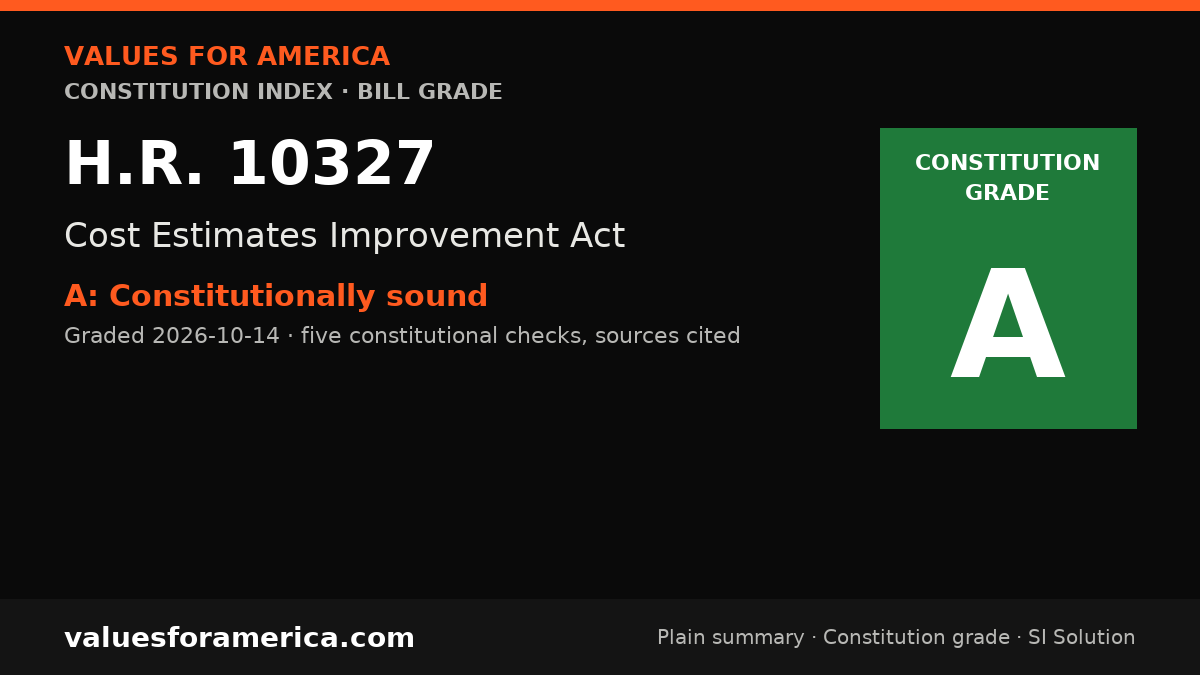
Cost Estimates Improvement Act
Cosponsors: 20 (3 D, 17 R) · per Congress.gov, 2026-10-14
Introduced: 2026-09-10
Latest action (2026-09-10): Referred to the Committee on Rules, and in addition to the Committee on the Budget, for a period to be subsequently determined by the Speaker, in each case for consideration of such provisions as fall within the jurisdiction of the committee concerned.
What H.R. 10327 does, in plain terms
Cost Estimates Improvement Act This bill requires cost estimates prepared by the Congressional Budget Office or the Joint Committee on Taxation to include the costs of servicing the public debt.
Official summary by the Congressional Research Service, via Congress.gov.
Constitution Index
“VFA Constitution grade”
Constitutionally sound
Graded 2026-10-14
SI-generated grade · five published checks · not individually reviewed by a person · methodology
This bill is fully constitutional. It requires cost estimates for federal legislation to include debt servicing costs, which is a procedural requirement within Congress's enumerated power to legislate and oversee the budget. It does not infringe any rights, restrict individual sovereignty, centralize power, or violate due process.
-
✓ Passes · Enumerated powers
Congress has explicit constitutional authority over the federal budget and taxation under Article I, Section 8, Clause 1 (the Taxing and Spending Clause), which grants Congress the power to 'lay and collect Taxes, Duties, Imposts and Excises, to pay the Debts and provide for the common Defence and general Welfare of the United States.' Requiring cost estimates to include debt servicing costs is a … -
✓ Passes · Bill of Rights
This bill imposes no restrictions on speech, religion, press, assembly, petition, arms, quartering, search and seizure, self-incrimination, due process, takings, trial rights, jury rights, or cruel and unusual punishment. It is a purely procedural requirement for legislative cost estimates and does not affect any rights protected by the Bill of Rights. -
✓ Passes · Individual sovereignty
The bill does not restrict any individual's control over their person, property, speech, labor, or belief. It imposes no mandates, prohibitions, or burdens on private citizens. It only changes how the Congressional Budget Office and Joint Committee on Taxation calculate cost estimates for proposed legislation. There is no government restriction on individual freedom, so no compelling justification… -
✓ Passes · Decentralization
This bill concerns the internal budgeting procedures of the federal government. It does not involve matters that individuals, families, local communities, or states could handle, because it addresses how Congress estimates the fiscal impact of federal legislation. The four-question test: (1) An individual or family cannot handle federal budget cost estimation—this is a federal legislative function… -
✓ Passes · Due process and takings
The bill does not deprive any person of life, liberty, or property, nor does it take private property for public use. It imposes no penalties, fines, or forfeitures. It does not bypass any procedural or substantive due process protections. It is a purely informational requirement for legislative cost estimates, with no impact on individual rights or property.
Sources: Congress.gov: HR 10327 summary
Report an error in this grade
What should pass
“VFA SI Solution”
No solution yet
A sourced SI draft appears here once it passes automated checks (Constitution citation, source verification, independent SI critic). How publication works.
Related on VFA

For journalists and bloggers
“Embed this grade”
Free to use with the link back. The badge and card update when the grade changes. Embed terms →
