H.R. 10319 explained · 119th Congress · Pending in Congress
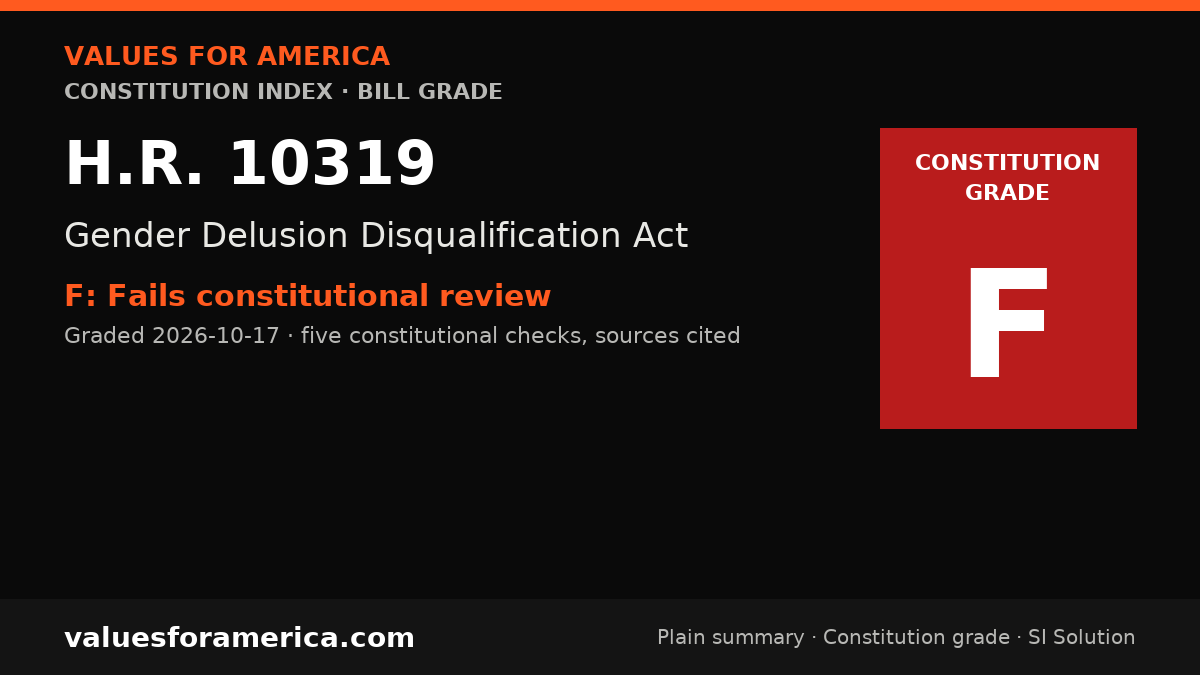
Gender Delusion Disqualification Act
Cosponsors: none · per Congress.gov, 2026-10-14
Introduced: 2026-09-08
Latest action (2026-09-08): Referred to the House Committee on Oversight and Government Reform.
What H.R. 10319 does, in plain terms
Gender Delusion Disqualification Act This bill prohibits individuals with a gender dysphoria diagnosis from occupying certain positions in executive agencies or obtaining or renewing certain federal credentials. (Gender dysphoria refers to the distress that may accompany the incongruence between one's experienced or expressed gender and one's assigned gender.) Under the bill, an individual with gender dysphoria may not occupy a position for which the employing agency has established mental health standards. Such standards are criteria the agency uses to determine whether an individual's diagnosed mental health condition renders them unable to safely or effectively perform the duties of a position. The criteria may be established through agency regulation, medical evaluation protocols, or government-wide personnel suitability standards. The bill also prohibits individuals with gender dysphoria from obtaining or renewing any license, certificate, or other credential that is issued by an executive agency and is conditioned on the individual satisfying specified mental health standards. For example, the Federal Aviation Administration prohibits airline pilot licenses from being issued to individuals with certain mental health diagnoses (e.g., bipolar disorder). Executive agencies must issue regulations necessary to establish these requirements for covered positions and credentials within 180 days after the bill's enactment.
Official summary by the Congressional Research Service, via Congress.gov.
Constitution Index
“VFA Constitution grade”
Fails constitutional review
Graded 2026-10-17
SI-generated grade · five published checks · not individually reviewed by a person · methodology
This bill categorically excludes individuals with a gender dysphoria diagnosis from federal employment and credentialing, imposing a blanket disability-based restriction that violates equal protection and due process, exceeds enumerated powers, and undermines individual sovereignty. It fails all five constitutional checks.
-
✗ Concern · Enumerated powers
The federal government has authority over federal employment and credentials under the Necessary and Proper Clause (Article I, Section 8, Clause 18) and the Property Clause (Article IV, Section 3, Clause 2). However, the bill's categorical exclusion based on a diagnosis, rather than on actual ability to perform duties, is not a legitimate exercise of these powers. It is an arbitrary and discrimina… -
✗ Concern · Bill of Rights
The bill violates the Fifth Amendment's Due Process Clause, which includes equal protection guarantees. It creates a suspect classification based on gender identity and disability status, subjecting individuals with gender dysphoria to a blanket disqualification without individualized assessment. This infringes on fundamental rights to liberty and equal treatment under the law. Additionally, it ma… -
✗ Concern · Individual sovereignty
The bill restricts individuals' ability to pursue their chosen profession and obtain credentials based solely on a medical diagnosis, without any showing that the individual is unable to perform the job safely or effectively. This is a severe restriction on personal autonomy and the right to work, which are fundamental aspects of individual sovereignty. The government has not provided a compelling… -
✗ Concern · Decentralization
The bill consolidates decision-making at the federal level, imposing a uniform rule that overrides state and local determinations of fitness for employment and credentials. It fails the decentralization test because it does not allow for individualized assessment or local variation, and it centralizes authority in federal agencies to define mental health standards and apply them categorically. -
✗ Concern · Due process and takings
The bill denies individuals with gender dysphoria the opportunity to demonstrate their fitness for employment or credentials, violating procedural due process by failing to provide a fair hearing or individualized assessment. It also constitutes a substantive due process violation because the classification is not rationally related to a legitimate government interest—a blanket ban is arbitrary an…
Sources: Congress.gov: HR 10319 summary
Report an error in this grade
What should pass
“VFA SI Solution”
No solution yet
A sourced SI draft appears here once it passes automated checks (Constitution citation, source verification, independent SI critic). How publication works.
Related on VFA

For journalists and bloggers
“Embed this grade”
Free to use with the link back. The badge and card update when the grade changes. Embed terms →
