H.R. 10296 explained · 119th Congress · Pending in Congress
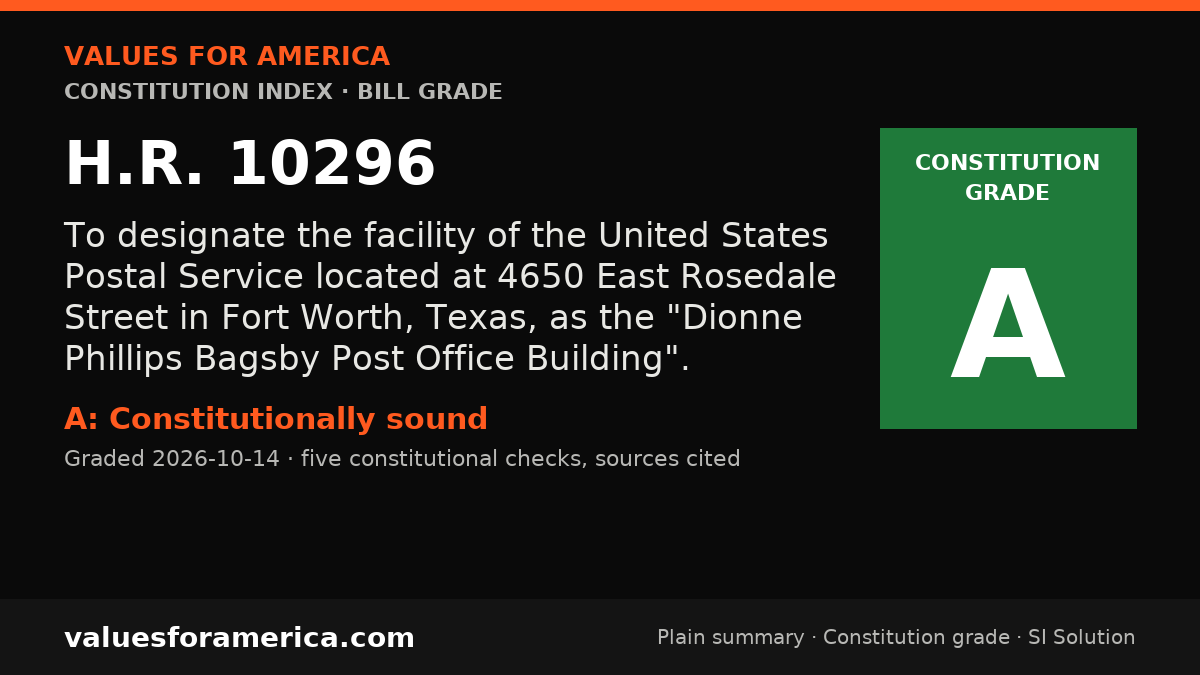
To designate the facility of the United States Postal Service located at 4650 East Rosedale Street in Fort Worth, Texas, as the "Dionne Phillips Bagsby Post Office Building".
Cosponsors: 11 (5 D, 6 R) · per Congress.gov, 2026-10-14
Introduced: 2026-09-03
Latest action (2026-09-03): Referred to the House Committee on Oversight and Government Reform.
What H.R. 10296 does, in plain terms
This bill designates the facility of the United States Postal Service located at 4650 East Rosedale Street in Fort Worth, Texas, as the "Dionne Phillips Bagsby Post Office Building".
Official summary by the Congressional Research Service, via Congress.gov.
Constitution Index
“VFA Constitution grade”
Constitutionally sound
Graded 2026-10-14
SI-generated grade · five published checks · not individually reviewed by a person · methodology
This bill simply names a federal post office building after an individual. It does not expand federal power, restrict rights, or affect individual sovereignty. The action falls within Congress's enumerated authority over postal services under Article I, Section 8, Clause 7, and raises no constitutional concerns.
-
✓ Passes · Enumerated powers
Congress has explicit authority under Article I, Section 8, Clause 7 to establish post offices and post roads. Naming a specific postal facility is a routine exercise of that authority and does not exceed it. -
✓ Passes · Bill of Rights
The bill does not implicate any provision of the Bill of Rights. It restricts no speech, religion, assembly, press, petition, arms, quartering, search, self-incrimination, due process, trial, jury, or punishment rights. -
✓ Passes · Individual sovereignty
The bill imposes no restrictions on personal liberty, property, speech, labor, or belief. It merely designates a name for a federal building, which does not burden any individual's sovereignty. -
✓ Passes · Decentralization
The action is a purely federal administrative matter regarding a federal facility. It does not consolidate decision-making upward; it is already a federal function. The four-question test is satisfied because the naming of a federal building is inherently a federal responsibility. -
✓ Passes · Due process and takings
The bill does not deprive anyone of life, liberty, or property, nor does it take private property. It involves no adjudicative or administrative process that could implicate due process or takings protections.
Sources: Congress.gov: HR 10296 summary
Report an error in this grade
What should pass
“VFA SI Solution”
No solution yet
A sourced SI draft appears here once it passes automated checks (Constitution citation, source verification, independent SI critic). How publication works.
Related on VFA

For journalists and bloggers
“Embed this grade”
Free to use with the link back. The badge and card update when the grade changes. Embed terms →
