H.R. 10277 explained · 119th Congress · Pending in Congress
Access to School Supplies Act of 2026
Cosponsors: 15 (15 D, 0 R) · per Congress.gov, 2026-10-14
Introduced: 2026-09-03
Latest action (2026-09-03): Referred to the House Committee on Education and Workforce.
What H.R. 10277 does, in plain terms
Access to School Supplies Act of 2026 This bill directs the Department of Education to carry out a pilot program to make competitive grants for up to 10 qualified local educational agencies to purchase school supplies. School supplies refer to books, supplies, and supplementary materials used by students and instructional staff in the classroom.
Official summary by the Congressional Research Service, via Congress.gov.
Constitution Index
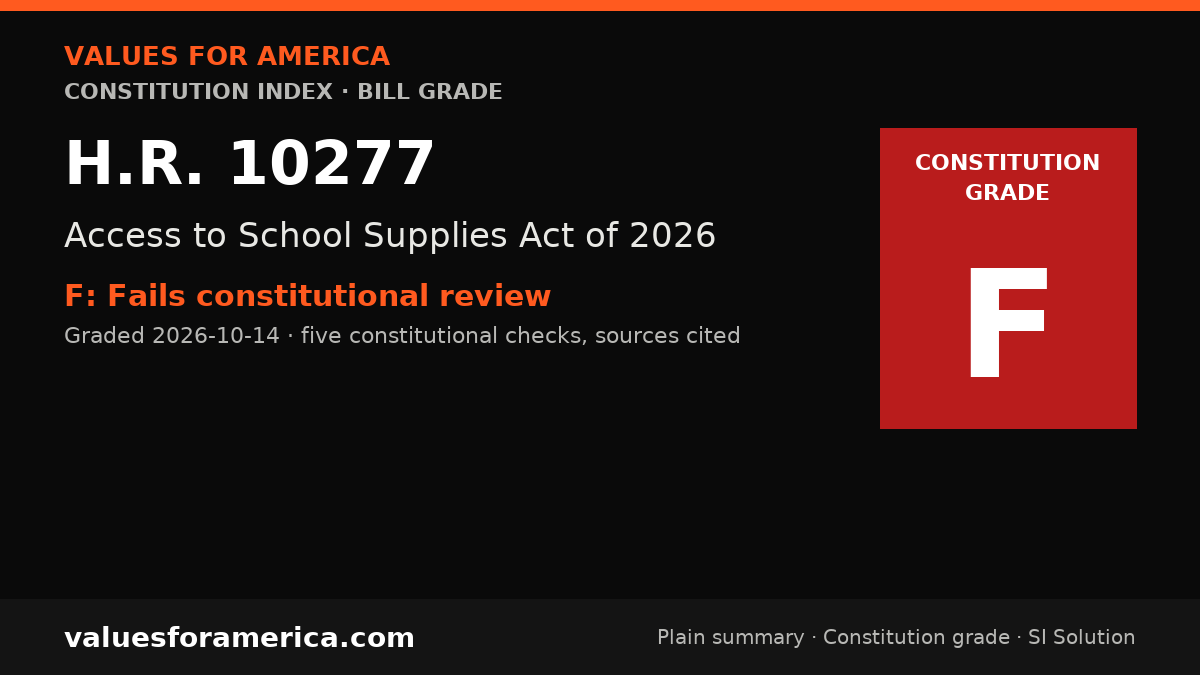
“VFA Constitution grade”
Fails constitutional review
Graded 2026-10-14
SI-generated grade · five published checks · not individually reviewed by a person · methodology
This bill is a direct violation of the Tenth Amendment and the principle of enumerated powers. The federal government has no constitutional authority to fund the purchase of school supplies, an activity reserved to the states and local communities under the Constitution. The bill also fails every check of the decentralization test, consolidating power at the highest level of government for a task that can and should be handled by individuals, families, and local communities.
-
✗ Concern · Enumerated powers
The federal government's powers are limited to those enumerated in Article I, Section 8 of the Constitution. Education is not among them. The General Welfare Clause (Article I, Section 8, Clause 1) does not grant a general police power to spend on any matter Congress deems beneficial; it is limited to spending for the common defense and the general welfare as tied to other enumerated powers. Schoo… -
✓ Passes · Bill of Rights
The bill does not directly infringe any right protected by the first ten amendments. It does not restrict speech, religion, assembly, press, petition, arms, quartering, search and seizure, self-incrimination, due process, takings, fair trial, jury, cruel and unusual punishment, or unenumerated rights. However, the Tenth Amendment is implicated by the federal overreach (see decentralization check). -
✓ Passes · Individual sovereignty
The bill does not restrict what individuals can do with their own person, property, speech, labor, or belief. It does not impose a mandate or prohibition on individuals. The burden of justification is not triggered because the bill does not restrict individual freedom. -
✗ Concern · Decentralization
This bill fails all four questions of the decentralization test. An individual or family can purchase school supplies without any government involvement. A local community or county can fund school supplies without state involvement. A state can fund school supplies without federal involvement. This action consolidates decision-making at the federal level, the highest level of government, for a ta… -
✓ Passes · Due process and takings
The bill does not bypass due process, presume guilt, or take property without just compensation. It is a voluntary grant program with no coercive or punitive elements. No due process or takings issues arise.
Sources: Congress.gov: HR 10277 summary
Report an error in this grade
What should pass
“VFA SI Solution”
No solution yet
A sourced SI draft appears here once it passes automated checks (Constitution citation, source verification, independent SI critic). How publication works.
Related on VFA

For journalists and bloggers
“Embed this grade”
Free to use with the link back. The badge and card update when the grade changes. Embed terms →
