H.R. 10232 explained · 119th Congress · Pending in Congress
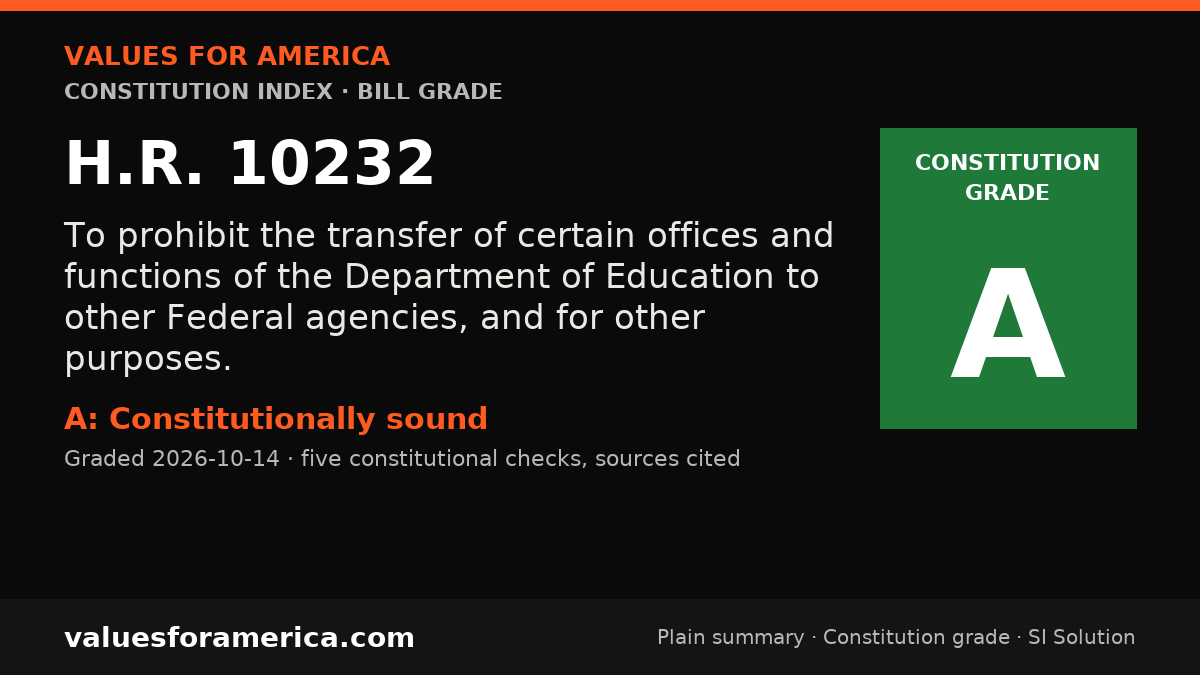
To prohibit the transfer of certain offices and functions of the Department of Education to other Federal agencies, and for other purposes.
Cosponsors: 2 (1 D, 1 R) · per Congress.gov, 2026-10-14
Introduced: 2026-09-02
Latest action (2026-09-02): Referred to the House Committee on Education and Workforce.
What H.R. 10232 does, in plain terms
This bill prohibits the Department of Education (ED) from transferring specified offices and functions to other federal agencies. Specifically, the bill prohibits ED from entering into or carrying out interagency agreements related to the following four offices: the Office of Special Education and Rehabilitative Services, the Office of Postsecondary Education, the Office of Indian Education, and the Office of Elementary and Secondary Education. This prohibition applies to the transfer of functions such as administering or operating programs, making grants, carrying out technical assistance, enforcing rights and requirements (e.g., data collection requirements), conducting administrative and oversight functions, and monitoring grantees. Additionally, ED may not transfer a function or program of one of the four offices to another ED office and then subsequently enter into an interagency agreement related to the function or program. The bill does not apply to agreements in effect on February 1, 2025, or renewals with substantially similar terms. ED must, within two weeks of the bill's enactment and on a quarterly basis, provide to Congress (and publish on its website) a report and cost analysis for each interagency agreement entered into on or after February 1, 2025. ED may not use specified FY2026 or FY2027 funds for travel expenses unless ED provides this required information. (As of July 30, 2026, ED has entered into 14 interagency agreements to transfer functions of ED to other federal agencies, including the ED offices listed in the bill.)
Official summary by the Congressional Research Service, via Congress.gov.
Constitution Index
“VFA Constitution grade”
Constitutionally sound
Graded 2026-10-14
SI-generated grade · five published checks · not individually reviewed by a person · methodology
This bill is a straightforward exercise of Congress's legislative authority to structure the executive branch and to condition appropriations. It does not infringe on any constitutional right, does not consolidate power upward, and does not implicate due process or takings concerns. The bill's reporting requirements are reasonable and within Congress's oversight powers.
-
✓ Passes · Enumerated powers
Congress has broad authority under Article I, Section 8, Clause 18 (the Necessary and Proper Clause) to make laws that are necessary and proper for executing its enumerated powers, including the power to appropriate funds (Article I, Section 9, Clause 7) and to organize the executive branch. The bill restricts the Department of Education's ability to transfer functions, which is a permissible exer… -
✓ Passes · Bill of Rights
The bill does not implicate any of the first ten amendments. It does not restrict speech, religion, assembly, press, petition, arms, quartering, search and seizure, self-incrimination, due process, takings, trial rights, or cruel and unusual punishment. It is a structural and administrative measure. -
✓ Passes · Individual sovereignty
The bill does not restrict individual liberty or property. It only governs the internal organization of the Department of Education and imposes reporting requirements on the agency. Individuals are not directly affected in their person, property, speech, labor, or belief. -
✓ Passes · Decentralization
The bill does not consolidate decision-making at a higher level of government; rather, it prevents the federal government from shifting functions among agencies, which is a federal internal matter. It does not affect the ability of individuals, local communities, or states to handle education matters, and it does not expand federal power. The reporting requirements are minimal and do not centraliz… -
✓ Passes · Due process and takings
The bill does not deprive any person of life, liberty, or property without due process, nor does it take private property for public use without just compensation. It imposes no penalties on individuals and does not affect any vested rights. The reporting requirements are procedural and do not implicate due process.
Sources: Congress.gov: HR 10232 summary
Report an error in this grade
What should pass
“VFA SI Solution”
No solution yet
A sourced SI draft appears here once it passes automated checks (Constitution citation, source verification, independent SI critic). How publication works.
Related on VFA

For journalists and bloggers
“Embed this grade”
Free to use with the link back. The badge and card update when the grade changes. Embed terms →
