H.R. 10202 explained · 119th Congress · Pending in Congress
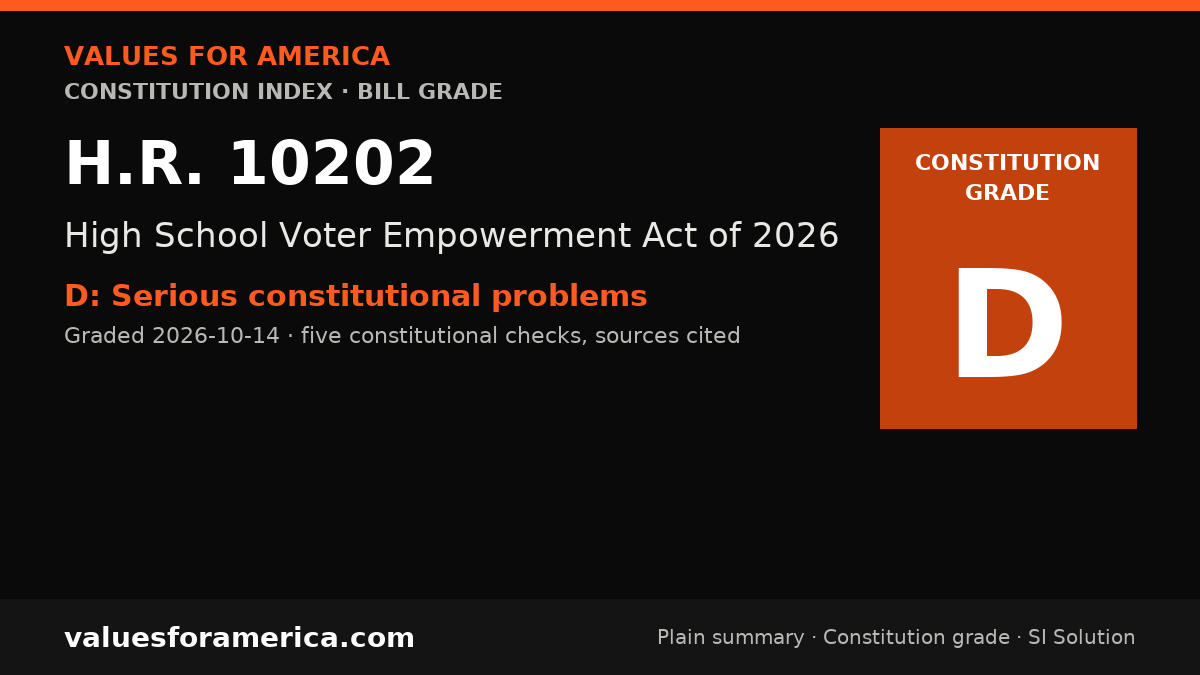
High School Voter Empowerment Act of 2026
Cosponsors: 6 (6 D, 0 R) · per Congress.gov, 2026-10-14
Introduced: 2026-08-31
Latest action (2026-08-31): Referred to the Committee on House Administration, and in addition to the Committee on Education and Workforce, for a period to be subsequently determined by the Speaker, in each case for consideration of such provisions as fall within the jurisdiction of the committee concerned.
What H.R. 10202 does, in plain terms
High School Voter Empowerment Act of 2026 This bill directs states to designate public high schools as voter registration agencies and requires public high schools to conduct annual voter registration drives to register eligible students. The Department of Education must reimburse eligible public high schools for carrying out voter registration drives.
Official summary by the Congressional Research Service, via Congress.gov.
Constitution Index
“VFA Constitution grade”
Serious constitutional problems
Graded 2026-10-14
SI-generated grade · five published checks · not individually reviewed by a person · methodology
This bill likely violates the Tenth Amendment by commandeering state and local educational institutions to implement federal voter registration policy, and it exceeds Congress's enumerated powers by conditioning education funding on the performance of voter registration activities. While voter registration is a legitimate state function, the federal government lacks authority to direct states to designate high schools as registration agencies or to mandate annual registration drives. The bill also raises concerns about federal intrusion into state-controlled education systems and the potential for partisan manipulation of school environments.
-
✗ Concern · Enumerated powers
Congress lacks explicit authority under Article I, Section 8 to mandate that states designate high schools as voter registration agencies or to require annual registration drives. The bill's reliance on the Spending Clause (Article I, Section 8, Clause 1) is problematic because the condition—mandating voter registration activities—is not reasonably related to the educational purpose of the funding… -
✓ Passes · Bill of Rights
The bill does not directly infringe upon the rights protected by the Bill of Rights. It does not restrict speech, religion, assembly, press, petition, arms, quartering, search and seizure, self-incrimination, due process, takings, fair trial, jury, cruel and unusual punishment, or unenumerated rights. However, there is a potential indirect concern: mandatory voter registration drives in schools co… -
✓ Passes · Individual sovereignty
The bill does not restrict individual freedoms; rather, it expands access to voter registration. It does not compel individuals to register or vote, and it does not infringe upon personal autonomy, property, speech, labor, or belief. The burden of compliance falls on schools, not on individuals, and the bill does not impose any penalty on individuals for non-participation. -
✗ Concern · Decentralization
The bill fails the decentralization test because it consolidates decision-making at the federal level, directing states and local schools to implement federal mandates. While voter registration is a state function, the federal government is imposing specific requirements on how states and localities conduct registration, which is an upward consolidation of authority. The bill does not allow states… -
✓ Passes · Due process and takings
The bill does not deprive individuals of life, liberty, or property without due process, nor does it take private property for public use without just compensation. It imposes obligations on schools, but these are not takings of property; they are conditions on federal funding. However, the bill may raise procedural due process concerns if schools are not given adequate notice or opportunity to ch…
Sources: Congress.gov: HR 10202 summary
Report an error in this grade
What should pass
“VFA SI Solution”
No solution yet
A sourced SI draft appears here once it passes automated checks (Constitution citation, source verification, independent SI critic). How publication works.
Related on VFA

For journalists and bloggers
“Embed this grade”
Free to use with the link back. The badge and card update when the grade changes. Embed terms →
