H.R. 10167 explained · 119th Congress · Pending in Congress
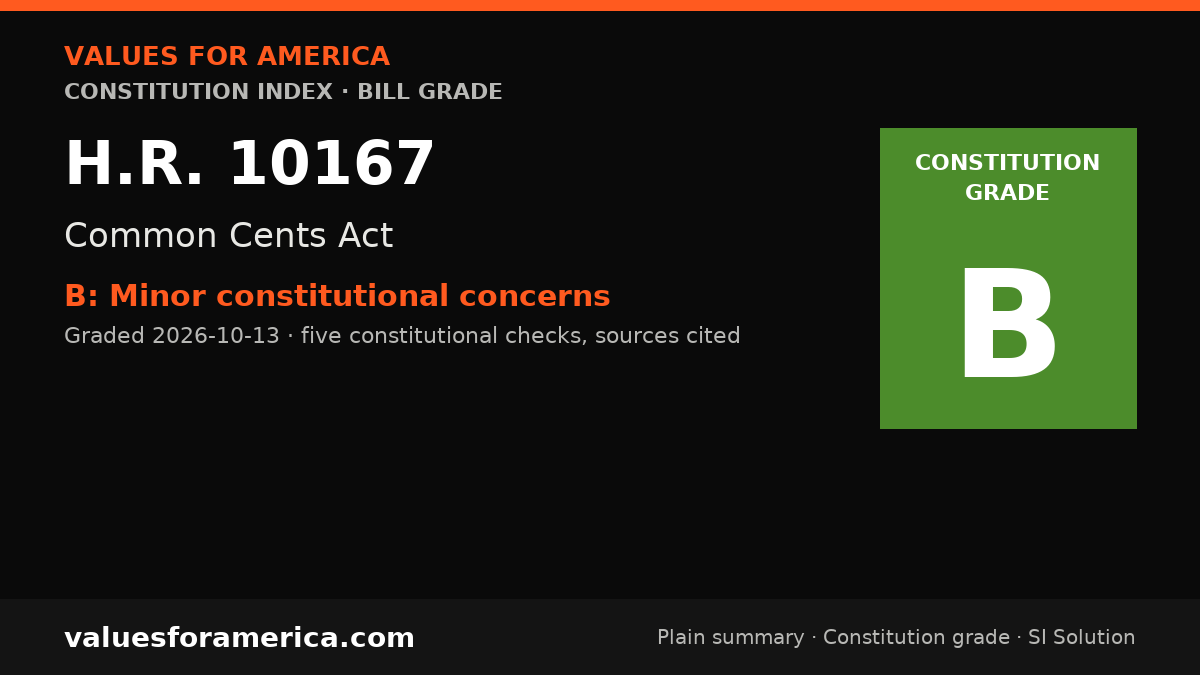
Common Cents Act
Cosponsors: 1 (1 D, 0 R) · per Congress.gov, 2026-10-14
Introduced: 2026-08-27
Latest action (2026-10-14): Message on Senate action sent to the House.
What H.R. 10167 does, in plain terms
Common Cents Act This bill ends the production of the penny for general circulation, requires rounding to an amount divisible by five for the payment or transfer of cash, and allows the nickel to be composed of different material. The Department of the Treasury must stop producing the penny, except to meet collector needs. The penny shall continue to be legal tender. Any person selling goods or services in a cash transaction, entering into other transfers of cash, or paying cash wages to an employee must round the payment up or down in accordance with the bill. The bill also allows Treasury to discontinue the minting for circulation of any coin if Treasury follows procedures as outlined by the bill, including providing notice and a briefing to Congress. The Federal Reserve Board must periodically report on a strategic plan for the acceptance of penny orders and deposits at commercial coin terminals that provide services under agreements with Federal Reserve banks. Finally, the bill allows for a different material composition of the nickel. In addition to being made from an alloy of copper and nickel, the nickel may also be clad with an inner core of zinc and an outer layer of nickel.
Official summary by the Congressional Research Service, via Congress.gov.
Constitution Index
“VFA Constitution grade”
Minor constitutional concerns
Graded 2026-10-13
SI-generated grade · five published checks · not individually reviewed by a person · methodology
The Common Cents Act is a federal statute that falls within Congress's enumerated power to coin money and regulate the value thereof. It does not infringe on any specific Bill of Rights protections, and while it imposes a minor burden on cash transactions, the burden is minimal and serves a legitimate governmental purpose. The bill does not consolidate power upward in a problematic way, as it addresses a national currency matter. The rounding requirement is a reasonable regulation of cash transactions, not a taking or a denial of due process. The bill is mostly sound, with minor concerns about the rounding requirement's impact on individual transactions.
-
✓ Passes · Enumerated powers
Article I, Section 8, Clause 5 grants Congress the power to coin money and regulate the value thereof. This bill directly concerns the production, composition, and legal tender status of coins, and the rounding of cash transactions is a regulation of the currency. Therefore, the federal government has explicit constitutional authority to enact this legislation. -
✓ Passes · Bill of Rights
The bill does not implicate any of the first ten amendments. It does not restrict speech, religion, assembly, press, petition, arms, quartering, search and seizure, self-incrimination, due process, takings, fair trial, jury, cruel and unusual punishment, or unenumerated rights. The rounding requirement applies to cash transactions but does not infringe on any enumerated right. -
✓ Passes · Individual sovereignty
The rounding requirement imposes a minor restriction on how individuals and businesses conduct cash transactions, but it is a reasonable regulation of currency and does not significantly restrict personal autonomy. The government has a compelling interest in maintaining an efficient currency system, and the burden is minimal. The bill does not restrict speech, labor, belief, or property in a way t… -
✓ Passes · Decentralization
The four-question test: (1) Individuals cannot handle the production of coins themselves; this is a national function. (2) Local communities cannot regulate the national currency. (3) States cannot coin money or regulate the value thereof; this is a federal power. (4) The bill does not consolidate decision-making upward beyond the minimum necessary, as the Constitution assigns coinage to the feder… -
✓ Passes · Due process and takings
The rounding requirement does not take property without just compensation; it is a regulation of the medium of exchange, not a taking of specific property. The bill provides procedural requirements for Treasury to discontinue coin production, including notice and briefing to Congress, which satisfies procedural due process. The rounding rule is not arbitrary and applies uniformly to cash transacti…
Sources: Congress.gov: HR 10167 summary
Report an error in this grade
What should pass
“VFA SI Solution”
No solution yet
A sourced SI draft appears here once it passes automated checks (Constitution citation, source verification, independent SI critic). How publication works.
Related on VFA

For journalists and bloggers
“Embed this grade”
Free to use with the link back. The badge and card update when the grade changes. Embed terms →
