H.R. 10159 explained · 119th Congress · Pending in Congress
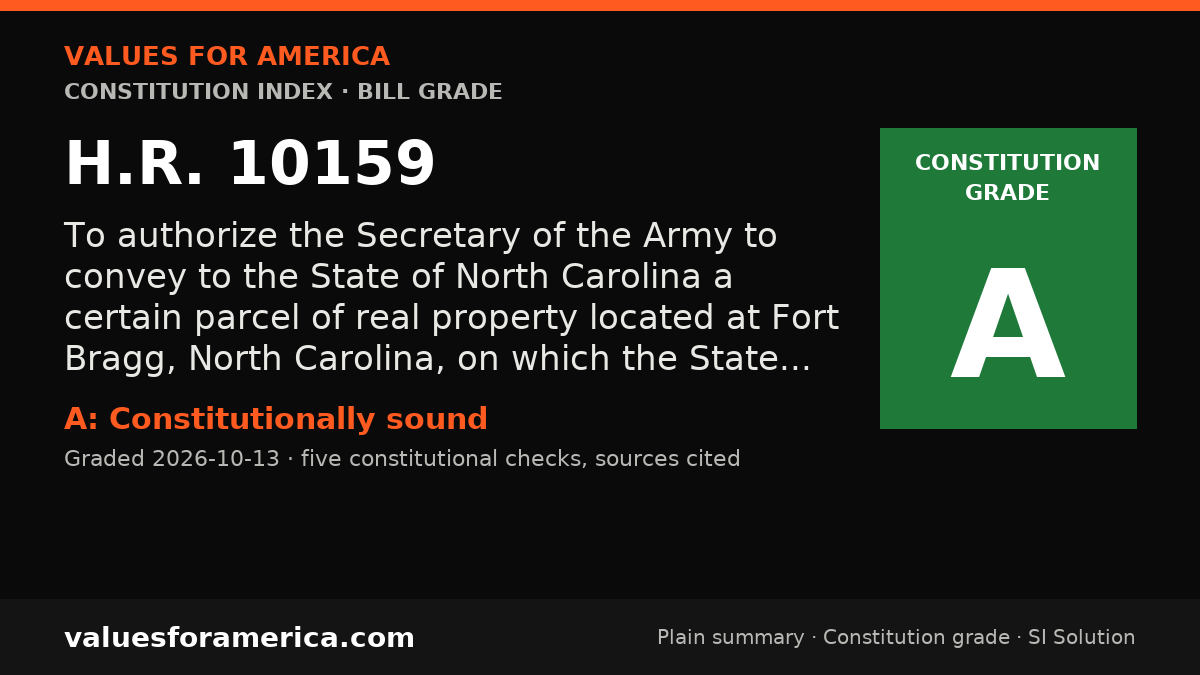
To authorize the Secretary of the Army to convey to the State of North Carolina a certain parcel of real property located at Fort Bragg, North Carolina, on which the State shall construct a veterans’ State home, and for other purposes.
Cosponsors: 13 (4 D, 9 R) · per Congress.gov, 2026-10-14
Introduced: 2026-08-27
Latest action (2026-10-14): Message on Senate action sent to the House.
What H.R. 10159 does, in plain terms
This bill authorizes the Department of the Army to transfer, without compensation or other consideration, all right, title, and interest to a specified 20-acre parcel of land on Fort Bragg to the State of North Carolina for the purpose of constructing a state home under the jurisdiction of the North Carolina Department of Military and Veterans Affairs. (A state home is a home established by a state for veterans who are disabled by age, disease, or otherwise and are incapable of earning a living because of such disability. The term also includes a home that furnishes nursing home care for veterans.) Specifically, the bill authorizes the conveyance of a 20-acre parcel of land situated on the Fort Bragg Training Area in Harnett County, North Carolina, that is commonly referred to as Parcel 3B. The State of North Carolina must cover all costs to carry out the conveyance. If the Department of the Army determines the property is not being used for activities related to a state home, all right, title, and interest in the property may revert to the United States.
Official summary by the Congressional Research Service, via Congress.gov.
Constitution Index
“VFA Constitution grade”
Constitutionally sound
Graded 2026-10-13
SI-generated grade · five published checks · not individually reviewed by a person · methodology
This bill is a straightforward, narrow authorization for the federal government to convey a specific parcel of surplus military land to a state for a constitutionally permissible purpose—supporting veterans. It does not expand federal power, restrict individual rights, or centralize authority. The conveyance is voluntary, state-initiated, and includes a reversion clause to protect federal interests. It fully respects federalism and the Tenth Amendment by enabling state action rather than mandating it.
-
✓ Passes · Enumerated powers
The federal government has explicit authority over military installations under Article I, Section 8, Clause 12 (to raise and support Armies) and Clause 14 (to make rules for the government and regulation of the land and naval forces). Conveying a portion of a military base to a state for a veterans' home is a proper exercise of property management incidental to these powers. The bill does not exc… -
✓ Passes · Bill of Rights
The bill does not implicate any of the first ten amendments. It does not restrict speech, religion, assembly, press, petition, arms, quartering, search and seizure, self-incrimination, due process, takings, trial rights, or cruel and unusual punishment. It is a property conveyance with no effect on individual liberties. -
✓ Passes · Individual sovereignty
The bill imposes no restrictions on individual conduct. It does not regulate personal behavior, property use, speech, labor, or belief. The only 'restriction' is a condition on the state's continued use of the conveyed land (for a veterans' home), which is a contractual condition voluntarily accepted by the state, not a restriction on individuals. The burden of justification is not triggered becau… -
✓ Passes · Decentralization
The bill passes all four questions of the decentralization test. (1) An individual or family could not handle the conveyance of a 20-acre federal military parcel; this is inherently a government-to-government transaction. (2) A local community or county could not handle the transfer of federal property; only the federal government can convey its own land. (3) The state of North Carolina could not … -
✓ Passes · Due process and takings
The bill does not take private property; it conveys federal property to a state. There is no deprivation of life, liberty, or property without due process. The reversion clause is a standard condition that does not bypass any procedural safeguards—it simply allows the federal government to reclaim the property if the state fails to use it for the stated purpose. No private party's property is affe…
Sources: Congress.gov: HR 10159 summary
Report an error in this grade
What should pass
“VFA SI Solution”
No solution yet
A sourced SI draft appears here once it passes automated checks (Constitution citation, source verification, independent SI critic). How publication works.
Related on VFA

For journalists and bloggers
“Embed this grade”
Free to use with the link back. The badge and card update when the grade changes. Embed terms →
