H.R. 10141 explained · 119th Congress · Pending in Congress
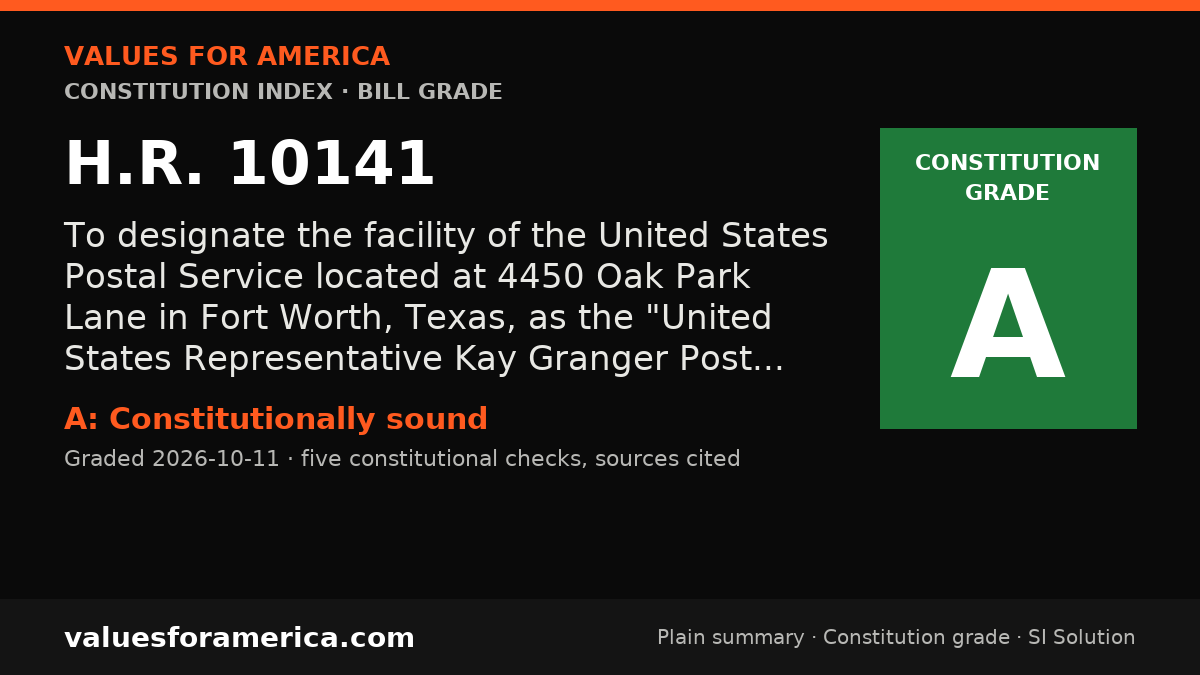
To designate the facility of the United States Postal Service located at 4450 Oak Park Lane in Fort Worth, Texas, as the "United States Representative Kay Granger Post Office Building".
Cosponsors: 11 (6 D, 5 R) · per Congress.gov, 2026-10-14
Introduced: 2026-08-24
Latest action (2026-08-24): Referred to the House Committee on Oversight and Government Reform.
What H.R. 10141 does, in plain terms
This bill designates the facility of the United States Postal Service located at 4450 Oak Park Lane in Fort Worth, Texas, as the "United States Representative Kay Granger Post Office Building".
Official summary by the Congressional Research Service, via Congress.gov.
Constitution Index
“VFA Constitution grade”
Constitutionally sound
Graded 2026-10-11
SI-generated grade · five published checks · not individually reviewed by a person · methodology
This bill simply names a federal post office building after a former member of Congress. It does not expand federal power, restrict rights, or affect individual sovereignty. The action is a routine exercise of Congress's authority over federal property under the Postal Clause, and it raises no constitutional concerns.
-
✓ Passes · Enumerated powers
Congress has explicit authority to establish post offices and post roads under Article I, Section 8, Clause 7. Naming a postal facility is a minor and direct exercise of that power. The bill does not exceed this enumerated authority. -
✓ Passes · Bill of Rights
The bill does not implicate any of the first ten amendments. It restricts no speech, religion, assembly, press, petition, arms, quartering, search, self-incrimination, due process, trial, jury, or cruel punishment rights. It is purely a naming designation. -
✓ Passes · Individual sovereignty
The bill imposes no restriction on any person's use of their person, property, speech, labor, or belief. It merely designates the name of a government building. There is no burden on individual freedom. -
✓ Passes · Decentralization
The naming of a federal post office is inherently a federal function because the facility is federal property. No lower level of government could plausibly handle this designation. The action does not consolidate decision-making upward beyond the necessary minimum; it is a routine administrative act by the federal government over its own facility. -
✓ Passes · Due process and takings
The bill does not deprive anyone of life, liberty, or property, nor does it take property without just compensation. It provides no new procedures or penalties. There is no due process or takings issue.
Sources: Congress.gov: HR 10141 summary
Report an error in this grade
The Framers
“Founders’ Verdict”
Confidence 1.00
Archived SI output (machine-generated)No editorial review recorded. This historical SI verdict was machine-generated by software and predates the review desk; check it against the official bill text.
Synthesis
Unanimous concurrence (4-0): Naming a federal postal facility is a lawful incident of Congress's express power 'To establish Post Offices and post Roads' under Article I, Section 8, Clause 7, carried into execution through the Necessary and Proper Clause (Article I, Section 8, Clause 18) and Congress's authority over federal property (Article IV, Section 3, Clause 2). The designation confers no hereditary rank or title of nobility (Article I, Section 9, Clause 8), constitutes no bill of attainder, commands nothing of the States or private citizens, and intrudes upon no right secured by the first ten Amendments or powers reserved under Amendment X. Per McCulloch v. Maryland (1819), the means are plainly adapted to a legitimate end within the scope of an enumerated power.
The measure before us is a mere designation of name upon a facility already lawfully established by the national government. The power of Congress over the posts is explicit and unqualified: Article I, Section 8, Clause 7 empowers the legislature 'To establish Post Offices and post Roads.' A power to establish carries with it, by every sound rule of construction, the incidental authority to govern the character, management, and designation of those establishments. Further, Article IV, Section 3, Clause 2 vests in Congress the power to make 'all needful Rules and Regulations respecting the Terr…
The power to establish Post Offices is expressly granted to Congress by Article I, Section 8, Clause 7, and the giving of a name to a federal postal facility is a mere incident of that grant, properly carried into execution under the Necessary and Proper Clause of Article I, Section 8, Clause 18. This act neither abridges the freedom of speech, or of the press, nor touches the free exercise of religion, nor the security of persons and papers guarded by the Fourth Amendment, nor any other right secured by the first ten amendments. It commands nothing of the several States and assumes no authori…
The power 'To establish Post Offices and post Roads' is expressly vested in the Congress by Article I, Section 8, Clause 7. As I observed in Federalist No. 44, the communication among the parts of the Union by post is a power of manifest necessity to the national government, and the designation of a name upon a facility so established is an incident to its establishment and administration. The measure exercises no authority beyond the enumeration; it creates no hereditary distinction or dignity of office, and therefore transgresses neither the prohibition of titles of nobility in Article I, Se…
The power to establish Post Offices is expressly vested in the national legislature by Article I, Section 8, Clause 7. A designation of the name borne by a postal facility is an incident of that express grant — a means of ordering and administering the postal establishment, and nothing more. Where the end is legitimate and within the scope of the Constitution, all appropriate means which are plainly adapted to that end, and which are not prohibited, may be lawfully employed; so this Court held in McCulloch v. Maryland (1819). I have examined the measure against every prohibition of the Constit…
Report an error in this Founders' Verdict
What should pass
“VFA SI Solution”
No solution yet
A sourced SI draft appears here once it passes automated checks (Constitution citation, source verification, independent SI critic). How publication works.
Related on VFA

For journalists and bloggers
“Embed this grade”
Free to use with the link back. The badge and card update when the grade changes. Embed terms →
