H.R. 1011 explained · 119th Congress · Pending in Congress
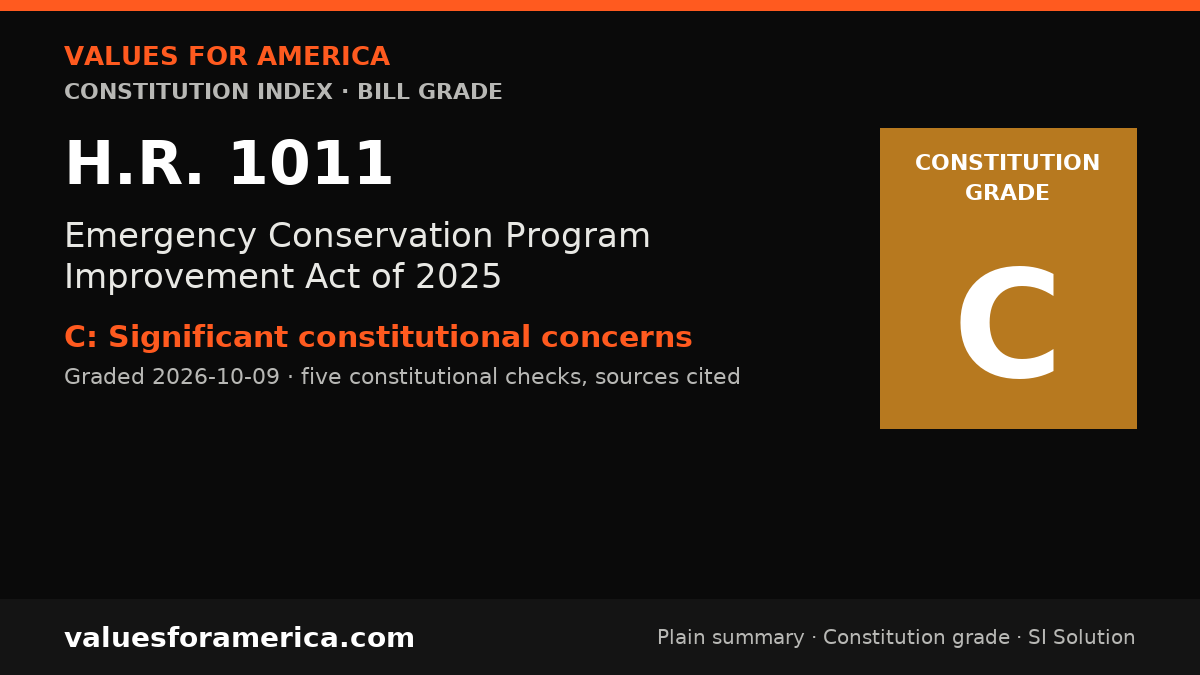
Emergency Conservation Program Improvement Act of 2025
Cosponsors: 4 (1 D, 3 R) · per Congress.gov, 2026-10-09
Introduced: 2025-02-05
Latest action (2026-04-15): Received in the Senate.
What H.R. 1011 does, in plain terms
Emergency Conservation Program Improvement Act of 2025 This bill revises the Emergency Conservation Program (ECP) and the Emergency Forest Restoration Program (EFRP) to expand eligibility for payments to agricultural producers and owners of forest land impacted by natural disasters. The bill also provides additional options to receive an advance on cost-sharing payments before carrying out emergency measures. The bill expands advance ECP payments to include payments for the rehabilitation of farmland or to repair or replace a farmland or conservation structure. Producers may receive an advance on cost-sharing payments for 75% of the cost of the replacement or rehabilitation and 50% of the cost of the repair. Current law limits advanced cost-sharing payments to 25% of the cost of the repair or replacement of fencing. The bill also expands eligibility for payments under ECP to include emergency measures to address damages caused by a wildfire that is not caused naturally (including a wildfire that is caused by the federal government), if the damage is caused by the spread of the wildfire due to natural causes. Under EFRP, the bill allows owners of nonindustrial private forest land impacted by a natural disaster to receive an advance on cost-sharing payments for up to 75% of the cost of the emergency measures. Recipients must use the funds within 180 days after the funds are disbursed. Currently, advance payments are not available under the program.
Official summary by the Congressional Research Service, via Congress.gov.
Constitution Index
“VFA Constitution grade”
Significant constitutional concerns
Graded 2026-10-09
SI-generated grade · five published checks · not individually reviewed by a person · methodology
The Emergency Conservation Program Improvement Act of 2025 expands existing federal cost-sharing programs for agricultural and forest land rehabilitation after natural disasters. While the bill does not infringe on individual rights and falls within Congress's spending power under Article I, Section 8, Clause 1 (General Welfare), it significantly consolidates decision-making at the federal level when states could reasonably administer such programs themselves. This raises substantial federalism concerns under the Tenth Amendment and the principle of decentralization, warranting a structural reconsideration of the federal role.
-
✓ Passes · Enumerated powers
Congress has authority under Article I, Section 8, Clause 1 (the General Welfare Clause) to spend for the general welfare, which includes agricultural and conservation programs. The Supreme Court has long upheld such spending as a valid exercise of federal power (e.g., Wickard v. Filburn, 317 U.S. 111 (1942); United States v. Butler, 297 U.S. 1 (1936)). The bill does not exceed this enumerated pow… -
✓ Passes · Bill of Rights
The bill provides voluntary cost-sharing payments and advances; it does not restrict speech, religion, assembly, press, petition, arms, quartering, search and seizure, self-incrimination, due process, trial rights, jury rights, cruel and unusual punishment, or any other right protected by the first ten amendments. No infringement occurs. -
✓ Passes · Individual sovereignty
The bill imposes no restrictions on individual action. Producers and landowners may choose to participate in the programs or not. There is no compelled labor, property seizure, or limitation on personal liberty. The government is providing optional financial assistance, which does not burden individual sovereignty. -
✗ Concern · Decentralization
The bill fails three of the four decentralization questions. (1) Individuals or families cannot typically handle large-scale natural disaster rehabilitation costs on their own. (2) Local communities or counties often lack the resources to fund such programs without state involvement. (3) States can and do administer similar conservation and disaster relief programs using their own resources and ex… -
✓ Passes · Due process and takings
The bill does not bypass due process or take private property. All payments are voluntary and conditioned on agreements with producers. There is no deprivation of life, liberty, or property without notice or hearing, and no taking of property for public use without just compensation. The Fifth Amendment's Due Process and Takings Clauses are not implicated.
Sources: Congress.gov: HR 1011 summary
Report an error in this grade
What should pass
“VFA SI Solution”
No solution yet
A sourced SI draft appears here once it passes automated checks (Constitution citation, source verification, independent SI critic). How publication works.
Related on VFA

For journalists and bloggers
“Embed this grade”
Free to use with the link back. The badge and card update when the grade changes. Embed terms →
