H.R. 10087 explained · 119th Congress · Pending in Congress
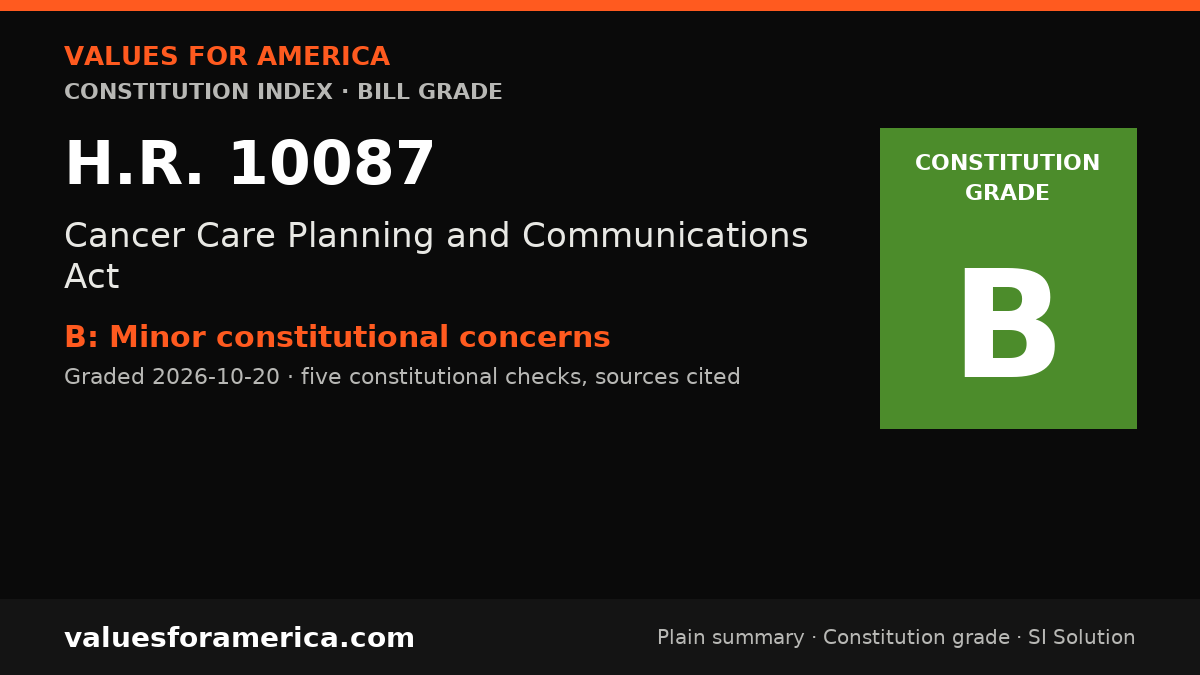
Cancer Care Planning and Communications Act
Cosponsors: none · per Congress.gov, 2026-10-14
Introduced: 2026-08-13
Latest action (2026-08-13): Referred to the Committee on Energy and Commerce, and in addition to the Committee on Ways and Means, for a period to be subsequently determined by the Speaker, in each case for consideration of such provisions as fall within the jurisdiction of the committee concerned.
What H.R. 10087 does, in plain terms
Cancer Care Planning and Communications Act This bill provides for Medicare coverage and payment of cancer care planning and coordination services for individuals who are diagnosed with or treated for cancer, including the development of treatment plans, follow-up care, and any necessary revisions.
Official summary by the Congressional Research Service, via Congress.gov.
Constitution Index
“VFA Constitution grade”
Minor constitutional concerns
Graded 2026-10-20
SI-generated grade · five published checks · not individually reviewed by a person · methodology
The bill is a federal Medicare coverage expansion for cancer care planning services. It operates within Congress's enumerated power to spend for the general welfare and to regulate interstate commerce, and it does not infringe on individual rights. The main constitutional tension is the expansion of federal involvement in healthcare, which raises decentralization concerns, but the bill does not mandate individual participation or coerce states, so it remains mostly sound.
-
✓ Passes · Enumerated powers
Congress has the power to tax and spend for the general welfare under Article I, Section 8, Clause 1. Medicare is a federal spending program, and this bill modifies Medicare coverage, which falls within that spending power. Additionally, the regulation of healthcare services and insurance markets has been upheld under the Commerce Clause (Article I, Section 8, Clause 3), though the primary basis h… -
✓ Passes · Bill of Rights
The bill does not restrict speech, religion, assembly, press, petition, the right to bear arms, or any other enumerated right. It does not involve searches, seizures, self-incrimination, or trial rights. It is a voluntary benefit expansion, not a mandate or prohibition, so no Bill of Rights provision is implicated. -
✓ Passes · Individual sovereignty
The bill does not restrict individual autonomy. It provides additional Medicare coverage for cancer care planning, which individuals may choose to use or not. It does not compel anyone to undergo treatment, purchase insurance, or surrender property. The burden of justification for any restriction is not triggered because there is no restriction. -
✗ Concern · Decentralization
The bill fails the decentralization test because it consolidates healthcare planning decisions at the federal level. While individuals and families could handle some cancer care planning without government, and states could certainly administer such programs, the federal government is expanding its role in a policy area traditionally managed by states and private actors. However, the bill does not… -
✓ Passes · Due process and takings
The bill does not deprive anyone of life, liberty, or property without due process. It does not take private property for public use without just compensation. It creates a new benefit, and any procedural requirements for Medicare coverage are administrative, not a deprivation of rights. No due process or takings issue arises.
Sources: Congress.gov: HR 10087 summary
Report an error in this grade
The Framers
“Founders’ Verdict”
Confidence 0.75
Archived SI output (machine-generated)No editorial review recorded. This historical SI verdict was machine-generated by software and predates the review desk; check it against the official bill text.
Synthesis
The Cancer Care Planning and Communications Act is constitutional only if its provisions respect the limits of enumerated federal powers: it must avoid coercive mandates on states or individuals, maintain a clear nexus to interstate commerce or valid spending conditions, and not intrude upon the reserved police powers of the states. If it operates as a voluntary, non-coercive program, it may stand; if it commandeers state authority or regulates purely intrastate matters without a substantial effect on interstate commerce, it would be unconstitutional.
This legislation, concerning cancer care planning and communications, falls squarely within the constitutional authority of Congress. The general welfare clause grants Congress power to tax and spend for the health and welfare of the people, and the commerce clause authorizes regulation of activities substantially affecting interstate commerce, including the provision of healthcare services. The bill, as a federal measure, does not exceed the enumerated powers; rather, it is a proper exercise of the spending power to condition Medicare reimbursement on such planning services, and it promotes t…
This bill, if it merely facilitates voluntary planning and communication between patients and physicians, may comport with the general welfare, but the federal government possesses no enumerated power to mandate or regulate the practice of medicine, which is reserved to the states and the people. The Tenth Amendment stands as a bulwark against any implied federal authority over such domestic concerns. Should this legislation impose requirements on physicians, insurers, or patients, or create federal oversight of cancer care planning, it would exceed the limited powers delegated by the Constitu…
The constitutionality of the Cancer Care Planning and Communications Act depends entirely on the specific provisions it contains. The federal government possesses only enumerated powers; thus, any congressional action must be traceable to a specific grant, such as the power to regulate interstate commerce or to provide for the general welfare through spending. If the act merely establishes conditions on federal funds or regulates activities that substantially affect interstate commerce, it may be permissible. However, if it commandeers state legislative processes or regulates purely intrastate…
This bill, which mandates the creation of a national cancer care planning and communications program, must be examined under the enumerated powers of Congress. The Constitution grants Congress the power to regulate interstate commerce (Article I, Section 8, Clause 3) and to make all laws necessary and proper for executing those powers (Article I, Section 8, Clause 18). As established in Gibbons v. Ogden (1824), commerce among the several states includes the regulation of activities that substantially affect interstate commerce. Cancer care planning, involving the collection and dissemination o…
Report an error in this Founders' Verdict
What should pass
“VFA SI Solution”
No solution yet
A sourced SI draft appears here once it passes automated checks (Constitution citation, source verification, independent SI critic). How publication works.
Related on VFA

For journalists and bloggers
“Embed this grade”
Free to use with the link back. The badge and card update when the grade changes. Embed terms →
