H.R. 10068 explained · 119th Congress · Pending in Congress
PROTECT Act
Cosponsors: 2 (2 D, 0 R) · per Congress.gov, 2026-10-14
Introduced: 2026-08-06
Latest action (2026-08-06): Referred to the House Committee on Energy and Commerce.
What H.R. 10068 does, in plain terms
Preventing Opportunities for Teen E-Cigarette and Tobacco Addiction Act or the PROTECT Act This bill requires the Centers for Disease Control and Prevention (CDC) to develop a strategy and carry out a specific initiative to prevent and reduce the use of electronic cigarettes and emerging tobacco products among youth and young adults. As part of the initiative, the CDC must conduct research and surveillance on types of products, patterns of use, health impacts, and other aspects of the use of such products by youth and young adults; evaluate prevention and intervention strategies and develop guidance for intervening and treating youth and young adults who use such products; identify effective messaging and communication efforts and implement a national public education campaign concerning the use of such products; and continue to fund grants for tobacco control programs in health departments, including efforts to prevent and reduce the use of such products by youth and young adults.
Official summary by the Congressional Research Service, via Congress.gov.
Constitution Index
“VFA Constitution grade”
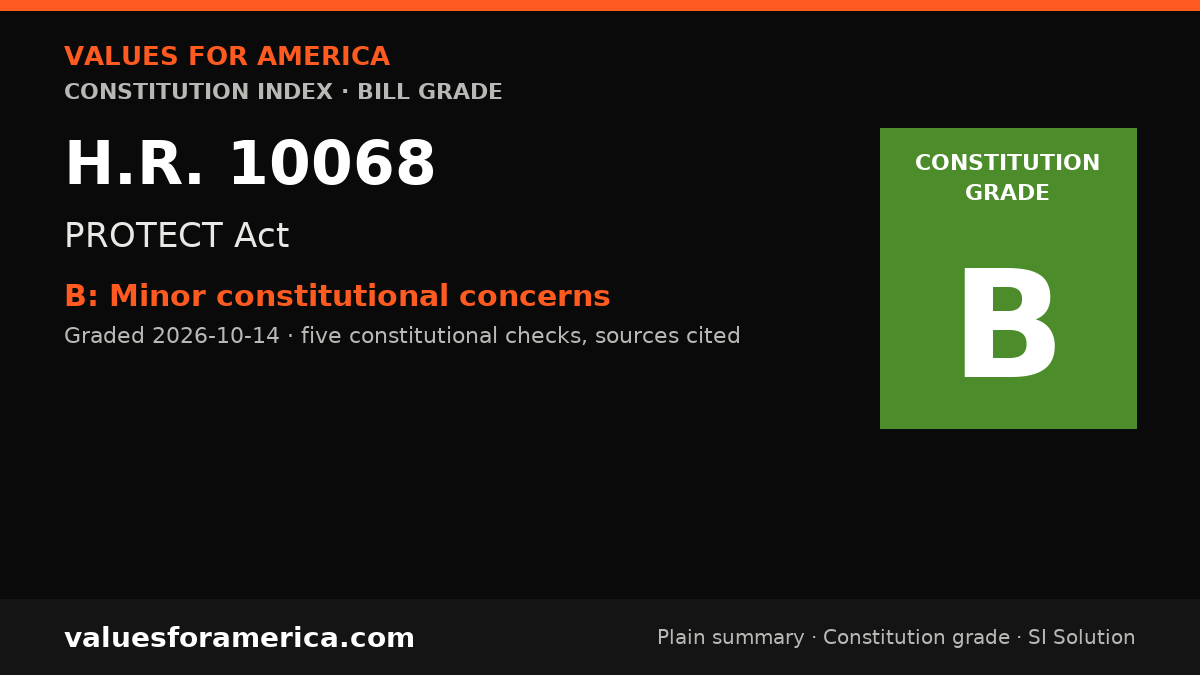
Minor constitutional concerns
Graded 2026-10-14
SI-generated grade · five published checks · not individually reviewed by a person · methodology
The PROTECT Act is a federal public health initiative that falls within Congress's spending power and its authority to regulate interstate commerce, particularly concerning products that are sold across state lines. While the bill does not directly infringe on individual rights, it does involve federal involvement in areas traditionally managed by states and localities, and it raises minor concerns about the scope of federal authority over public health messaging and research. The bill is mostly sound but requires careful implementation to avoid overreach.
-
✓ Passes · Enumerated powers
Congress has the power to spend for the general welfare under Article I, Section 8, Clause 1, and to regulate commerce among the several states under Article I, Section 8, Clause 3. Electronic cigarettes and tobacco products are articles of interstate commerce, and the federal government has a long history of regulating such products for public health purposes. The bill's provisions for research, … -
✓ Passes · Bill of Rights
The bill does not infringe on any of the first ten amendments. It does not restrict speech, religion, assembly, press, or petition. It does not involve searches or seizures, self-incrimination, or any criminal procedure. The public education campaign is government speech, which is not subject to First Amendment restrictions on private speech. The bill does not compel any individual to speak or ref… -
✓ Passes · Individual sovereignty
The bill does not restrict individual liberty. It imposes no mandates on individuals, businesses, or states. It only directs the CDC to conduct research, develop guidance, and run a public education campaign. While the bill may influence individual choices through education, it does not coerce or prohibit any behavior. The burden on individual sovereignty is minimal and justified by the compelling… -
✗ Concern · Decentralization
The bill fails the decentralization test because it consolidates decision-making at the federal level for public health initiatives that could be handled by states or localities. While the federal government has a role in interstate commerce and public health, the bill's national public education campaign and federal research initiatives could be more appropriately tailored to state and local need… -
✓ Passes · Due process and takings
The bill does not deprive any person of life, liberty, or property without due process of law. It does not impose penalties or take property. It is a spending and research bill that does not affect any individual's legal rights. There is no issue with procedural or substantive due process, and no takings are involved.
Sources: Congress.gov: HR 10068 summary
Report an error in this grade
What should pass
“VFA SI Solution”
No solution yet
A sourced SI draft appears here once it passes automated checks (Constitution citation, source verification, independent SI critic). How publication works.
Related on VFA

For journalists and bloggers
“Embed this grade”
Free to use with the link back. The badge and card update when the grade changes. Embed terms →
