H.R. 1005 explained · 119th Congress · Pending in Congress
Combating the Lies of Authoritarians in School Systems Act
Cosponsors: 5 (0 D, 5 R) · per Congress.gov, 2026-10-10
Introduced: 2025-02-05
Latest action (2025-12-04): Received in the Senate and Read twice and referred to the Committee on Health, Education, Labor, and Pensions.
What H.R. 1005 does, in plain terms
Combating the Lies of Authoritarians in School Systems Act or the CLASS Act This bill prohibits public elementary and secondary schools, as a condition of receiving federal elementary and secondary education funds, from accepting funds from or entering into a contract with the Chinese government, the Chinese Communist Party (CCP), or any individual or entity acting on behalf of the Chinese government or the CCP. The bill also requires schools to disclose funding from or contracts with a foreign source to the Department of Education.
Official summary by the Congressional Research Service, via Congress.gov.
Constitution Index
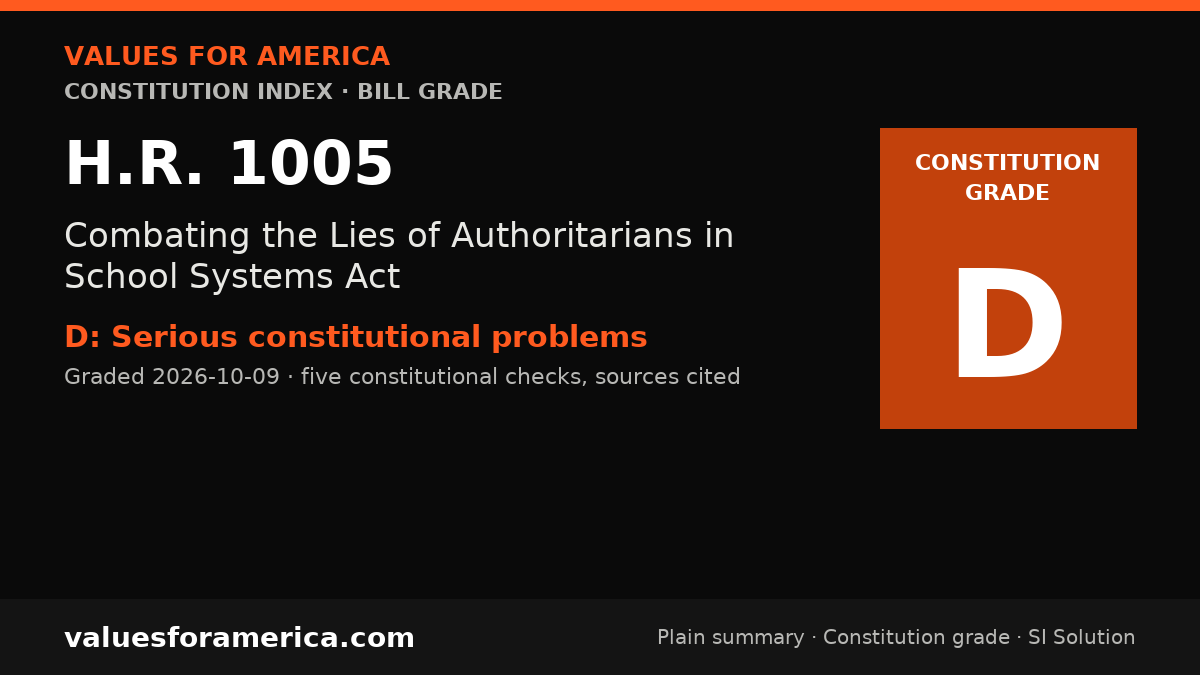
“VFA Constitution grade”
Serious constitutional problems
Graded 2026-10-09
SI-generated grade · five published checks · not individually reviewed by a person · methodology
The CLASS Act imposes conditions on federal education funding that likely exceed Congress's enumerated powers under the Spending Clause, infringe on state and local control of education in violation of the Tenth Amendment, and restrict individual sovereignty by compelling schools to disclose foreign-source contracts without a clear constitutional justification. The bill fails the decentralization test by consolidating decision-making at the federal level for matters that states and localities can handle, and it raises due process concerns by conditioning funding on vague prohibitions.
-
✗ Concern · Enumerated powers
Congress's power under the Spending Clause (Article I, Section 8, Clause 1) allows it to attach conditions to federal funds, but those conditions must be unambiguous, related to the federal interest in the program, and not coercive. Here, the condition—prohibiting contracts with the Chinese government or CCP—is not clearly related to the educational purpose of federal funding (e.g., improving acad… -
✓ Passes · Bill of Rights
The bill does not directly infringe on First Amendment speech, religion, assembly, press, or petition rights. It does not restrict Second Amendment arms, Fourth Amendment search and seizure, or other enumerated rights. However, the requirement to disclose foreign-source contracts could chill protected speech or association if interpreted broadly, but as written, it does not violate the Bill of Rig… -
✗ Concern · Individual sovereignty
The bill restricts what schools—and by extension, students and parents—can do with their own property and labor by prohibiting contracts with foreign entities. The government has not provided a compelling constitutional justification for this restriction, as the burden is on the government to show a direct threat to national security or educational integrity. The Tenth Amendment (reserved powers) … -
✗ Concern · Decentralization
The bill fails three of the four decentralization questions. (1) Individual families could handle foreign-source contracts without government involvement, as they can choose schools or curricula. (2) Local communities or counties could handle this without state involvement, as they already manage school contracts. (3) States could handle this without federal involvement, as education is a state po… -
✗ Concern · Due process and takings
The bill conditions federal funding on compliance with vague prohibitions (e.g., 'any individual or entity acting on behalf of the Chinese government or the CCP'), which could be interpreted arbitrarily. This lacks fair notice and a clear standard, violating procedural due process under the Fifth Amendment. Additionally, if schools lose federal funds for noncompliance, it could constitute a taking…
Sources: Congress.gov: HR 1005 summary
Report an error in this grade
What should pass
“VFA SI Solution”
No solution yet
A sourced SI draft appears here once it passes automated checks (Constitution citation, source verification, independent SI critic). How publication works.
Related on VFA

For journalists and bloggers
“Embed this grade”
Free to use with the link back. The badge and card update when the grade changes. Embed terms →
