H.R. 10038 explained · 119th Congress · Pending in Congress
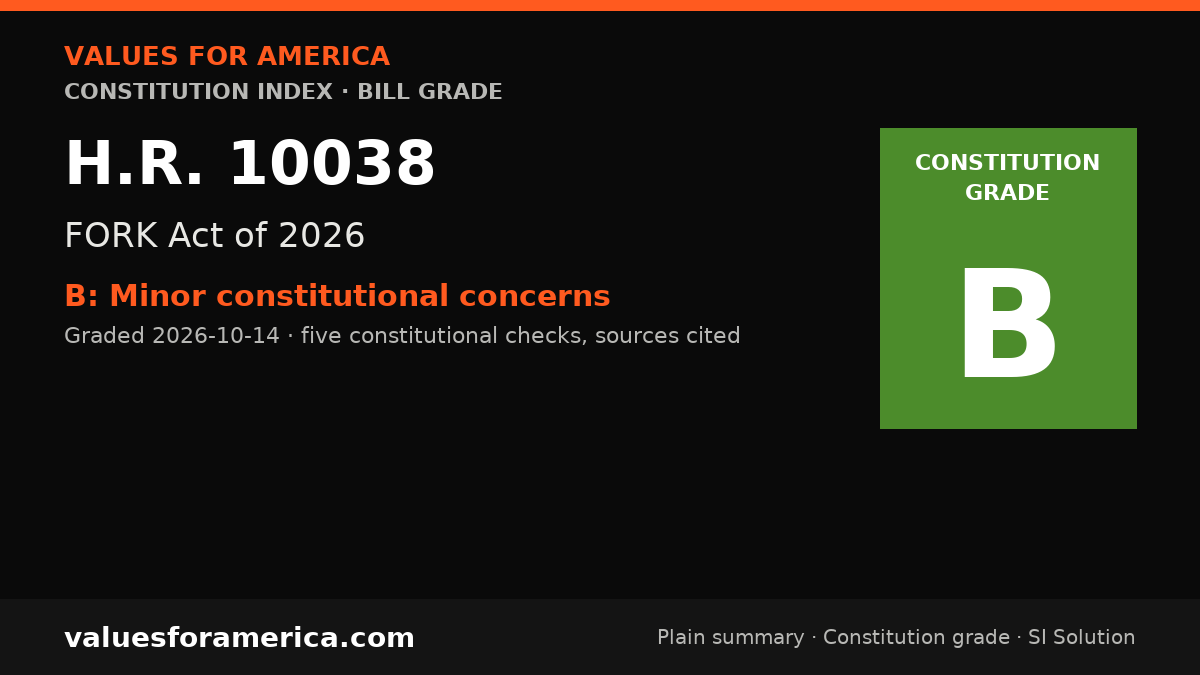
FORK Act of 2026
Cosponsors: 3 (2 D, 1 R) · per Congress.gov, 2026-10-14
Introduced: 2026-08-03
Latest action (2026-08-03): Referred to the House Committee on Education and Workforce.
What H.R. 10038 does, in plain terms
Feeding Our Rural Kids Act of 2026 or the FORK Act of 2026 This bill establishes a summer meal delivery vehicle pilot program as part of the Summer Food Service Program (SFSP). (The SFSP is a federally funded, state-administered program that reimburses providers that serve no-cost, healthy meals and snacks to children and teens at summer sites in low-income communities.) Under the bill, the Department of Agriculture (USDA) must award one-year grants of up to $100,000 for service institutions (e.g., school food authorities) to purchase, retrofit, or repair vehicles to facilitate noncongregate meal distribution. This is meal distribution outside of the typically required group, or congregate, setting (e.g., grab-and-go meal service). Among other things, USDA must give priority to service institutions located in an area in which poor economic conditions exist and that serve a high proportion of students from socially disadvantaged backgrounds. USDA must also ensure, to the maximum extent practicable, that service institutions receiving grants are located in different states.
Official summary by the Congressional Research Service, via Congress.gov.
Constitution Index
“VFA Constitution grade”
Minor constitutional concerns
Graded 2026-10-14
SI-generated grade · five published checks · not individually reviewed by a person · methodology
The FORK Act of 2026 is a federal grant program for summer meal delivery vehicles, operating within Congress's spending power and the general welfare clause. It does not infringe on individual rights, and it delegates administration to states and localities. However, it represents a federal expansion into a policy area traditionally handled by states and localities, and it consolidates decision-making at the federal level, raising mild federalism concerns.
-
✓ Passes · Enumerated powers
Congress has the power to tax and spend for the general welfare under Article I, Section 8, Clause 1. The bill authorizes federal grants to support a child nutrition program, which is a permissible exercise of the spending power. The program is voluntary for states and service institutions, and the federal government is not mandating state action but offering funds for a specific purpose. -
✓ Passes · Bill of Rights
The bill does not restrict speech, religion, assembly, press, petition, the right to bear arms, or any other enumerated right. It imposes no searches, seizures, or criminal penalties. It does not affect trial rights or cruel and unusual punishment. The program is purely voluntary and does not condition receipt of benefits on waiver of any constitutional right. -
✓ Passes · Individual sovereignty
The bill does not restrict individual liberty. It provides funding to service institutions to facilitate meal distribution. Individuals are free to participate or not. There is no mandate on individuals to do anything, and no restriction on their person, property, speech, labor, or belief. The burden of justification for any restriction is not triggered because there is no restriction. -
✗ Concern · Decentralization
The program is administered by the USDA, with grants awarded to service institutions, which are often local school authorities. States are involved in the SFSP administration. However, the decision to create the program and fund it is made at the federal level, and the federal government sets priorities and criteria. While states and localities implement the program, the policy decision is consoli… -
✓ Passes · Due process and takings
The bill does not take property without just compensation. It does not impose any penalty or deprive anyone of life, liberty, or property without due process. The grant program is voluntary, and any conditions attached to the grants are likely to be reasonable and clearly stated. There is no arbitrary government action; the bill specifies priorities and criteria for grant awards.
Sources: Congress.gov: HR 10038 summary
Report an error in this grade
What should pass
“VFA SI Solution”
No solution yet
A sourced SI draft appears here once it passes automated checks (Constitution citation, source verification, independent SI critic). How publication works.
Related on VFA

For journalists and bloggers
“Embed this grade”
Free to use with the link back. The badge and card update when the grade changes. Embed terms →
