H.R. 1 explained · 119th Congress · Became law
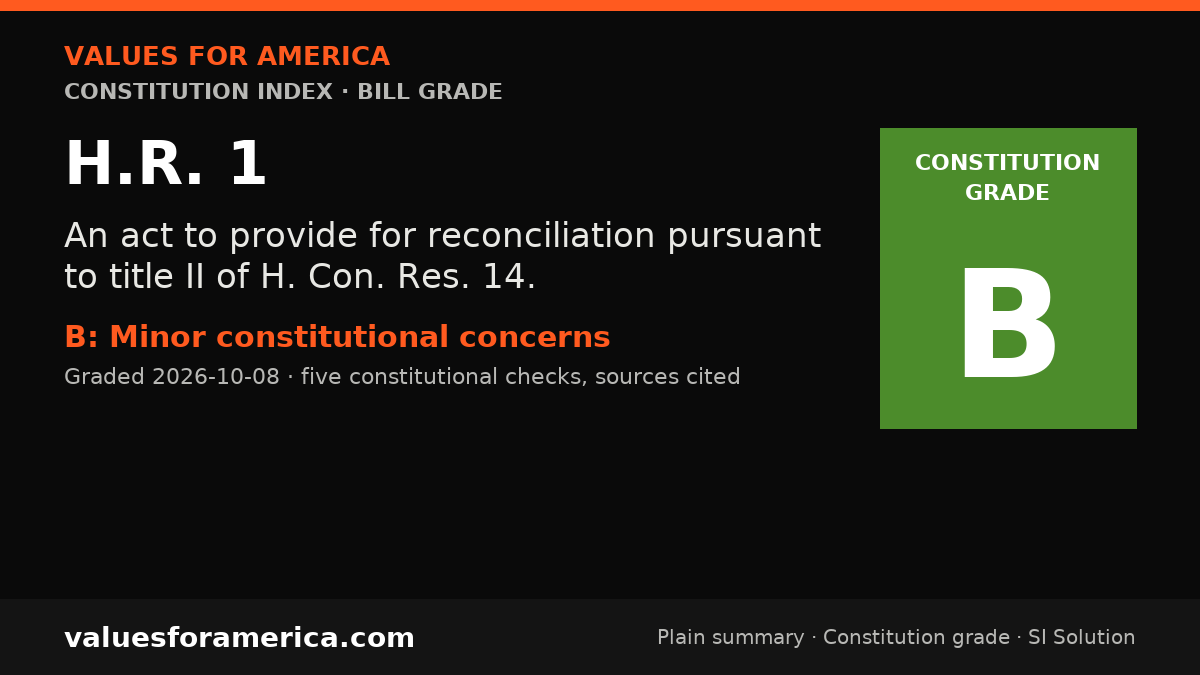
An act to provide for reconciliation pursuant to title II of H. Con. Res. 14.
Cosponsors: none · per Congress.gov, 2026-10-11
Introduced: 2025-05-20
Latest action (2025-07-04): Became Public Law No: 119-21.
What H.R. 1 does, in plain terms
This act reduces taxes, reduces or increases spending for various federal programs, increases the statutory debt limit, and otherwise addresses agencies and programs throughout the federal government. It is known as a reconciliation bill and includes legislation submitted by several congressional committees pursuant to provisions in the FY2025 congressional budget resolution (H Con. Res. 14) that directed the committees to submit legislation to the House or Senate Budget Committee that will increase or decrease the deficit and increase the statutory debt limit by specified amounts. (Reconciliation bills are considered by Congress using expedited legislative procedures that prevent a filibuster and restrict amendments in the Senate.) TITLE I--COMMITTEE ON AGRICULTURE, NUTRITION, AND FORESTRY This title addresses a wide range of Department of Agriculture (USDA) programs, including by changing the Supplemental Nutrition Assistance Program (SNAP) and extending programs authorized by the Agriculture Improvement Act of 2018 (commonly known as the 2018 farm bill). Subtitle A--Nutrition (Sec. 10101) This section prohibits USDA from increasing the cost of the Thrifty Food Plan (TFP) based on a reevaluation of the contents of the TFP (i.e., the market basket of goods). Further, any annual adjustment to the cost of the plan must be based on the Consumer Price Index for All Urban Consumers. As background, USDA created the TFP (the cost of purchasing a nutritionally adequate low-cost diet), which is used to determine maximum monthly benefits under the Supplemental Nutrition Assistance Program (SNAP). USDA calculates the cost of the TFP each year to account for food price inflation. Maximum allotments are set at the monthly cost of the TFP for a four-person family, adjusted for family size. Under a provision of the 2018 farm bill, USDA must reevaluate the market basket of goods every five years based on current food prices, food composition data, consumption patterns, and dietary guidance. (Sec. 10102) This section increases the work requirements for certain SNAP recipients who are able-bodied adults. As background, SNAP recipients who are able-bodied adults without dependents (ABAWDs) currently have work-related requirements in addition to the general SNAP work registration and employment and training requirements. SNAP law limits benefits to ABAWDs to 3 months out of a 36-month period, unless the participant meets the additional work-related requirements. This section raises the age for those who must meet these additional work requirements to include adults who are 65 years old and younger, whereas these requirements currently apply to adults who are 55 years old and younger. This section requires parents and household members to meet the additional work requirements (similar to someone who does not have a dependent child) if the child is age 14 and older. Currently, those with a child under the age of 18 are exempt from the requirements. This section excludes from the additional work requirements SNAP recipients who are Indians, Urban Indians, or California Indians (as these terms are defined by the Indian Health Care Improvement Act). In addition, the section generally requires homeless individuals, veterans, and certain foster care individuals to meet these work requirements. Foster care individuals are those who are 24 years old or younger and were in foster care on the date of attaining 18 years of age or a higher age. Specifically, this section eliminates the current exclusion from the additional work requirements for these individuals based on this status. Finally, this section limits the ability of a state to temporarily suspend the three-month time limit for SNAP benefits for ABAWDS in areas with high unemployment or an insufficient number of jobs. Under current law, the ABAWD waiver program allows states to request a temporary waiver of the three-month SNAP benefit limit. States may receive a waiver based on an area having an unemployment rate of over 10% or an insufficient number of jobs. The section repeals the provision that allows a state waiver if that area does not have a sufficient number of jobs. Further, the section allows Alaska and Hawaii to qualify for the state exemption with an unemployment rate that is at or above 1.5 times the national unemployment rate, effectively lowering the unemployment rate that these states must meet to receive a waiver. (Sec. 10103) This section generally eliminates the ability of a household to use participation in certain energy assistance programs to determine SNAP income eligibility unless the household includes an elderly or disabled member. As background, a household may deduct a portion of their housing and utility costs from their income (i.e., the excess shelter expense deduction) when determining SNAP benefits. Under current law, a household that receives a certain level of energy assistance through the Low Income Home Energy Assistance Program (LIHEAP) or a similar energy assistance program may deduct a set allowance. This set allowance (i.e., Standard Utility Allowance or SUA) represents low-income household utility costs in the state or local area. Using this allowance makes qualifying for an excess shelter deduction more likely. This section eliminates the use of the set allowance for households without elderly or disabled members, which may decrease the availability of the excess shelter deduction and reduce the SNAP benefits for these households. (Sec. 10104) This section prohibits a household from using any internet connection service fees as part of their housing and utility costs for the purposes of determining the size of household SNAP benefits, thus potentially reducing the SNAP benefits for these households. As background, a household may deduct a portion of their housing and utility costs from their income (i.e., the excess shelter expense deduction) when determining SNAP benefits. Under current law, household expenses may include internet connection service fees. (Sec. 10105) This section establishes state-matching fund requirements for the cost of SNAP program allotments beginning in FY2028. The state contribution ranges from 0% to 15% for the cost of SNAP program allotments and is based on the state’s SNAP payment error rate. Currently, the state match is 0%. For FY2028, a state may elect either the FY2025 or FY2026 payment error rate to calculate its state-matching fund requirement. For FY2029 and each fiscal year thereafter, the state match is calculated using the payment error rate for the third fiscal year preceding the fiscal year for which the state share is being calculated. Any state that has a payment error rate that is less than 6% will have a state match of 0% (i.e., the state does not have to contribute). A state with a payment error rate that is at least 6% but less than 8% must contribute 5%, at least 8% but less than 10% must contribute 10%, and 10% or greater must contribute 15%. In general, the effective date for the state-matching fund requirements is the beginning of FY2028. However, any state that has an error rate above a certain level will have implementation delayed until FY2029 or FY2030. Specifically, the implementation date is delayed for states where the state's error rate multiplied by 1.5 equals or exceeds 20% in FY2025 or FY2026. For such states, the implementation date is delayed until FY2029 if the specified error rate occurs in FY2025 and until FY2030 if the error rate occurs in FY2026. (Sec. 10106) This section reduces the amount that USDA may pay a state agency for administrative costs for the operation of SNAP to 25% of all administrative costs beginning in FY2027 and for each fiscal year thereafter. Currently, USDA must pay 50% of all administrative costs, thus this section increases the state share of administrative costs from 50% to 75%. (Sec. 10107) This section eliminates funding for the SNAP Nutrition Education and Obesity Prevention Grant Program (SNAP-ED). SNAP state and local agencies administer this federal grant program. SNAP-Ed uses evidence-based, public health projects and interventions with the goal to implement a nutrition education and obesity prevention program for eligible individuals that promotes healthy food choices and physical activity consistent with the most recent Dietary Guidelines for Americans. (Sec. 10108) This section eliminates SNAP eligibility for certain individuals who are classified as an alien under federal law and legally present in the United States, including those who have qualified for conditional entry under the asylum and refugee laws or based on urgent humanitarian reasons (e.g., a survivor of domestic violence or human trafficking). The section maintains SNAP eligibility for individuals who reside in the United States and are (1) U.S. citizens or U.S. nationals; (2) lawful permanent residents, with exceptions; (3) aliens who are Cuban or Haitian entrants; or (4) individuals who are lawfully residing in the United States in accordance with the Compacts of Free Association between the United States and Micronesia, the Marshall Islands, and Palau. Subtitle B-- Forestry (Sec. 10201) This section rescinds certain funds provided to the Forest Service as part of the Inflation Reduction Act of 2022. For example, this includes the rescission of funds for the protection of old-growth forests on National Forest System land, grants for nonfederal forest landowners for climate mitigation or forest resilience practices, grants for state and private forestry conservation programs for tree planting, and administrative costs for the National Forest System to implement these and other related programs. Subtitle C--Commodities This subtitle amends and extends commodity support programs. For example, the subtitle extends the Price Loss Coverage (PLC) program, the Agricultural Risk Coverage (ARC) program, and Dairy Margin Coverage (DMC) through crop year 2031. It also modifies various requirements for the programs. (Sec. 10301) This section increases the reference prices for specified commodities under the ARC and PLC programs for crop years 2025 through 2030. This change would increase the likelihood of triggering a payment and increase the payments made to eligible producers when triggered. Beginning in crop year 2031, USDA must increase the reference price so that it is equal to the reference price in the previous crop year multiplied by 1.005. USDA must continue to increase the reference price using this formula for each crop year after 2031, up to a maximum of 113% of the 2030 reference price. The ARC and PLC programs, administered by the Farm Service Agency, offer financial assistance to eligible agricultural producers, and the reference prices are used to calculate benefits under the programs. The ARC program is an income support program that provides payments to producers triggered when actual crop revenue declines below a specified guarantee level. The PLC program provides income support payments triggered when the effective price for a covered commodity falls below its effective reference price. (Sec. 10302) This section grants eligible agricultural producers a one-time option to expand and allocate base acre holdings in proportion to average 2019-2023 plantings of covered and noncovered commodities. In general, the Price Loss Coverage and Agriculture Risk Coverage programs make payments per enrolled base acre (i.e., a unit of production associated with specific tracts of farmland in proportion to historical production of certain crops). This section allows producers to allocate existing unassigned base acres to a covered commodity. The section limits the total existing unassigned and newly granted base acres to no more than 30 million acres, effectively increasing total base acres nationwide from approximately 274 million to approximately 304 million. (Sec. 10303) This section req
Official summary by the Congressional Research Service, via Congress.gov.
Constitution Index
“VFA Constitution grade”
Minor constitutional concerns
Graded 2026-10-08
SI-generated grade · five published checks · not individually reviewed by a person · methodology
Reconciliation tax, spending, borrowing, and debt-limit provisions fall squarely within Congress enumerated fiscal powers, and prospective SNAP work and benefit-formula rules condition a voluntary benefit rather than abridging rights, liberty, or property. The only tension is federalism: a national welfare design consolidates decisions states, localities, and civil society could handle, warranting B rather than A.
-
✓ Passes · Enumerated powers
Tax reduction, spending levels, deficit reconciliation, and debt-limit action rest on Article I, Section 8, Clauses 1-2 on laying and collecting taxes, paying debts, providing for general welfare, and borrowing on federal credit, plus the Sixteenth Amendment for income taxation and Article I, Section 7 on revenue legislation. Adjusting SNAP, farm programs, and waiver authority is an exercise of th… -
✓ Passes · Bill of Rights
No provision described restricts speech, religion, press, assembly, arms, searches, self-incrimination, trial rights, jury rights, or punishment. SNAP eligibility and work rules condition a federal benefit on work-related criteria and preserve categorical exclusions; they do not criminalize expression or belief under the First Amendment and impose no search, seizure, or compelled testimony under t… -
✓ Passes · Individual sovereignty
Work requirements condition receipt of a voluntary federal benefit; they do not compel labor, restrict speech, belief, property ownership, or bodily autonomy. A person may decline SNAP and avoid the condition entirely. The government therefore does not restrict protected personal conduct without justification under the Ninth and Tenth Amendments and the Fifth Amendment liberty interest. -
✗ Concern · Decentralization
Food assistance can be and historically has been handled by families, charities, local communities, and states without federal direction. By setting national benefit formulas, Thrifty Food Plan rules, ABAWD time limits, and waiver limits in federal statute, the act consolidates welfare policy upward beyond the minimum necessary, in tension with the Tenth Amendment reservation of non-delegated powe… -
✓ Passes · Due process and takings
SNAP benefits are statutory entitlements subject to prospective legislative change, not vested private property taken for public use under the Fifth Amendment Takings Clause. The bill acts prospectively through legislation with notice, preserves legislative standards for eligibility, and creates no criminal presumption, summary seizure, or deprivation without lawful procedure under Article I, Sect…
Sources: Congress.gov: HR 1 summary
Report an error in this grade
What should pass
“VFA SI Solution”
No solution yet
A sourced SI draft appears here once it passes automated checks (Constitution citation, source verification, independent SI critic). How publication works.
Related on VFA

For journalists and bloggers
“Embed this grade”
Free to use with the link back. The badge and card update when the grade changes. Embed terms →
