H.J.Res. 78 explained · 119th Congress · Pending in Congress
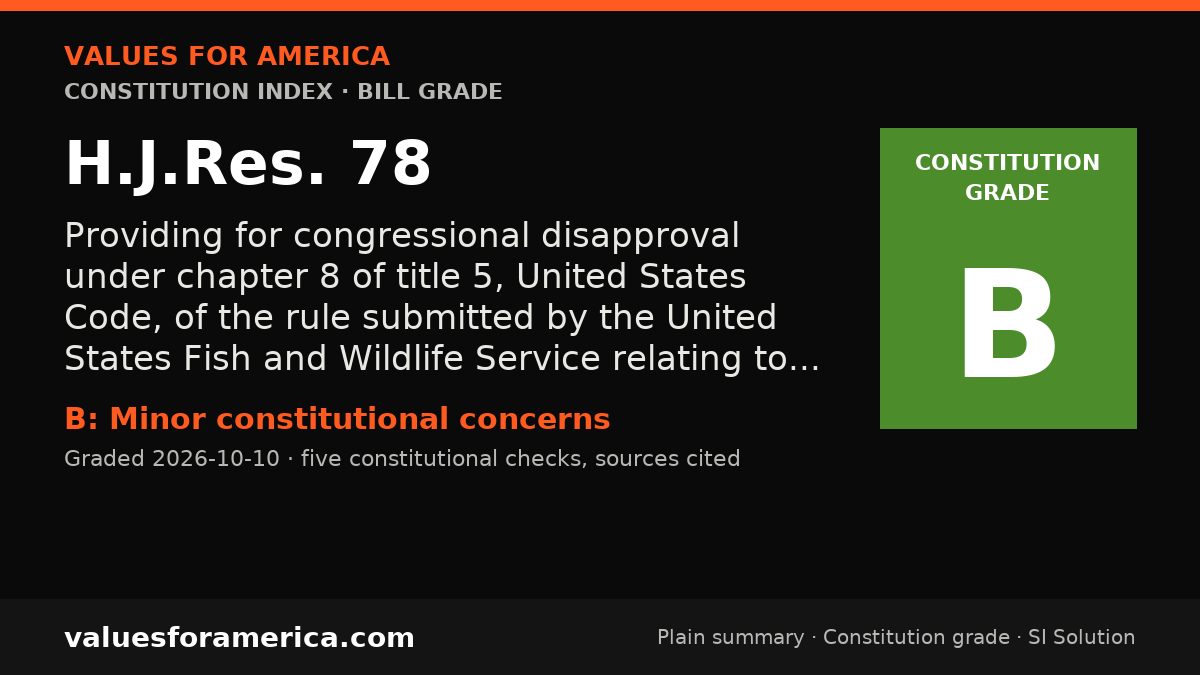
Providing for congressional disapproval under chapter 8 of title 5, United States Code, of the rule submitted by the United States Fish and Wildlife Service relating to "Endangered and Threatened Wildlife and Plants; Endangered Species Status for the San Francisco Bay-Delta Distinct Population Segment of the Longfin Smelt".
Cosponsors: 8 (0 D, 8 R) · per Congress.gov, 2026-10-11
Introduced: 2025-03-21
Latest action (2025-05-05): Received in the Senate.
What H.J.Res. 78 does, in plain terms
This joint resolution nullifies the rule issued by the U.S. Fish and Wildlife Service titled Endangered and Threatened Wildlife and Plants; Endangered Species Status for the San Francisco Bay-Delta Distinct Population Segment of the Longfin Smelt and published on July 30, 2024. The rule lists the San Francisco Bay-Delta distinct population segment of longfin smelt, a fish species of the Pacific Coast, as an endangered species. Thus, the joint resolution removes protection for the species under the Endangered Species Act of 1973.
Official summary by the Congressional Research Service, via Congress.gov.
Constitution Index
“VFA Constitution grade”
Minor constitutional concerns
Graded 2026-10-10
SI-generated grade · five published checks · not individually reviewed by a person · methodology
The joint resolution uses Congress's express authority under the Congressional Review Act to disapprove an agency rule, which is a legitimate exercise of legislative power. It does not infringe on individual rights, and it returns decision-making to the political process rather than consolidating power. However, the resolution removes endangered species protections, which raises concerns about the federal government's duty to conserve species under the Endangered Species Act and the public interest in preserving natural resources. The action is within Congress's enumerated powers and does not violate the Bill of Rights, but it may be seen as undermining conservation efforts that have constitutional grounding in the Commerce Clause and treaty powers.
-
✓ Passes · Enumerated powers
Congress has the explicit authority to pass joint resolutions disapproving agency rules under the Congressional Review Act (5 U.S.C. §§ 801-808), which is a delegation of Congress's legislative power under Article I, Section 1 and Article I, Section 7. The Endangered Species Act itself is grounded in Congress's Commerce Clause power (Article I, Section 8, Clause 3) and treaty powers (Article II, S… -
✓ Passes · Bill of Rights
The resolution does not implicate any of the first ten amendments. It does not restrict speech, religion, assembly, press, petition, arms, quartering, search and seizure, self-incrimination, due process, takings, trial rights, or cruel and unusual punishment. It is a legislative action regarding administrative rulemaking, not a criminal or civil rights matter. -
✓ Passes · Individual sovereignty
The resolution does not restrict individual liberty or property rights. It removes federal protections for a species, which may affect property owners who would otherwise face restrictions under the Endangered Species Act, but the resolution itself does not impose any new restrictions on individuals. It actually reduces federal regulatory burdens on individuals and businesses, which is consistent … -
✓ Passes · Decentralization
The resolution returns decision-making to Congress, which is the most representative and accountable branch of government. It does not consolidate power upward; rather, it checks the executive branch's rulemaking authority. The questions: (1) Individuals and families cannot handle endangered species conservation alone, so federal action is appropriate. (2) Local communities cannot handle this with… -
✓ Passes · Due process and takings
The resolution does not bypass due process or take property without just compensation. It is a legislative action that nullifies an agency rule, which is a standard procedure under the Congressional Review Act. It does not deprive any person of life, liberty, or property without due process, nor does it take private property for public use without compensation.
Sources: Congress.gov: HJRES 78 summary
Report an error in this grade
What should pass
“VFA SI Solution”
No solution yet
A sourced SI draft appears here once it passes automated checks (Constitution citation, source verification, independent SI critic). How publication works.
Related on VFA

For journalists and bloggers
“Embed this grade”
Free to use with the link back. The badge and card update when the grade changes. Embed terms →
