H.J.Res. 42 explained · 119th Congress · Became law
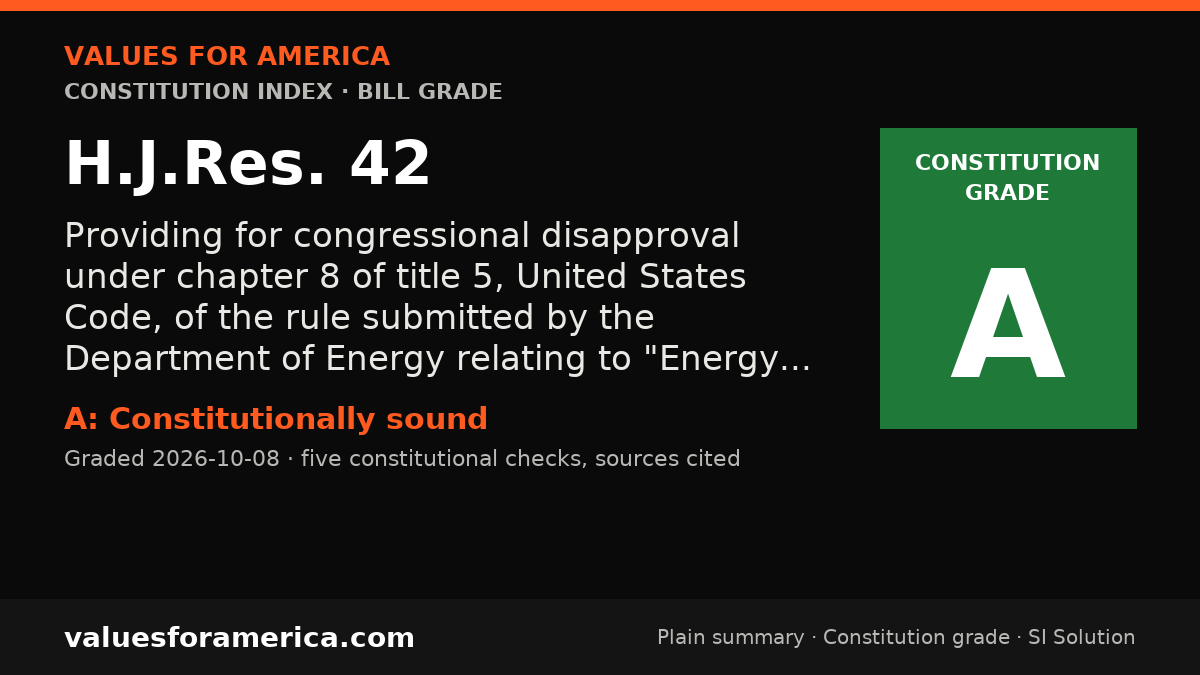
Providing for congressional disapproval under chapter 8 of title 5, United States Code, of the rule submitted by the Department of Energy relating to "Energy Conservation Program for Appliance Standards: Certification Requirements, Labeling Requirements, and Enforcement Provisions for Certain Consumer Products and Commercial Equipment".
Cosponsors: 6 (0 D, 6 R) · per Congress.gov, 2026-10-11
Introduced: 2025-02-12
Latest action (2025-05-09): Became Public Law No: 119-8.
What H.J.Res. 42 does, in plain terms
This joint resolution eliminates new, more stringent certification, labeling, and enforcement requirements related to energy conservation standards for specific types of appliances. Specifically, the joint resolution nullifies a rule titled the Energy Conservation Program for Appliance Standards: Certification Requirements, Labeling Requirements, and Enforcement Provisions for Certain Consumer Products and Commercial Equipment and published by the Department of Energy (DOE) on October 9, 2024. Under the rule, DOE modified its regulations on the energy efficiency of certain types of consumer products (e.g., washing machines and dishwashers) and industrial equipment (e.g., computer room air conditioners). DOE modified certification requirements, labeling requirements, and enforcement provisions for these products and equipment to (1) align reporting requirements with currently applicable energy conservation standards and test procedures, and (2) provide DOE with the information necessary to determine the appropriate classification of products for the application of standards.
Official summary by the Congressional Research Service, via Congress.gov.
Constitution Index
“VFA Constitution grade”
Constitutionally sound
Graded 2026-10-08
SI-generated grade · five published checks · not individually reviewed by a person · methodology
HJRES 42 is a constitutional use of congressional oversight to void an executive energy-efficiency reporting and enforcement rule. It asserts no new federal power, infringes no rights, takes no property, and moves decisions away from Washington toward individuals, markets, and states.
-
✓ Passes · Enumerated powers
Congress acts within explicit authority under Article I, Section 1 vesting legislative power, Article I, Section 8 Clause 18 Necessary and Proper Clause to check executive implementation, and Article I, Section 7 presentment process, using the Congressional Review Act at 5 U.S.C. chapter 8 to disapprove a Department of Energy rule. Disapproving an agency rule is a restraint on unenumerated executi… -
✓ Passes · Bill of Rights
Nullification of the DOE certification, labeling, and enforcement rule does not infringe speech, religion, press, arms, search, trial or other rights under Amendments 1-10. It removes compelled reporting and enforcement exposure for manufacturers and reduces federal coercion affecting consumer choice, consistent with the First Amendment, Fourth Amendment, Ninth Amendment, and Tenth Amendment. -
✓ Passes · Individual sovereignty
The joint resolution expands sovereignty rather than restricting it. It relieves manufacturers of additional federal certification and labeling burdens and preserves consumer choice among washing machines, dishwashers, and other products. No restriction on person, property, speech, labor, or belief is imposed; the burden the government had imposed is removed without need for further justification … -
✓ Passes · Decentralization
(1) Individuals and families can choose appliances by price and efficiency without federal certification mandates. (2) Local retailers, utilities, and communities can provide efficiency information voluntarily. (3) States retain police powers to set their own efficiency or labeling policies under the Tenth Amendment. (4) HJRES 42 does not consolidate power upward; it reverses upward consolidation … -
✓ Passes · Due process and takings
The resolution does not bypass notice, hearing, presumption of innocence, or take property. It removes expanded enforcement provisions that increased risk of penalties under agency procedures, thereby strengthening procedural due process and substantive due process under the Fifth Amendment Due Process Clause and Article I, Section 1 vesting of legislative power in Congress rather than agencies.
Sources: Congress.gov: HJRES 42 summary
Report an error in this grade
What should pass
“VFA SI Solution”
No solution yet
A sourced SI draft appears here once it passes automated checks (Constitution citation, source verification, independent SI critic). How publication works.
Related on VFA

For journalists and bloggers
“Embed this grade”
Free to use with the link back. The badge and card update when the grade changes. Embed terms →
